
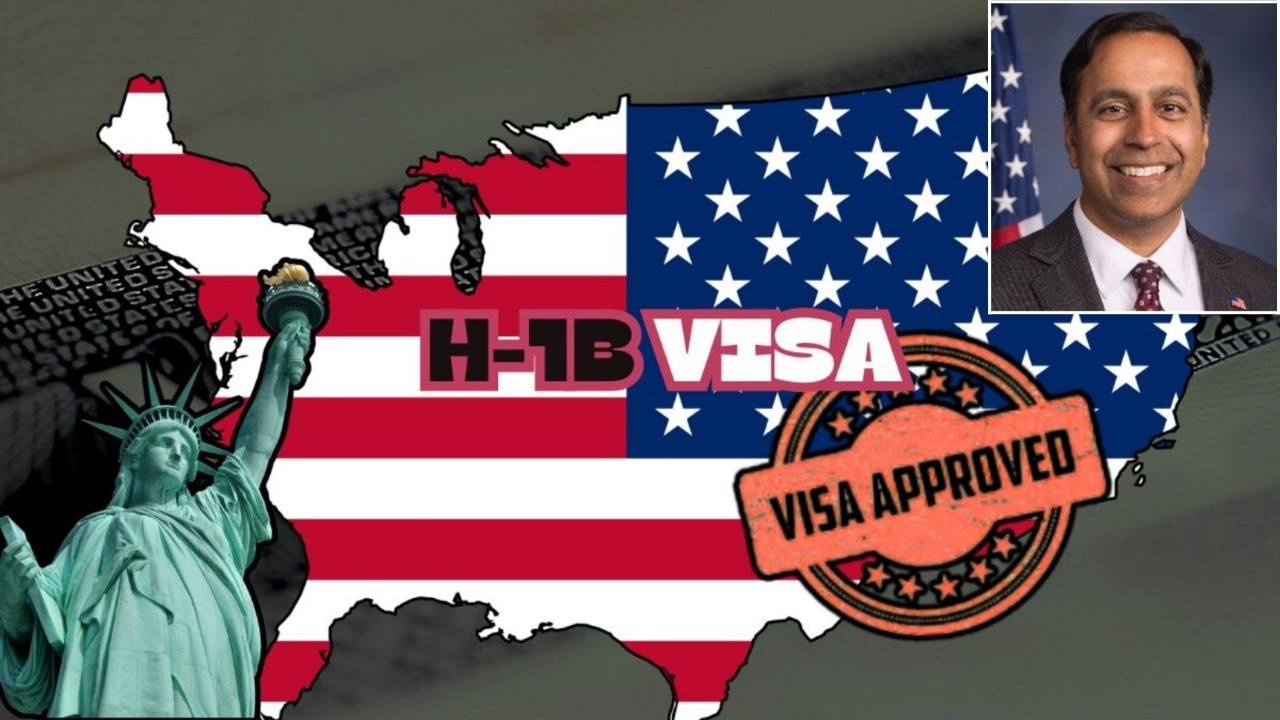
Raja Krishnamoorthi has warned that the Trump administration's $100,000 H-1B fee could deter skilled workers and push companies to shift work overseas. The debate over the fee is also unfolding in US courts.Indian-origin Congressman Raja Krishnamoorthi said the policy risks making it harder for US companies to access specialised talent at a time when many industries depend on workers with advanced technical expertise. (File Photo)The Donald Trump administration has made it harder for companies to bring foreign talent into the US. But there is a risk that the policy could end up making it easier for those same companies to move the work out of the country. That is the concern US Congressman Raja Krishnamoorthi has raised over the Trump administration's $100,000 fee on new H-1B visa applications. He warned that the steep cost could discourage highly skilled professionals from coming to the US while giving companies another reason to offshore jobs.Krishnamoorthi, an Indian-American lawmaker, said the policy risks making it harder for US companies to access specialised talent at a time when many industries depend on workers with advanced technical expertise. He said the impact would go well beyond Indian professionals, pointing out that H-1B workers from countries such as India, China and Sweden play a major role in some of the US economy's most specialised fields."These people fill some of the most exquisite technical roles in our economy," Krishnamoorthi said in a podcast interview.Many foreign professionals who first entered the US workforce through the H-1B programme have gone on to build companies of their own, creating hundreds and thousands of jobs along the way, according to Krishnamoorthi. ‘$100,000 TAX’ ON SPECIALISED TALENTThe fee, he argued, would effectively amount to a "$100,000 tax" on companies looking to hire H-1B workers. His concern is that the unusually high cost could discourage companies from recruiting specialised foreign professionals and could also make workers already in the US question whether they want to remain there."People from India or China or Sweden. It doesn't matter. And so when you put this, I call it a tax, $100,000 tax on this group of people who by the way fill some of the most kind of exquisite technical roles in our economy," he said. The H-1B programme allows US employers to hire foreign workers in speciality occupations requiring technical or theoretical expertise. It is widely used by technology, engineering and other firms seeking specialised talent. Indian professionals have historically accounted for a significant share of H-1B beneficiaries, particularly in technology and engineering. As a result, any major increase in the cost of the programme has attracted particular attention in India and among US companies that depend on Indian talent.‘ONSHORE THE TALENT OR OFFSHORE THE WORK’The congressman's strongest warning concerned what companies could do if hiring foreign talent becomes significantly more expensive. He said businesses would still need to complete their work, even if the cost of bringing specialised workers into the US rises sharply."You can either onshore the talent or offshore the work," Krishnamoorthi said."These companies are not going to just sit by and not do the work," he added. He argued that companies could therefore decide to move certain operations outside the US instead of paying the additional cost associated with H-1B workers.The impact, he warned, could be felt even before companies decide where to place the work, with prospective workers reconsidering a move to the US and those already there questioning their long-term plans."You're basically pushing these people away in the first instance and then probably getting people here to rethink whether they should stay," he said.US COURT PUTS $100,000 FEE ON HOLDThe debate over the fee is also unfolding in US courts.US President Donald Trump issued a proclamation in September 2025 imposing a $100,000 fee on new H-1B visa applications. It triggered opposition from businesses and immigration advocates, who argued that such a steep charge could make it considerably harder for US employers to recruit specialised foreign workers.In June 2026, US District Judge Leo T Sorokin ruled that the fee was an unlawful tax that had not been authorised by Congress. The Trump administration subsequently sought to pause the ruling while it pursued an appeal.In July, however, a three-judge panel of the Boston-based First Circuit Court of Appeals rejected the government's request to stay Sorokin's decision."We deny the defendants' motion to stay pending appeal to this Court, the district court's June 8, 2026, Memorandum and Order and accompanying Judgment," the court said in its ruling. The decision means the administration's effort to impose the $100,000 charge remains tied up in the legal battle, even as the wider debate over the future of the H-1B programme continues.WHY THE H-1B DEBATE MATTERS FOR INDIAThe H-1B programme has traditionally been a major pathway for highly skilled Indian professionals seeking to work in the US, particularly in fields such as information technology, engineering and other specialised occupations.That makes the proposed fee especially significant for Indian workers and US companies that rely on global talent.For Krishnamoorthi, however, the central concern is what the policy could mean for America's competitiveness.He argued that foreign-born professionals are not simply workers filling vacancies. Some eventually become entrepreneurs, create companies and generate employment in the US. His warning is therefore centred on a potential economic trade-off: making foreign talent more expensive may reduce immigration costs in one area while encouraging companies to move the underlying work elsewhere.- EndsPublished By: Satyam SinghPublished On: Aug 17, 2026 19:38 IST
H-1B fee could push talent away, US jobs offshore, warns Indian-American lawmaker
Full Article
Original Source
Read the full article at Indiatoday →KhanList aggregates and links to publicly available news content. We do not host full articles from third-party sources. Always verify important information with original sources.