
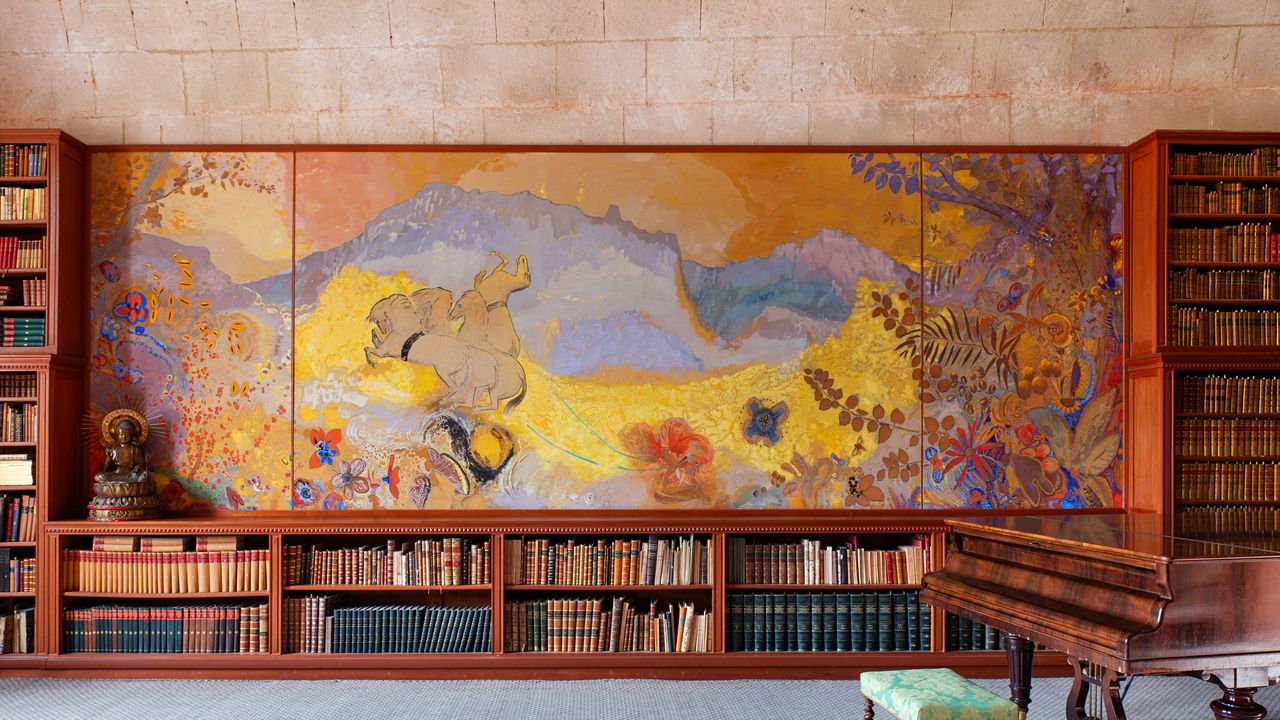
Gustave Fayet once owned enough Gauguins to turn his Paris home into a de facto museum dedicated to the artist. Fayet also organized one of the first French outings of the work of Pablo Picasso, at the time not yet 20 years old. Jeanne Lanvin commissioned Fayet to create rugs for her apartment, and Paul Poiret designed Fayet’s daughter’s wedding dress. For someone so central to the cultural scene of early-20th-century France, Fayet remains relatively unknown. The forgotten multihyphenate emerges from obscurity this fall, as the Fondation Louis Vuitton unveils Gustave Fayet, Collector–Designer, the next in its monumental Icons of Modern Art exhibition series, on view October 9 through March 8. Taking over the whole of the Frank Gehry–designed building, the show explores Fayet’s many influential roles, from patron to entrepreneur to artist.Fayet’s Mise en Cart G21 (1920–25). Photo: Gustave Fayet EstateFayet painting Photo: Gustave FayetBorn in 1865 into a wealthy family of landowners and wine merchants, Fayet learned to paint alongside his father and uncle, both amateur artists. As a young man, he made the rounds of art fairs and was hired as a curator at the Musée de Béziers, where he worked with Louis Paul, a sculptor who had studied with Rodin. Together they produced Japonisme-inspired ceramics that were displayed at one of the most important Parisian galleries.Then, in 1899, Fayet inherited the family estate and began collecting in earnest, acquiring his first Renoirs and Gauguins. Many of the important works that flowed through Fayet’s collection, such as Van Gogh’s Self-Portrait With Bandaged Ear, Cézanne’s The Great Pine, and Gauguin’s Three Tahitians, feature prominently in the Fondation Louis Vuitton show. For a while he was so immersed in collecting and curating that he put aside his own creative practice.More of Fayet’s rug designs (1922–25) installed at Maison Losseau in Mons, Belgium Photo: Gustave FayetLes Cyprès Bleus (1902), oil on canvas, also by Fayet Photo: Gustave FayetA 1920–25 rug by Fayet, realized by Atelier de la Dauphine Photo: Gustave FayetAll that began to change around 1908, when Fayet and his wife, Madeleine, bought the abandoned Abbaye de Fontfroide, near Narbonne. Fayet had a vision of restoring it as a total work of art and assembled a group of artists, his “Fontfroideans,” and other creative kindred spirits to help realize this dream. Among them were Odilon Redon, who painted three remarkable murals, titled Day, Night, and Silence, for the library. These Redon panels will be on public view for the first time in the FLV exhibition.Fontfroide inspired Fayet himself toward new artistic impulses. In 1911 he developed an idiosyncratic art form, deploying watercolor on blotting paper, which he used to create a large body of floral works. “The drawings demonstrate an almost childlike spontaneity at a time when Gustave Fayet was a mature man,” says Robert Carsen, the exhibition’s artistic director. Decorator Paul Dumas began reproducing these watercolors as fabric and wallpaper, and jointly Fayet and Dumas founded the Atelier de la Dauphine to manufacture them as rugs—prime examples of which have been restored for display alongside the original artworks. Fayet later moved into illustration, illuminating works of poetry and even a book for his grandchildren.A collection of his and Louis Paul’s glazed-stoneware vessels Photo: © Fondation Louis Vuitton / Nicolas Mathéus“He was truly exploring new territory,” says Carsen, “venturing deeper and deeper into the new genre he was exploring with each new endeavor.” In the end, imagination was the through line to everything Fayet touched.This story appears in the November issue. Never miss a story when you subscribe to AD.
Gustave Fayet Reemerges from the History Books
Full Article
Original Source
Read the full article at Architecturaldigest →KhanList aggregates and links to publicly available news content. We do not host full articles from third-party sources. Always verify important information with original sources.