
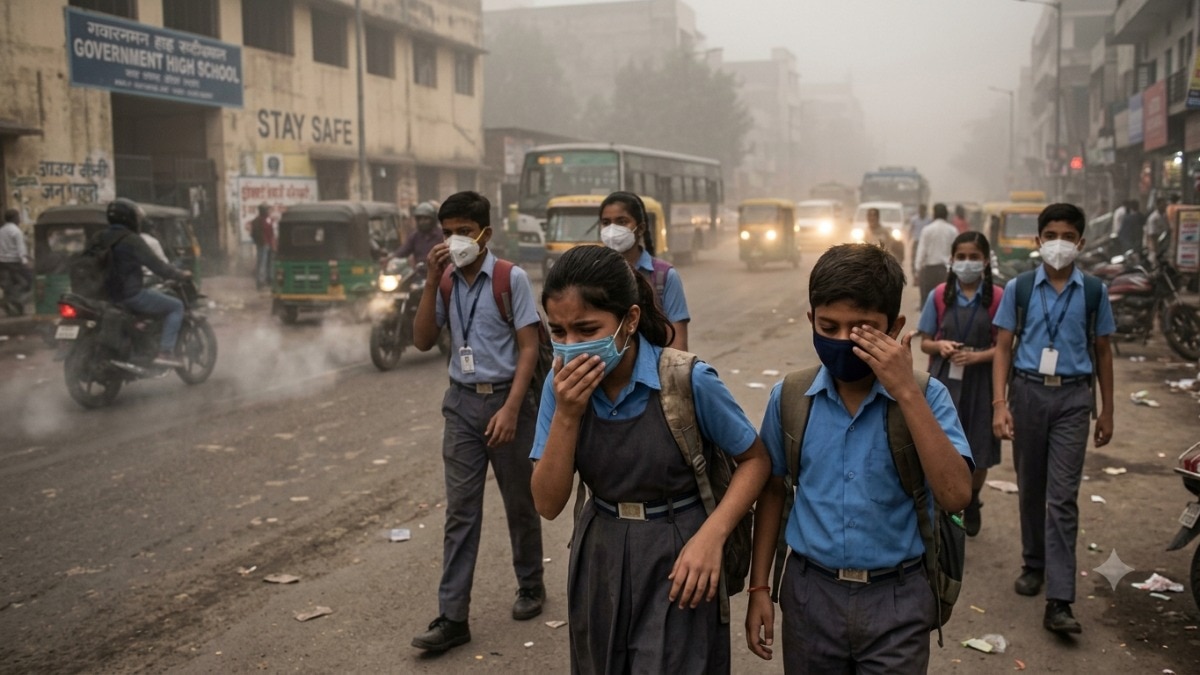
A new study by the International Council on Clean Transportation has linked road-transport pollution in Gurugram to missed school days and new asthma cases among children. The findings show how traffic emissions are affecting students not just outside classrooms, but their attendance too.A new study by the International Council on Clean Transportation has linked road-transport pollution in Gurugram to missed school days and new asthma cases among children. (Photo: AI-generated)New Delhi,Oct 8, 2026 18:18 ISTA new study by the International Council on Clean Transportation (ICCT) has put a number on how traffic pollution affects children’s education in Gurugram. In 2025, road-transport emissions were linked to 94,859 lost school days among children and adolescents aged 5 to 18.That does not mean 94,859 calendar days of school missed. The number is the combined total of school days missed by children because of pollution-related illness. Put simply, if thousands of children each miss some school because they fall ill, all those missed days add up to 94,859.The ICCT says that total is equivalent to an entire academic year of school days for 431 children.The study also estimated 89 new asthma cases linked to vehicle emissions — roughly one new case every four days. WHEN POLLUTION BECOMES A SCHOOL PROBLEMFor students, the impact is not limited to breathing polluted air. When illness keeps a child away from school, classroom time is lost too.The ICCT study measured this burden alongside health outcomes, making school-day loss one of its key findings. For schools, that means missed lessons, disrupted routines and lost learning time. The researchers estimated that local road transport accounted for 6% of PM2.5 exposure and 20% of nitrogen dioxide exposure in the Municipal Corporation of Gurugram in 2025. Transport-attributable PM2.5 concentrations reached as high as 7 g/m.THE NUMBERS BEHIND THE ABSENCEStudy finding2025 estimateLost school days94,859Full academic year equivalent431 studentsNew asthma cases89Age group studied5–18 yearsRoad transport share of PM2.5 exposure6%Road transport share of NO exposure20%The study found that 41% of the Municipal Corporation of Gurugram area exceeded the World Health Organization’s annual guideline for all-source PM2.5.Children are particularly vulnerable because their lungs and immune systems are still developing, and they breathe more air relative to their body weight than adults.As ICCT researcher and co-author Moorthy Nair said, “Children are particularly vulnerable to health impacts of air pollution, with road transport an important contributor.”CARS DRIVE A BIG PART OF THE BURDENPrivate cars were the largest source of traffic emissions in Gurugram. The city had 323 cars for every 1,000 residents. More than 80% of vehicle emissions came from newer Bharat Stage IV and Bharat Stage VI vehicles, according to the study.That means the issue is not limited to older vehicles. The researchers also considered vehicles entering Gurugram from outside the city.WHAT CLEANER SCHOOL TRAVEL COULD CHANGEThe study modelled different vehicle scenarios, including zero-emission school buses, two- and three-wheelers, and a wider shift to zero-emission vehicles. It found that electrifying every vehicle registered in Gurugram could deliver about three-quarters of the potential health gains.However, around 0.5 million vehicles enter Gurugram every day from Delhi and other parts of the National Capital Region. The study therefore points to the need to address these vehicles too.The findings put a clear educational cost on traffic pollution: when illness keeps children away, they lose classroom time that cannot easily be recovered.- Ends
Gurugram's polluted air kept 431 children out of school for nearly a year: Study
Full Article
Original Source
Read the full article at Indiatoday →KhanList aggregates and links to publicly available news content. We do not host full articles from third-party sources. Always verify important information with original sources.