
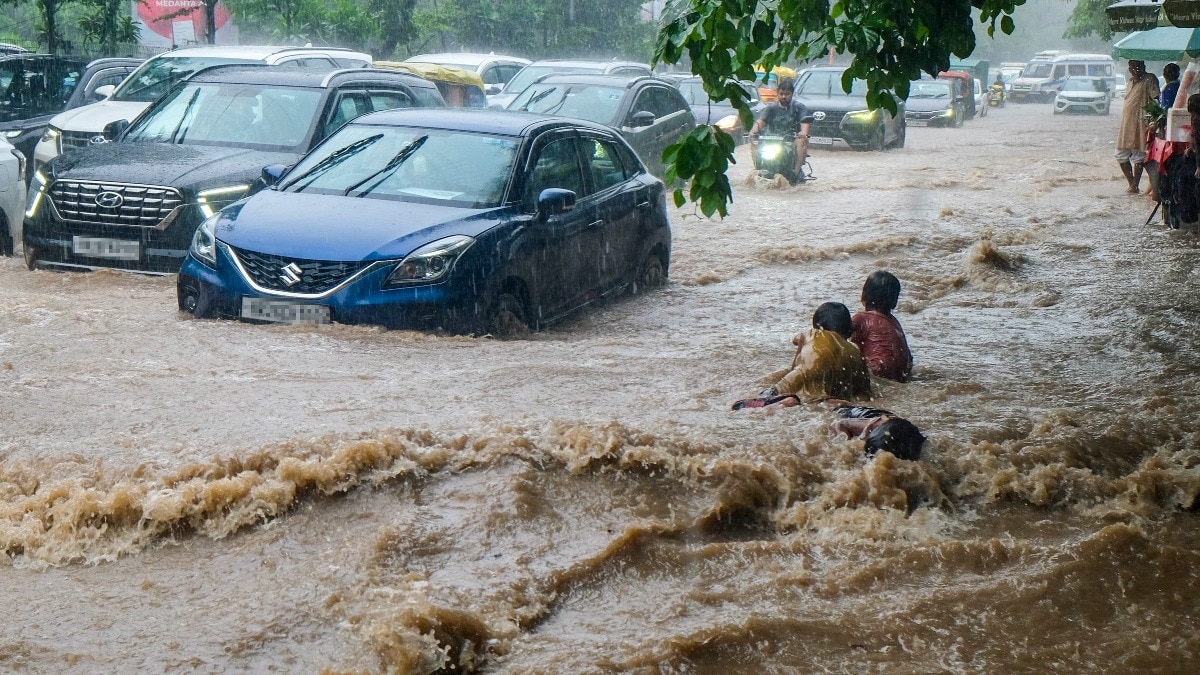
What should have been a 10-minute journey took Anshul Jain nearly 45 minutes.The 28-year-old, who lives in Delhi and works at an MNC in Gurugram, usually takes the Metro to the office. But on Monday, even after the train helped him reach the city, the final 2-3 km from the station to his workplace became a struggle as waterlogged roads brought traffic to a crawl.“I do have a car but I don't use it every day because of daily traffic jams. Although the Metro helps me reach my place, reaching from the station to the workplace was painful because of waterlogged roads and auto/cab drivers charging high fares,” Jain told India Today Digital.After working from the office on Monday, Jain decided to work from home on Tuesday and Wednesday. “Gurugram has become 'Drowngram' now,” he said, referring to the city's infrastructure woes.His experience was far from unusual. Around 70 mm of rain fell over a 35-minute period on Monday, submerging major roads and underpasses, stranding vehicles and triggering traffic jams that lasted for hours. Heavy rain continued into Tuesday, compounding the chaos. (Photo: PTI) Gurugram, the Millennium City of towering skyscrapers, corporate offices and glossy urban landscapes, was brought to a standstill as its drainage system struggled to cope with the downpour. Haryana's biggest revenue generator was left with submerged roads, stranded vehicles and commuters spending hours on journeys that would normally take minutes.FROM MILLENIUM CITY TO 'DROWNGRAM'Videos of the chaos flooded social media, including footage of children swimming through a waterlogged underpass. But away from the viral clips, routine commutes had turned into an ordeal.Raju Kumar, 33, an accounts officer at IFFCO who travels from IFFCO Colony in Gurugram to Saket in south Delhi, said his commute currently takes around an hour. While traffic from Gurugram towards Delhi has been relatively manageable because of work-from-home arrangements in Gurugram, he said those travelling in the opposite direction were facing longer commute times.“Commuting in and around Gurugram is also a challenge due to waterlogging and widespread traffic, which is a result of the waterlogging,” Kumar told India Today Digital. (Photo: PTI) Avijit Mohanty, a manager at PwC, said the Metro solves only part of the problem. He commutes daily from Malviya Nagar to Gurugram, but getting to and from the station becomes a struggle when it rains.“I commute daily from Malviya Nagar to Gurugram for work, and the commute is anything but easy, even if you take the metro, especially if it rains. The main problem arises when we have to take an e-rickshaw or auto from the metro station to my office building after getting off the metro, and the same while coming back from the office,” Mohanty told India Today Digital.“If it rains, it gets difficult to find an e-rickshaw or auto, and the crowd is so much that we struggle to find a commute. I dare not take a cab back home because of the exorbitant price hike, and not to mention, the traffic is worse at Chattarpur,” he said.Mohanty moved from Noida to Delhi partly to cut his travel time, but said rain still meant getting stuck. “The metro works best, but reaching the metro station is a big challenge on these days,” he said.A corporate employee living in a PG in Gurugram described the situation more bluntly. “It's horrible. Even with a little bit of rain, there's proper waterlogging and, of course, traffic jams.”She said the DLF side of the city was particularly badly affected. “The situation in Sector 21-22 isn't as bad as it is on the DLF side. I think the area behind DLF, maybe Phase 2/5, is probably the worst when it comes to waterlogging.”She left the PG at 7.30 pm on Monday to travel to Delhi, despite living close to the border, but did not get out of Gurugram until around 9 pm. “Since my PG is very close to the border, it shouldn't take me that long, but I ended up leaving Gurugram only around 9,” she said.Another individual from Noida, who spoke on condition of anonymity, said his journey back home took nearly four hours because of the waterlogging and traffic on Tuesday. He decided to work from home instead.Even finding an auto or cab became difficult, with waiting times and fares rising sharply.“I was unable to find a regular auto and those which were available were charging exorbitantly. The cab and auto fares on ride-hailing apps were also high. But I had no other option but to shell out so much money to return home from office after a long day,” said Shivani Seth, a 27-year-old radio jockey who works and lives in Gurugram. (Photo: PTI) CHILDREN STRANDED, ROADS COLLAPSEThe crisis became more worrying as the heavy downpour coincided with the time schoolchildren were returning home.Around 15 vehicles, including nine school buses, were stranded at waterlogged Subhash Chowk, with more than 300 schoolchildren trapped inside the buses for nearly two hours, according to officials. School buses and ambulances were also among vehicles caught in the flooding across the city. (Photo: PTI) In some cases, families said children remained trapped in buses for around eight hours. Parents said some children who normally reached home by around 1.30 pm arrived only between 8 pm and 8.30 pm on Tuesday. They alleged that children were left hungry and thirsty, while some cried because of the lack of water and access to toilets.Families criticised the administration and police, alleging that help was slow to reach the stranded children. School staff tried to keep them calm, offering biscuits and other food.The rain also appeared to expose deeper cracks in the city's infrastructure.A large section of a service lane near IFFCO Chowk, one of Gurugram's busiest intersections, caved in on Tuesday, creating a roughly 25-foot-wide pit. A GMDA team reached the site, and officials said a sewer line leakage had washed away the soil beneath the road. Since the service lane is part of the Delhi-Jaipur highway, the NHAI will carry out repairs after the leakage is fixed. Road cave-ins were also reported at Sector 9 and Narsinghpur village. (Photo: PTI) “The roads are way worse. We have normalised potholes and broken roads at this point,” one Gurugram resident said.“The service lane outside my PG was built just a year ago, and there's a school just around the corner. You won't believe this -- right when the rains started in August, that ‘new’ road literally collapsed, and now there's a huge hole right in front of the school. It's so dangerous for kids,” she said.Repair work is underway and barricades have been put up, but she said parts of the site remained inadequately secured.“If I'm walking on the footpath carelessly, I could literally fall in because on one side there weren't any barricades,” she added.CRORE-PLUS HOMES, BUT ROADS THAT FLOODThe disruption has also sharpened a question residents have long asked: has Gurugram's infrastructure kept pace with the money flowing into its real estate and corporate economy?Sushmita, an HR head who bought a house on Sohna Road before property prices soared, said she now feels fortunate not to have paid today's rates.“I purchased a house on Sohna Road at a time when Gurugram real estate prices weren't sky-high. I can only thank my stars now because had I shelled out that kind of money, in crores, and ended up in this terrible situation, it would have been heartbreaking,” she told India Today Digital.The contrast between soaring property prices and the condition of the roads, she said, was difficult to understand.“For a decent house in Gurugram, you need to shell out somewhere between Rs 3-4 crore minimum, and this is what you get. This is utterly ridiculous. Except for a few premium societies, nothing is in order. The funny part is, even outside these premium societies, the situation isn't any better.”Calling Gurugram a city of HNIs, she questioned why basic infrastructure continued to fail.“Gurugram is a city of HNIs, and this is the infrastructure. It fails when it rains for half an hour. There is no drainage, nothing. I don't know how the demand for houses is still so high in these areas and the prices don't seem to go down,” she said.Gurugram's waterlogging problem is not new. Rapid urbanisation and construction over traditional drainage channels have reduced the routes available for rainwater to escape. Even with 408 rainwater harvesting systems in municipal corporation areas, waterlogging remains a recurring monsoon problem, with the Badshahpur drain also central to the city's struggle to carry excess stormwater.The contrast is hard to miss. Gurugram has emerged as one of India's biggest corporate and commercial hubs, but a few hours of rain left commuters stranded, children trapped in buses and roads giving way.For Jain, the gap between the Millennium City's image and what residents experienced this week came down to one word: “Drowngram”.- EndsPublished By: Prateek ChakrabortyPublished On: Aug 26, 2026 11:58 IST
Gurugram is now 'Drowngram': 4-hour commutes, flooded roads leave people fuming
Full Article
Original Source
Read the full article at Indiatoday →KhanList aggregates and links to publicly available news content. We do not host full articles from third-party sources. Always verify important information with original sources.