
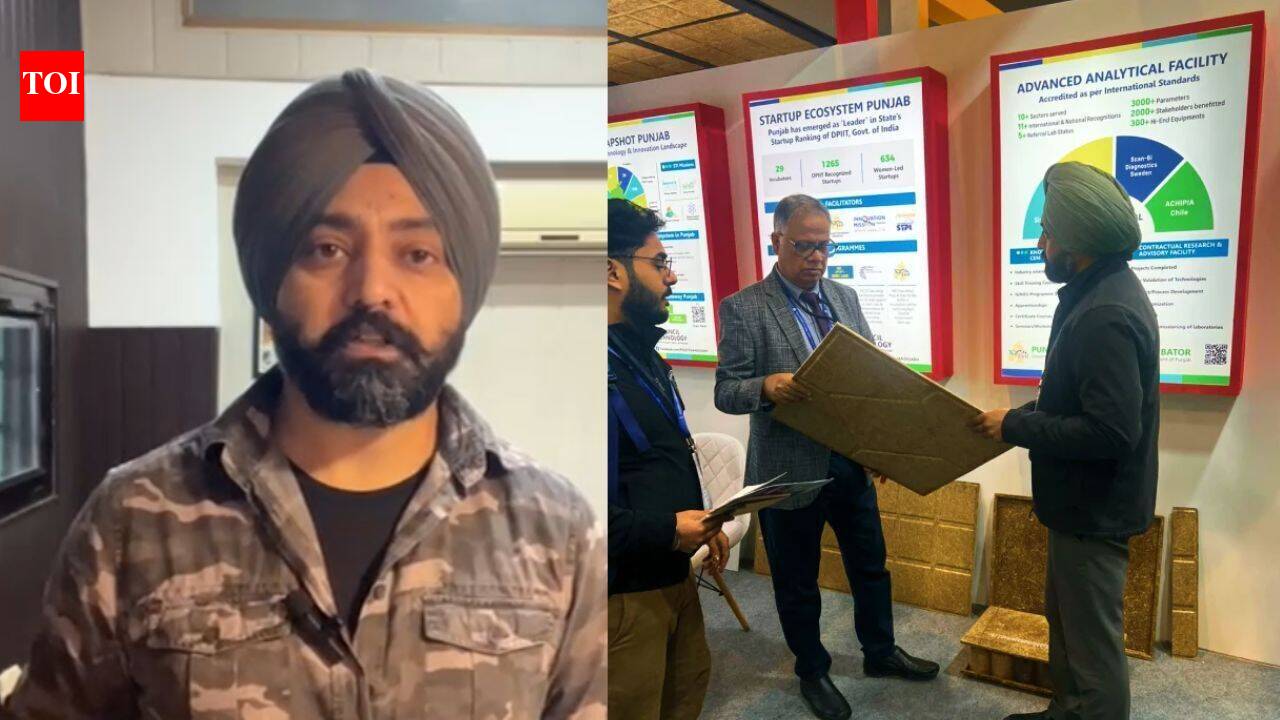
Every harvest season, the fields of Punjab face a familiar problem. Once the paddy is cut, farmers are left with heaps of dry straw that must be cleared before the next crop can be planted. With limited time and costly alternatives, many resort to burning the residue, adding to the region’s air pollution. But what if the same material could become something useful inside homes, offices and commercial buildings?In Gurdaspur, Punjab, innovator Parminder Singh has spent eight years exploring that possibility. What began as an experiment in a corner of his garage has developed into drop-down ceiling tiles made using paddy stubble. Designed to be waterproof and fire-resistant, the panels also offer insulation against heat and cold.Through his venture, Agro Stubble Management Private Limited, Singh hopes to create a market for agricultural residue, giving farmers an economic reason to collect and sell it instead of setting it on fire. His journey, recently highlighted by The Better India, is an example of how an environmental challenge can inspire a practical product.Eight years, one garage and an unusual ideaSingh did not begin with a large manufacturing facility or an established research team. He started experimenting with paddy waste in his garage in Gurdaspur, trying to understand whether a material usually treated as farm refuse could be converted into a useful construction product. The idea was not immediately welcomed by everyone around him. According to The Better India, people mocked his experiments, questioning whether dry crop residue could ever become a durable building material. Singh continued working on the concept for eight years until he developed ceiling tiles using the straw.An earlier report by The Tribune in December 2023 noted that he had even made his own pressing machine and moulds to manufacture the panels. At the time, he said around 90 per cent of the tile material came from stubble, while the remaining portion consisted of adhesive. The tiles are designed for drop-down ceilings and can be used in spaces such as offices, hospitals, malls and exhibition venues. Their insulation properties are particularly relevant in regions that experience significant temperature changes through the year.Turning a seasonal problem into a building materialThe value of Singh's idea lies in changing how crop residue is viewed. Instead of treating paddy straw only as something that needs to be removed from farmland, his venture sees it as a raw material that can be processed into a product with a potential market. According to The Better India’s November 2026 report, the tiles are designed to resist both water and fire while providing heat and cold insulation. The company's website also describes its products as lightweight, moisture-resistant panels with thermal and acoustic properties.The manufacturing process involves combining agricultural stubble with a binder and using a hot press to form the panels. A technology compendium published by the Punjab Knowledge Cluster describes Agro Stubble Management's approach as converting agricultural waste into durable ceiling tiles through hot pressing. This could offer a second use for straw that might otherwise be burned. However, the product's environmental promise depends on whether it can be manufactured at scale, transported affordably and purchased by builders at a competitive price.Giving farmers a reason not to burnFor Singh, the larger ambition is not limited to selling ceiling tiles. He wants to establish production plants across Punjab, bringing processing closer to farming communities and creating a regular demand for crop residue. The economics of collecting straw are an important part of this plan. In his 2023 interview with The Tribune, Singh said his startup was spending approximately Rs 3,000 to cut and collect around 3 to 3.5 tonnes of stubble from an acre. The expense included machinery, labour and transportation.Such costs underline why simply asking farmers not to burn residue may not be enough. A practical alternative needs to make collection and disposal financially workable. If manufacturers create a dependable market for straw, farmers could have an additional reason to preserve it rather than burn it. The venture received recognition in May 2025, when Punjab Agricultural University announced that Agro Stubble Management had won the first prize at the HARVEST AgriTech Challenge, along with a Rs 50,000 award. It was also selected as an accelerated startup under the programme.From a promising pilot to wider adoptionSingh's innovation has attracted attention, but the next challenge is expanding beyond experimentation and pilot production. A 2026 solid-waste technology compendium lists the venture's commercial readiness as piloted and records that its products had not yet been deployed at scale. It also notes that patent applications are pending. That distinction matters. The tiles offer a possible use for paddy straw, but they cannot yet be described as a solution that has ended stubble burning or replaced conventional ceiling materials across the market.For the idea to make a wider difference, the company will need reliable supplies of collected residue, affordable manufacturing, buyers and evidence that the panels meet the requirements of large-scale construction. Still, Singh's eight-year effort points towards a useful shift in thinking. A problem that has long been associated with smoke-filled skies could also become an opportunity for rural enterprise and sustainable building materials. His next task is to take an idea shaped in a small garage and make it work on a much larger scale.
Gurdaspur man turns paddy stubble into fire-proof ceiling tiles after 8 years
Full Article
Original Source
Read the full article at Timesofindia →KhanList aggregates and links to publicly available news content. We do not host full articles from third-party sources. Always verify important information with original sources.