
In March 2025, Germany did more than loosen a fiscal rule. It fused two national emergencies — a deteriorating European security order and a deteriorating industrial model — into a single constitutional bargain. The reform de facto exempted German defense expenditure from any domestic budgetary ceiling — as the German Bundesbank itself has acknowledged — and enabled a military expansion of extraordinary proportions. E.U. debt rules of 3 percent of GDP for annual government deficits and 60 percent for public debt technically still apply — though 14 out of the 27 Eurozone countries are not expected to meet these rules in 2026. The European Union is also in the process of loosening them. During 2025 to 2028, a Eurozone country with an approved defense escape clause can get away with a 4.5 percent annual deficit if its other fiscal commitment conditions are met.Germany spent 46.6 billion euros ($55 billion) on defense in 2021. In 2025, that amount grew to 86.5 billion euros ($97.8 billion) — 62.4 billion in the regular Defense Ministry budget plus 24.1 billion from the Bundeswehr special fund. For the period 2026 to 2030, Germany’s draft budget foresees defense spending of roughly 750 billion euros. France is projected to spend 338.2 billion euros in the same period — less than half of the German amount.The conventional explanation points to Russian military aggression and doubts about American support for European allies as the key drivers of this monumental turnaround. But this is only half of the story. The much less discussed part is Berlin’s attempt to use this vast, deficit-financed military expansion to revive its stagnating economy — an extraordinary experiment in military Keynesianism.The spending measure that passed the German Bundestag by 512 votes to 206 was packed with pork barrel payoffs for almost every voting member of Germany’s mainstream parties — the Christian Democratic Union and Christian Social Union, the Social Democratic Party, and the Greens — with only the small liberal Free Democratic Party and extremist parties such as the far-right Alternative for Germany, the far-left Die Linke, and its offshoot Bündnis Sahra Wagenknecht opposing it. Indeed, the amendment was passed by an outgoing Bundestag whose successor had already been elected. The 20th Bundestag met in a special session on March 18, 2025, after the February election but before the new chamber convened on March 25. This timing was consequential: The mainstream parties still commanded the two-thirds majority needed to amend the Basic Law. In the incoming parliament, they would fall short of that threshold, while Alternative for Germany and Die Linke would together have enough seats to block an amendment if both opposed it.Individual lawmakers from all four opposing parties unsuccessfully sought to halt the proceedings through emergency applications to the Federal Constitutional Court. The agreement was therefore secured within the narrow window between the election and the new parliament’s first sitting, by a chamber containing 333 members who would not return. Although the outgoing Bundestag retained its full constitutional authority, as the court confirmed, the deal was concluded before the new balance of power established by the election formally took effect.The key to understanding the breadth of the coalition supporting this spending hike is the economic shock for which its conventional policy repertoire offers no easy answer: the so-called “China Shock 2.0.”The first China shock followed China’s entry into the World Trade Organization and primarily damaged relatively labor-intensive American industries such as textiles, furniture, and basic metals. Now it is Europe’s turn. China has built enormous industrial overcapacity. Domestic Chinese demand is too weak to absorb this output. Chinese companies therefore increasingly depend on foreign markets — above all the comparatively open and affluent European market — to sell their excess production. Chinese competitiveness is thereby not simply the result of superior efficiency. The International Monetary Fund estimates that the renminbi’s undervaluation ranges from roughly 16 percent to as much as 30 percent. The Organization for Economic Co-operation and Development found that, between 2005 and 2024, Chinese firms received on average three to eight times more government support than firms in member countries of the organization.China’s surplus in manufacturing is hitting at Europe’s technological core: automotive manufacturing, machinery, chemicals, pharmaceuticals, and green energy. Germany is already shedding roughly 10,000 industrial jobs a month.The industries most exposed to Chinese competition overlap with many of the capabilities required for military rearmament: precision engineering, vehicles, propulsion, optics, electronics, software, machine tools, and advanced materials. German defense expenditure can therefore be understood as an industrial conversion mechanism. It creates a politically legitimate source of long-duration demand for sectors facing shrinking civilian markets, preserves skilled labor and supplier networks, and offers firms a bridge from automobiles and capital goods into armored vehicles, missiles, satellites, and military communications. A crucial question is whether the bulk of these investments will simply rebuild previous strengths rather than replacing dependence on U.S. suppliers of advanced technology systems.The Logrolling CoalitionLogrolling describes a process in which groups with different concentrated interests trade support: Each obtains the policy it values most, the programs are bundled, and the diffuse costs are shifted to society at large. A heterogeneous coalition can agree on a policy package for different reasons, producing a larger commitment than any component would have selected on its own. This process could in principle produce a politically efficient outcome by aligning innovative nascent industrial sectors with support from established interests. However, it could also produce waste and overstretch. Research on such diverse cases as the New Deal, the Marshall Plan, and Wilhelmine Germany’s coalition of “iron and rye” shows that logrolls can pave the way to successful reform based on Keynesian economic stimulus but sometimes lock in protectionist or imperialist coalitions.The March 2025 settlement was almost a textbook example of logrolling. Security conservatives obtained an effectively open-ended exemption from Germany’s debt brake — a constitutional barrier used to limit the federal government’s structural budget deficit to 0.35 percent of gross domestic product, sharply restricting its ability to finance new spending through borrowing — for qualifying defense and security expenditures. The Social Democrats secured their demand that increased defense financing be accompanied by civilian investment: a 500 billion euro infrastructure and climate fund, with investment commitments permitted over 12 years, including 100 billion for the federal states and municipalities. The Greens secured 100 billion euros for the Climate and Transformation Fund within — not on top of — that 500 billion, an explicit reference to climate neutrality by 2045 in the fund’s constitutional purpose, and an additionality or Zusätzlichkeit safeguard intended to prevent the fund from simply replacing existing investment in the regular budget. They also obtained a broader security exemption covering areas such as civil protection and cyber security. The agreement could then be justified in the shared language of security, resilience, and national modernization, even though its constituencies valued different parts of the package.This interpretation does not require a conspiracy or proof that ministers privately rank jobs above deterrence. Logrolling works precisely because motives need not be identical. Some elites can support rearmament because they believe Russia may attack NATO and the United States may no longer underwrite Europe. Others can support the same program because defense is the only form of fiscal expansion that can now be presented simultaneously as constitutional necessity, strategic prudence, and industrial policy. The security argument explains why the spending is legitimate. The economic argument helps explain why it commands such unusually broad support.The logroll’s fingerprints are also visible in the composition of the spending, not just its size. Of the 222 billion euros in German defense procurement orders with a known supplier since January 2020, 55 percent have been placed with purely German companies. Another 30 percent went to German firms in partnership with, or hosting subsidiaries of, foreign producers. This marks a dramatic change from orders placed directly outside Europe, which spiked past 40 percent in the panicked months after the Russian invasion of Ukraine in 2022 as Berlin rushed to buy F-35 aircraft, Chinook helicopters, and Patriot missile batteries off the shelf. Such outside orders have fallen every year since as domestic industry — Rheinmetall, Diehl Defense, Hensoldt, Renk, and ThyssenKrupp Marine Systems — has picked up demands. Purchases from other European suppliers, meanwhile, remain negligible at 3 percent of the orders for which supplier origin could be identified. This national bias has become a particular source of friction with France: Paris has criticized the fact that Germany’s rearmament is doing too little to build a genuinely integrated European defense industry.Can Military Keynesianism Work?Germany’s idea of reinvigorating its economy via defense spending is nothing new. There is a name for this: military Keynesianism.One of the precedents is the American rearmament of 1950 to 1953, when Washington — having adopted the sweeping strategic logic of National Security Council Report 68 — roughly quadrupled defense spending in barely three years, from around $13 billion to more than $50 billion annually amid the Korean War. We know that this was to some degree an opportunistic logroll because the strategist behind the report, Paul Nitze, was a conservative banker who believed in balanced budgets. Only when he joined forces with the Keynesian economist Leon Keyserling in the Truman White House did he realize that deficit spending theory could help him overcome resistance to his global military containment strategy. Historians still argue over how much of that surge was strategically necessary and how much was, functionally, fiscal stimulus. While some evidence suggests that the 1949 recession was already tapering off before the report was issued, its fiscal jolt ensured that there would not be a sluggish recovery, cementing two decades of American manufacturing dominance.Why did military Keynesianism work in the United States? First, the spending absorbed some residual labor market slack and underused resources left by the 1948 to 1949 recession, allowing military demand to raise output as well as prices. Second, the United States was — and remained — a net arms exporter, capturing the growth benefits of military demand. A meta-analysis of 243 estimates drawn from 42 studies on military spending and growth confirms that this distinction matters enormously: Positive growth effects cluster in developed, arms-exporting economies, while negative effects cluster in countries that mainly import, or simply consume, what they buy — a pattern the same researchers attribute partly to a genuine “Keynesian effect” that exporters enjoy without the balance-of-payments drag importers face. Third, Washington also enjoyed exceptional external financing latitude. The dollar’s position at the center of the Bretton Woods system, combined with America’s postwar creditor position and chronic trade surpluses, relaxed the external constraint on fiscal expansion relative to that faced by other countries. Fourth, and most consequentially, the American program poured money disproportionately into frontier technology — jet propulsion, radar, nuclear physics, and eventually semiconductors and space systems — generating the civilian spillovers that fed decades of subsequent growth. Government procurement then provided early markets in which these technologies could improve and scale, producing new firms, skills, and civilian applications whose productivity effects persisted long after the original military expenditure.German Military Keynesianism TodayWhat about Germany today? Do similar conditions prevail? Germany satisfies three important preconditions. First, there is a genuine and durable security demand, which reduces the danger that factories will be expanded for a brief stimulus and then get stranded. Second, domestic procurement incidence is high, limiting import leakage. Third, the country possesses sophisticated engineering firms, a skilled manufacturing workforce, and fiscal capacity that was previously constrained more by constitutional choice — the debt brake — than by an inability to borrow.Nevertheless, at present Germany’s rearmament fails to pour money disproportionately into frontier technologies. From 2020 to 2026, 61 percent of German procurement went to established, platform-centric systems, 15 percent to clothing, training, and infrastructure, 11 percent to communications, and only 12 percent to frontier technologies such as autonomous and semi-autonomous systems, drones, integrated networked air and missile defense, advanced cyber capabilities, and similar technologies. The share devoted to these “new-paradigm” capabilities — as they are called in the German context — indeed declined over the period: 22 percent during 2020 to 2021, 14 percent during 2022 to 2023, and 9 percent during 2024 to January 2026.Large communications and space programs are promising exceptions — the planned military space effort alone is valued at 35 billion euros through 2030 — but the aggregate pattern remains biased toward conventional platforms, replacement purchases, and low-spillover items. A 21 billion euro clothing framework passed by the Bundestag in 2025 covering the period 2026 to 2035 may be militarily useful and employment-supporting, but it is not a German equivalent of the Defense Advanced Research Projects Agency – the legendary U.S. institution that funded risky research including the internet and stealth aircraft.Defense spending can support German long-term growth only if it helps to create new technologies, more productive firms, exportable products, and skills that can also be used in the civilian economy. Otherwise, it may raise demand for a few years without improving Germany’s underlying competitiveness. The missing element is therefore a clear industrial strategy linking military procurement to innovation.In an ideal world, an institutional system would exist in Germany that allowed the Bundeswehr to (1) find the most innovative firms, (2) provide them with funding for the production and testing of prototypes, and (3) provide successful prototypes with long-term procurement contracts allowing the firms to scale while also continuously updating their technology as it gets rolled out. In addition, this process would put a particular emphasis on technologies that are deliberately developed as dual-use platforms from the outset to spill back into the civilian economy as quickly as possible.Recent reforms in Germany have worked toward building this pipeline, but critical elements are still missing.For example, the German government has now substantially improved the legal ability to buy innovation. It has reduced some of the administrative workload of the procurement process and shortened the procurement time. But one critical hurdle, Germany’s 25 million euro rule, still persists: Any Defense Ministry procurement or development contract above that threshold — which is not much money in the military world — requires separate approval from the Bundestag Budget Committee, even after parliament has appropriated the money. The rule is formally neutral but costly to navigate, especially for startup firms. Germany’s defense giants such as Airbus, Rheinmetall, and Renk have procurement teams, security-cleared staff, certified products, lawyers, and long experience with the German defense procurement agency. As a result, they have a considerable advantage in managing the red tape. A startup moving from a 2 million euro prototype to a 30 million euro deployment faces much of the same machinery without those advantages.Maybe more importantly, the incentive structures for members of the German parliament sitting on the Budget Committee reinforce this bias. A failed 500 million euro program can become a parliamentary scandal, so parliamentarians at times rationally respond with additional Maßgabebeschlüsse: conditions, reporting obligations, or instructions accompanying the approval process. The result is a system well suited to buying a known tank from a known manufacturer. It is far less suited to buying a drone from a two-year-old company whose software changes every three months.The German government has also launched a separate restructuring of the German defense procurement agency. The plan creates program and project teams, strengthens market and technology intelligence, increases monitoring of suppliers and supply chains, and seeks closer interaction among industry, project managers, and the armed forces. Germany now even allows a procurement procedure to begin before financing is definitively secured, which can save time. All these steps point in the right direction, but what is equally urgently needed is a long-term demand signal. For innovation to escape “the valley of death,” the German government needs to offer long-term financing.Indeed, the valley of death has been the main reason for the rather weak results of the Bundeswehr Cyber Innovation Hub. It was founded in 2017 with the idea that soldiers should identify a problem and the hub would then find relevant startup technology and test it with users. By 2024, it had launched more than 160 projects. The bottleneck came afterward, as Sven Weizenegger —head of the Cyber Innovation Hub — stated in an interview:We find ourselves too often in a situation where we successfully test innovation projects and recommend them for introduction into the Bundeswehr, only for a lengthy procurement process to follow.In other words, the hub could prototype but not provide a long-term demand signal. Many of the innovations could thus not be procured at scale.Germany’s problem is hence no longer a lack of money, but a lack of appetite for risk. If politicians, officials, and financiers continue to punish technological failure more than technological stagnation, any procurement reform will remain cosmetic. A system built to avoid mistakes will not deliver military transformation — and Germany’s military-Keynesian experiment may end up buying more without becoming much more capable.Military spending alone cannot, of course, resolve the other questions surrounding Germany’s military buildup. Although Bundeswehr personnel numbers have reached a 13-year high, personnel shortages persist and should be addressed regardless of how sophisticated German air defenses become and how well its startup landscape develops. Indeed, innovation becomes even more important if personnel shortages persist, because new technologies can help compensate for manpower constraints on the battlefield.The Missing Strategic ElementGermany appears to have constructed a politically successful military Keynesian coalition — though frictions have emerged. What Germany has not yet developed is a genuine military Keynesian growth strategy. The security rationale for higher expenditure is strong. The China shock helps explain why the policy has become the preferred route out of fiscal restraint. But economic success requires more. It requires a deliberate strategy to turn defense spending into a broader engine of industrial renewal and long-term productivity growth. Without that strategy, rearmament may cushion industrial decline. It will not restore Germany’s growth model, and it might not fill the gap in high-tech weaponry and communications that the retrenchment of the United States from European defense could open up.Marina Henke is a professor of international relations at the Hertie School in Berlin and director of the Hertie Centre for International Security. She is the author of the award-winning book Constructing Allied Cooperation published by Cornell University Press in 2019 and numerous articles in journals such as International Security, Security Studies, Journal of Strategic Studies, and Foreign Affairs.Jack Snyder is the Robert and Renée Belfer professor of international relations in the Political Science Department and the Saltzman Institute of War and Peace Studies at Columbia University. He is a fellow of the American Academy of Arts and Sciences. His books include Human Rights for Pragmatists: Social Power in Modern Times (Princeton University Press, 2022) and Myths of Empire: Domestic Politics and International Ambition (Cornell University Press, 1991, Chinese edition, 2007).Image: Dirk Vorderstraße via Wikimedia Commons
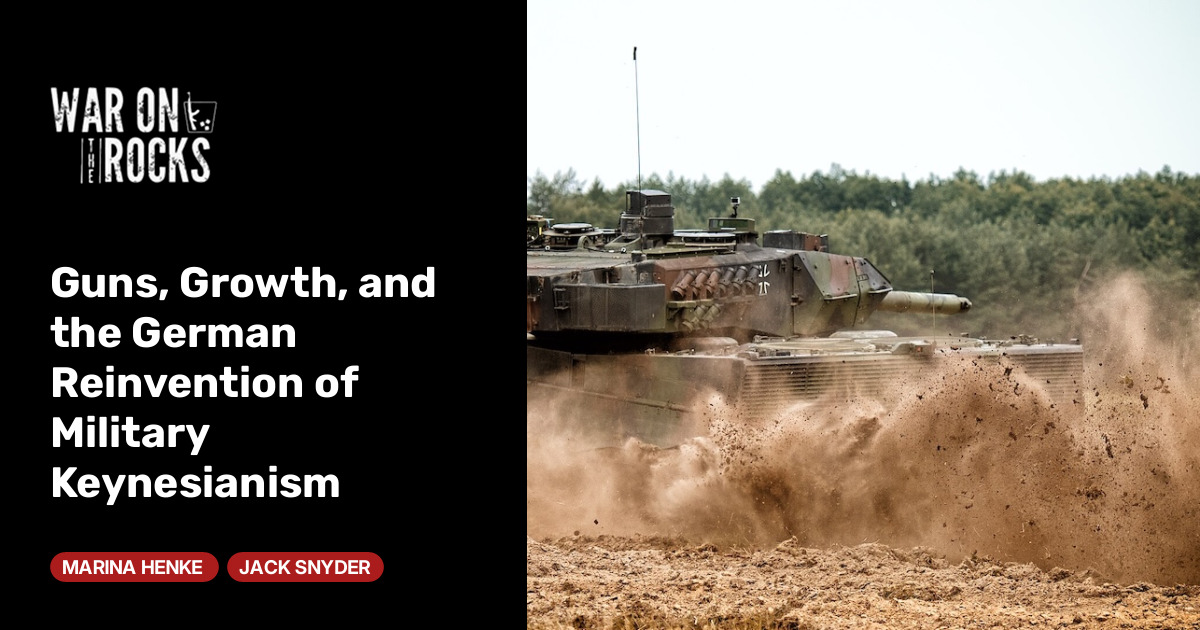
Guns, Growth, and the German Reinvention of Military Keynesianism
Full Article
Original Source
Read the full article at Warontherocks →KhanList aggregates and links to publicly available news content. We do not host full articles from third-party sources. Always verify important information with original sources.