
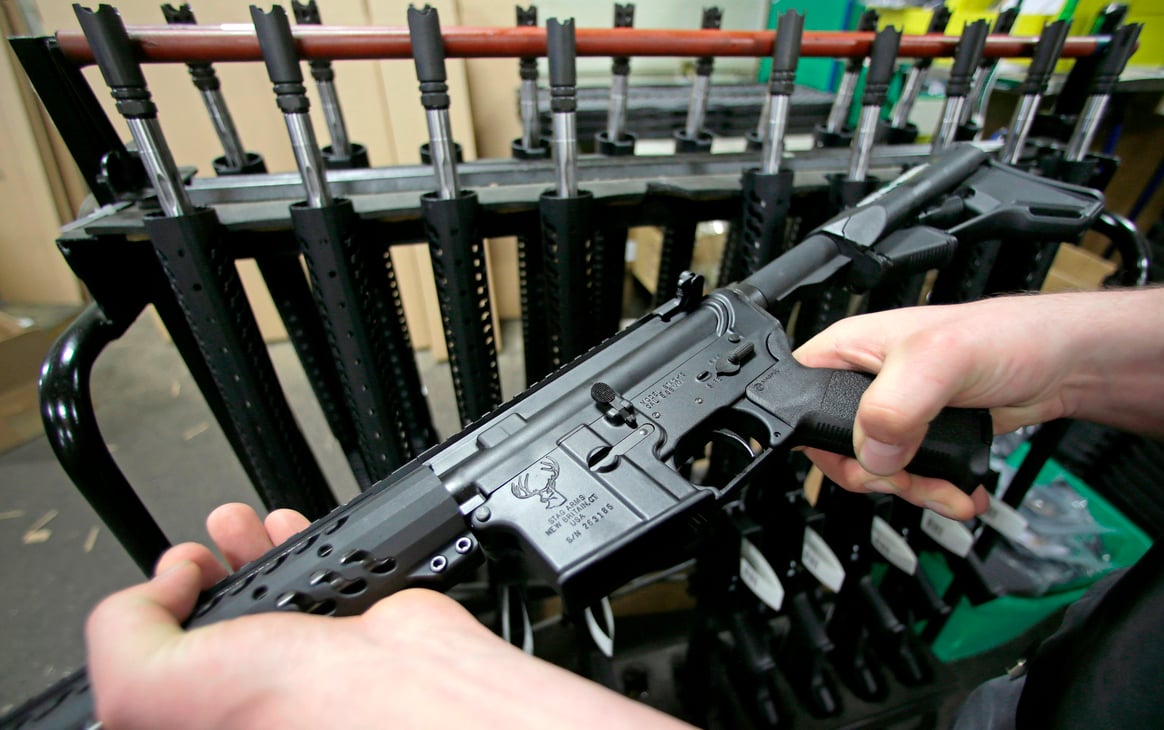
Canada banned firearms like the AR-15 and the Ruger Mini-14 rifle in the wake of a shooting in Nova Scotia in 2020 that killed nearly two dozen people.OTTAWA, Ontario (CN) — Firearm enthusiasts in Canada are trying to reverse a ban introduced by the federal government in May 2020 prohibiting the ownership and importation of 1,500 models of firearms and their variants, claiming that Ottawa exceeded its legal authority.Four different appeals of the ban have been combined for the hearings in front of Canada’s highest court on Monday and Tuesday.Christine Generoux, a woman from Ottawa representing herself, is leading the appellate campaign. She is supported by hunters, Indigenous people and sports and firearm advocates.The gun rights activists are arguing that the broad policy, notably banning the use of AR-15 and Ruger Mini-14 rifles, has made weapons illegal that have always been used safely by hunters and sports amateurs, and even Olympic athletes.Generoux said that the ban prohibits firearms that could cause harm to another person, but that could apply to any weapon, and could lead to more restrictions for gun owners in the future.She claimed that firearms enthusiasts were being unduly targeted and painted as criminals for their hobby by the government, saying that they were “using our community as scapegoats to cover for their own poor public policy.”The ban was introduced in the wake of a deadly mass shooting that caused 23 deaths — including the shooter — in Nova Scotia in April 2020. A month later, then-Prime Minister Justin Trudeau announced that military-grade assault weapons would be prohibited.The prime minister’s Cabinet policy is considered an Order in Council — equivalent to a U.S. president’s executive order — and has therefore not been ratified by Parliament. The Criminal Code grants power to the Cabinet to enact restrictions regarding firearms if it deems that the weapons cannot reasonably be used for hunting and sports shooting.Counsel for the Canadian Coalition for Firearm Rights, Michael A. Loberg, argued that the ban targeted weapons that historically have been used for hunting and sports, and that the Cabinet had overreached its legal authority and violated the mandate Parliament had granted it to restrict firearms.The case was previously dismissed by the Federal Court and the Federal Court of Appeal, which had both deemed that the government has used valid arguments regarding public safety to justify the ban.The nine justices of the top court also questioned if the weapon owners had sufficiently considered the weight of public safety in the balance that the government tried to strike with firearms enthusiasts’ interests.“I can see that many of these weapons, despite their potential danger, can be used safely,” Justice Glenn D. Joyal said. “In some instances, at some point in time, suddenly, irrespective of how safely the weapon is being used by a sports person, others are using it in a very different way.”The attorney general of Canada defended the policy, arguing that only 3% to 5% of gun owners would be affected by the ban, and that plenty of other firearms were available for hunting and sport shooting.“Is it reasonable to allow these guns to continue to be used in Canada for hunting and sporting purposes, given the risk of enormous harms they can cause if they get into the wrong hands?” attorney Zoe Oxaal said.The justices sought many clarifications from attorney general regarding the policy and its wide reach, but they seemed to agree that the government had acted lawfully.“There may be cases where perhaps the [Government in Council] has gone too far, but that’s different than saying the whole shebang is defective,” said Justice Mahmud Jamal, claiming that the ban on some models could be contested individually, if necessary.The current ban is suspended until the Supreme Court ruling comes out. If the justices uphold the policy, Canadians who own the firearm models and variants included in the ban will have an amnesty period of 90 days to dispose of or permanently deactivate their weapons.A buyback program established to help businesses and individuals be compliant with the law has collected almost 75,000 weapons as of mid-2026, and businesses have received 96 million Canadian dollars ($67 million) in compensation for their participation.The hearing will continue Tuesday, with firearms and sports associations expected to intervene in favor of the plaintiffs, as well as three conservative provincial governments opposing the ban: Alberta, Ontario and Saskatchewan.Courthouse News reporter Tatiana Mulowayi-Pelletier is based in Montreal, Canada.Subscribe to our free newslettersOur weekly newsletter Closing Arguments offers the latest about ongoing trials, major litigation and rulings in courthouses around the U.S. and the world, while the monthly Under the Lights dishes the legal dirt from Hollywood, sports, Big Tech and the arts.Additional Reads
Gun-owners fight assault rifle ban at Supreme Court of Canada
Full Article
Original Source
Read the full article at Courthousenews →KhanList aggregates and links to publicly available news content. We do not host full articles from third-party sources. Always verify important information with original sources.