
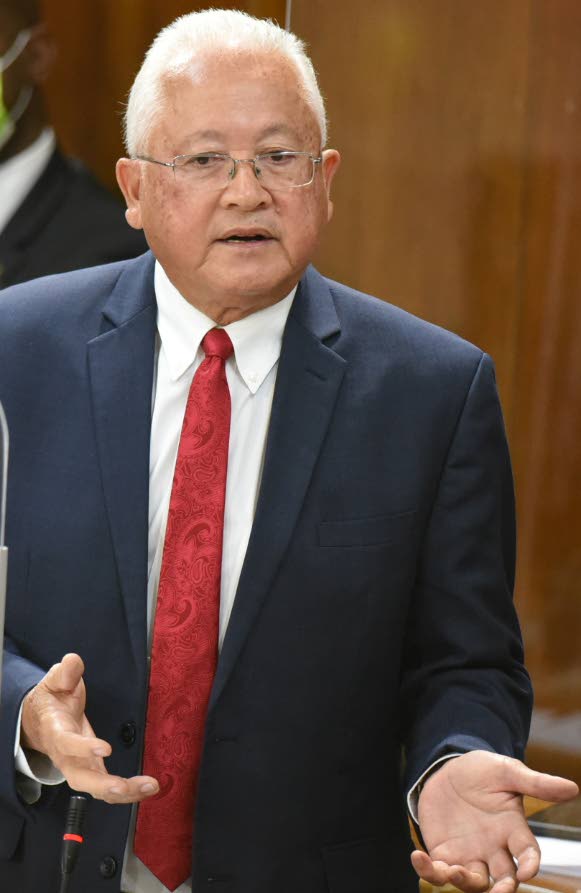
CHUCK... the mandatory minimum sentence is under consideration, but firearms are a major problem in our country and that is why we don’t want to send a signal that we are going to relent on the enforcement to condemn the possession and the use of firearms JUSTICE Minister Delroy Chuck signalled Sunday that while legislators are set to review the mandatory minimum sentences under the 2022 Firearms Act, a repeal is unlikely as security forces and other key stakeholders are crediting the law for the sharp decline in murders and shootings in recent times. According to the Serious Crimes Report published by the Jamaica Constabulary Force (JCF), up to July this year Jamaica recorded 275 murders, 23 per cent less than the 335 reported during the same period in 2025. It said overall, Category One crimes declined by 15 per cent, with 322 fewer major crimes reported than last year. According to the JCF, the reduction in murders formed part of a broader decline in serious crimes, with shootings falling by 27 per cent, robberies by 25 per cent, while both rapes and break-ins declined by 10 per cent over the comparative period. In January this year the country reported its lowest monthly murder figure since national crime data collection began in 2001 with 33 homicides, representing a 55 per cent reduction when compared to January 2025 which recorded 74 murders. “I am aware that in the Firearms Act you have mandatory [minimum] sentences. It is a matter that is being examined but I can tell you that ,from where I sit, the security forces and a number of my colleagues feel that the Act is working and it is bringing down murders and shootings. It is under consideration, but firearms are a major problem in our country and that is why we don’t want to send a signal that we are going to relent on the enforcement to condemn the possession and the use of firearms. But it is under consideration,” Chuck told members of the judiciary attending the 2026 Assize Church Service at East Queen Street Baptist Church. MCDONALD-BISHOP… revealed in 2024 that there would be a full court sitting soon to hammer out issues with aspects of the new Act which have been proving a pain to lawyers and judges alike The Firearms (Prohibition, Restriction and Regulation) Act, 2022, which prescribes a mandatory 15-year sentence for violations, took effect in November 2022 and, among other things, provides penalties ranging from 15 years to life imprisonment for possession of illegal weapons, and establishes a dual regime — distinguishing between prohibited weapons or unregulated firearms and connected activities, and firearms that are duly authorised or registered. However, members of the bench have telegraphed that the provision is problematic. In 2024, Appeal Court President Marva McDonald Bishop revealed that there would be a full court sitting soon to hammer out issues with aspects of the new Act which, she said, have been proving a pain to lawyers and judges alike. “The Firearms Act is giving problems to prosecutors, it’s giving problems to trial judges, and surely at the Court of Appeal. We might have seen other cases where the court might seem inconsistent in its approach, and we have taken the decision that we have to take steps to put the court in a position where we can declare conclusively what the position of the court is on a particular area of the law so to avoid confusion,” the Appeal Court president said in presiding over a special sitting of the court marking the opening of the Michaelmas Term — her first since being appointed in July that year. Additionally, concerns have been that the mandatory minimum provisions in the Act counteract the Plea Negotiations and Agreements Act (plea bargaining legislation), with many accused opting to head to trial rather than plead guilty at their first appearance. On Sunday, the justice minister’s remarks about the provision came in the course of his comments about the deluge of criminal matters awaiting trial before the island’s circuit courts. Said Chuck: “Probably one of the main criticisms of our justice system is not access to justice but the inordinate and unnecessary delays in the delivery of justice. In truth, there are non-contentious matters which really should be dealt with in weeks rather than months and years, and it’s a major complaint which we need to address. And then… there are trials that must be heard and must be determined… we cannot try all cases, it’s just impossible, and so over the next many months I will be, literally, not only advocating but on a missionary zeal to urge persons in dispute to really settle matters by mediation. SYKES… the courts cannot try every case, and not every case needs a trial “In the criminal courts there are far too many cases now that need to be tried, and they can’t be tried because the volume of cases are significant. In the Home Circuit we have about a thousand cases to be tried. Even if we multiply the courts five times, they will not be tried in two or three years — and at the moment trials are starting after three to five years in the circuit courts. When you go to any circuit — Trelawny, I understand, started out last week with 186 cases; Westmoreland has over 400 cases — it is impossible to try all these cases. And that is why, presidents of the Advocates Association and the Jamaican Bar Association, you have to tell your members that accused persons must face reality: If you do the crime, you must serve the time — and I would like to add shortly, abide the time,” he said further. According to the justice minister, the plea bargaining provisions are an opportunity for accused individuals to “show that you really regret having done the crime, and therefore negotiate with the director of public prosecutions an appropriate means”. “Maybe a reduction in sentence in appropriate cases, [as] the time has to be served. But to the extent that there can be non-custodial sentences I urge the judges that, if it is possible and it is an appropriate case, that non-custodial sentences can be imposed. If non-custodial sentences are imposed then you bide the time so that eventually you may well get expungement,” he said. In early August Chuck, speaking during the opening ceremony of the 2026 Strategic Management Retreat, indicated that he would be consulting with Director of Public Prosecutions (DPP) Claudette Thompson, King’s Counsel, regarding greater use of plea bargaining agreements as “far too many cases are being tried”. On Friday, Thompson, in response to queries from the Jamaica Observer, said Chuck “had attended on” her offices and that discussions had taken place. THOMPSON… discussions regarding greater use of plea bargaining agreements have been held with Chuck On Sunday, head of the judiciary, Chief Justice Bryan Sykes, who addressed the gathering ahead of Chuck, used the biblical example of Jewish leader and royal cup-bearer Nehemiah’s rebuilding of the walls of Jerusalem, where individuals worked on the portion of the wall nearest them, eventually leading to all sections meeting in complete fortification, to underscore that “justice is the work of everyone in society”. “This is the picture of restoration that Jamaica needs. Justice, like Nehemiah’s wall, is not the work of the judiciary alone; it is the work of bench and bar, the Ministry of Justice and Constitutional Affairs, the police, the correctional and probation services, social workers, court staff, jurors, witnesses, the media, and every person. So, each person has a portion of the wall to build,” Sykes argued. Addressing attorneys directly, the chief justice, who urged citizens to resolve disputes using mediation rather than violence, said, “The courts cannot try every case, and not every case needs a trial. “You have to move past the idea that justice can only be served when the person appears before the judge; no legal system can accomplish this. So, I am of the view that most civil cases can be settled and most criminal cases really shouldn’t be there in the first instance. I say to attorneys and our professional partners, ‘Let us examine honestly our portion of the wall.’ Every unnecessary delay leaves someone waiting — a victim waiting for closure, an accused person waiting for resolution, a child waiting for maintenance, a family waiting for an estate to be settled, or a business person or entity waiting for a commercial issue to be resolved,” Sykes stated. “For its part, the judiciary is committed to embracing justice, not only in the final outcome of cases but in the entire experience that people have in the process from filing to final disposition,” he pledged.
Gun law credited with decrease in murders, says Chuck
Full Article
Original Source
Read the full article at Jamaicaobserver →KhanList aggregates and links to publicly available news content. We do not host full articles from third-party sources. Always verify important information with original sources.