
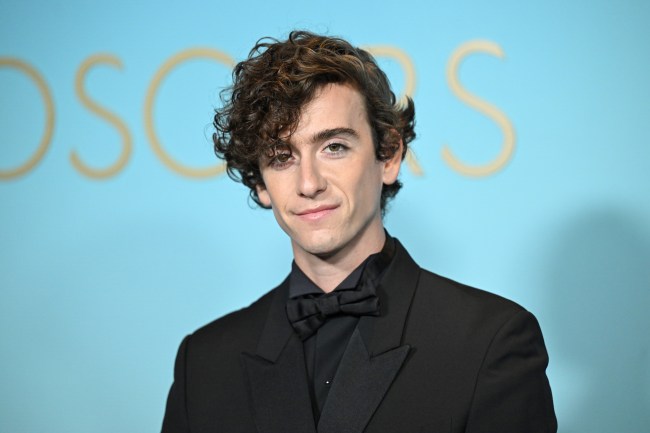
[Editor’s note: The following interview contains spoilers for “La Bola Negra.”] With a head of hair, lithe frame, and the soft eyes Caravaggio would’ve loved if the Italian painter were Spanish, pop star Guitarricadelafuente is having a monumental year on- and off-screen. The gay 29-year-old songwriter finished touring his sensational, sensually charged second album “Spanish Leather” earlier this fall, and only just a few short months after his screen debut, “La Bola Negra,” won a Cannes top prize, got scooped up by Netflix, and entered the awards season fray. Oscar talk is in the wind, not just for his performance as queer closeted trumpeter Sebastián, who joins the Nationalist forces during the Spanish Civil War to survive, but for writing the original song “La Nieve.” The sweeping ballad ties together the film’s three story threads that convene around queer Spanish playwright Federico García Lorca’s incomplete text: 1932, 1937 (Sebastián’s storyline), and 2017. Born Álvaro Lafuente Calvo, he’s now a meme thanks to his stage and screen sobriquet, which means “little guitar of the fountain.” Guitarricadelafuente’s performance balances both hushed repression and eventually unleashed emotions throughout “La Bola Negra,” as Sebastián nurses wounded (and handsome) Republican soldier Rafael (Miguel Bernardeau, a more established actor in Spain). They fall for each other in the process, in a furtive romance mostly framed in stolen glances and tacit looks — in other words, the sort of good old-fashioned gay yearning that’s made movies like “Brokeback Mountain,” “Call Me by Your Name,” and “God’s Own Country” so popular. “La Bola Negra” is, by now, one of the highest-grossing Spanish movies ever to play in Spain, and it’s a major Oscar contender in select theaters as it gears up for its early December Netflix streaming premiere. IndieWire spoke to Guitarricadelafuente over Zoom where, behind him, an oversized window frame flanked the waves gently rushing up to Miami Beach. Below, we discuss his songwriting process for “La Nieve,” witnessing the breakup of directors Javier Ambrossi and Javier Calvo (which happened during filming), and how he overcame his fears to make his auspicious screen debut. That’s all while balancing a proudly out music career where his sexuality is front and center. Plus, watch an exclusive video about his role in the film at the bottom of this story. The following interview has been edited and condensed for clarity and length. IndieWire: You’ve been all over the world with “La Bola Negra,” from Cannes in May to Toronto and, now, Miami Beach for this virtual junket interview. You’re used to being all over the place. You also toured your album this year. Did that help you prepare for promoting the film? Guitarricadelafuente: I would say that kind of, in a way, because there’s something that I see as very similar to going and talking about the movie and talking about your character, which is something very similar to when you’re going around touring with your album. I think it’s more difficult because you need to talk about yourself and not just about playing a character because the music you make comes from a very profound place, and you need to talk about many things that go inside of you. This is your acting debut, and there’s Oscar chatter for both your performance and the song you wrote for the film, “La Nieve.” Do you watch the Academy Awards in Spain? Not that much recently, but I remember when I was studying architecture in college, I used to stay up late at night doing projects. I remember staying up until 3:00 a.m. and with my friends, we were doing our little houses, and we would put the television on, and see the awards. But that was one of the only times that I stayed up late, or that I used to stay up late to see the awards, because you always receive that in Spain in the morning after. You signed up for the movie without a script. What was the pitch that the Javis gave you? You knew you’d have to learn the trumpet. They didn’t tell me that I had to learn an instrument because it was going to be originally something that I already knew how to play, but they wanted to make it more difficult. So they said, “OK, why don’t you try a trumpet?” But yeah, the first pitch, there was not much about it. They told me about “La piedra oscura” by Alberto Conejero, which was the original play where the characters of Rafael and Sebastián appear. I just knew that it was going to be set against the backdrop of the Spanish Civil War, with Lorca being so present. … They didn’t convince me, but I was so moved by how they were so confident that I could do it because I was so frightened and I wasn’t sure at all, but it was their vision. I admired them so much from before. I knew that they’ve worked with many nonprofessional actors, and people acting for the first time. So it was something that I just threw myself into. You were frightened about whether or not you could deliver as an actor, or was it the material? I was spending all of my time making music and touring, and it was very time-consuming and exhausting. … I didn’t know if I could put myself into that experience because I thought the proper way to dig into that role was to put your soul into it. They were looking for someone who was openly gay for this role, right? There’s a spectrum of sexualities among the cast. Miguel Bernardeau, your scene partner, is straight. Well, I don’t even know if we talked about that at any point because it was just assumed that I was. [Laughs] I don’t know if that was a condition. I think it was something that, to be more faithful to the story, had to happen. At the time that they approached me with the role, I was finishing my last album, “Spanish Leather.” It represented an imaginary — but not that imaginary — journey of a young gay man who comes out from his village and puts himself out to the world, discovering who he is and where he belongs. Many people would know my music, but I would realize that not many people knew that I was gay even. There’s a big, not sexual, but I would say sensual component to [“Spanish Letter”] and this process of growing up and sexual [awakening]. So it was very special in a way to play this role … it’s something that you don’t get that much, maybe in Spain, just to see things where you can get referenced with or reflected with. ‘La Bola Negra’©Netflix/Courtesy Everett Collection Los Javis broke up during production. Did they communicate that to the cast? How did you find out? It was so weird because I don’t know if I’m stupid or what, I didn’t even notice. I would hear obviously so many rumors, but … you couldn’t tell that they were apart because they were acting as one. And I couldn’t believe that they were breaking up with the intensity of that shoot. It was like, “How on earth are they going to split up in the middle of this craziness and this madness?” But I don’t even remember when they told us. I think it was at the end of the shoot. We would eventually know that something was going on. I couldn’t believe it. How have you managed to carry this shoot? But that also represented how moving this story was to them. People were gossiping at that point. Of course. Even when they reached out to me with the role, I would hear rumors, and I was like, “How is this going to be possible if they’re so tight together?” It was inevitable because they are so well known in Spain, that rumors would arrive. Miguel has probably 10 years of acting experience that you don’t have. Was he helpful as a mentor, as well as an onscreen romance? The first time that we met, it was actually when he was doing his audition because the only character that was clear in the movie was Sebastián. We had to test how this approach was going to be with the real Rafael, because this very tight and intimate connection had to happen. He didn’t know that I was going to play Sebastián, and he just appeared in the rehearsal room. And I thought there was a very special instant connection there, that I think we’re obviously very different, or we come from very different backgrounds or different ways of seeing the world. But there was a beauty in that because obviously I saw him as this wonderful, beautiful, talented, and professional actor that I could anchor myself in. He’s all the time lying on a bed [on screen]. And so he has to say so many things without being able to move. We were both left a lot of freedom on set and to try and to make errors. The room would get empty, and it was just Los Javis, Miguel, and I. Were you writing the movie’s theme song, “La Nieve,” during production? It was a very long process from the beginning, when I was told to write the song. I don’t think of me doing a song as in I get into a room and say, “OK, what I’m going to talk about right now?” And then I get a lyric, and I go back home. This Film has so many stories in it, and to try to be faithful to all of them and try to unify them in a thread, in a song, was very difficult. I was listening at the time, before they reached out to me, to Spanish Civil War songs. It was actually a queer singer of the time who was called Rolando Alarcón. There were songs played with parlor guitars that were [made] to be sung on the waterfront. We started preparing the role with Los Javis. Lorca had to be very present also in this because he’s all over the place. He’s pretty omnipresent all of the time, surveilling what’s going on. And you had to pay a homage to him because, in the end, “La bola negra” was this unfinished script that he was writing. I had to live my character in my own skin and properly carry that emotional baggage that he was holding. And it wasn’t until the end of the shoot, when we were in Cantabria living for two months … I obviously had this melody in my head, but when this scene with the firing squad happens, and [SPOILER ALERT] Rafael dies, it was a combination of all of that emotional journey that the character was living. I would arrive home that day and start playing a melody on a piano and mumbling some lyrics, and I would send this to Los Javis, and I didn’t know that they were going to use this to unify the three stories that go on in the movie. And it was a way for me to let all of that emotion go. ‘La Bola Negra’©Netflix/Courtesy Everett Collection This song will now have to be part of every setlist you perform. It’s your “My Heart Will Go On.” I hope it turns into that. I wish to be 50 years old and be in Madrid and be singing that. That would be so beautiful. Because I feel that I was just playing in Madrid my last concert one month ago, it was kind of the closing chapter of this “Spanish Leather” tour, and the film was just released one week before that. And so I got the chance to play “La Nieve” there for the first time. After that, it was very emotional because you would hear 18,000 people singing to that. It was like goosebumps. After that, people would be commenting on TikTok, “So Sebastián had the chance to finally be a musician and get to Madrid and perform.” That’s kind of like a closing of the thread, a very beautiful thing. “La Bola Negra” is also one of the highest-grossing Spanish movies to play in Spain ever. Have you been able to go home and experience that? We were in Spain those first two weeks until we had the last concert in Madrid, and then we went to Toronto and all over the place. And that was a very special week because I was at my sister’s wedding. You could feel something in the air. There was a communal excitement, and people of all ages, all different ages, going to the cinema, or even people, like aunts of mine, who haven’t been to the cinema in 10 years, to see how that’s happening is something that makes us very proud. For me, the Spanish premiere was more important because that’s all Spanish people’s lives. Everybody has been linked to that moment of time, it’s like their ancestors. So the Spanish were going to be the most critical of it. But to see how young people, old people, people from different backgrounds go and you suddenly have this sense of communion was something spectacular that you could see in the streets. Like older ladies and young queer guys coming up to you, it’s just incredible. What are you doing next? Do you want to keep acting? Yeah. It’s been a crazy time. I’m having the time to even make new music and to, I don’t know, to see what I’m able to, because even three years ago… I would oblige myself to be quiet and rest to be able to feel inspired. But now it’s all these hectic times that are making me feel so inspired, and to share that time and put it into making art. You’re thriving on the chaos. I’m thriving on the chaos. “La Bola Negra” is now in select theaters will start streaming on Netflix on Wednesday, December 2.
Guitarricadelafuente Was Terrified to Make His Acting Debut in ‘La Bola Negra’: ‘I Wasn’t Sure at All’
Full Article
Original Source
Read the full article at Indiewire →KhanList aggregates and links to publicly available news content. We do not host full articles from third-party sources. Always verify important information with original sources.