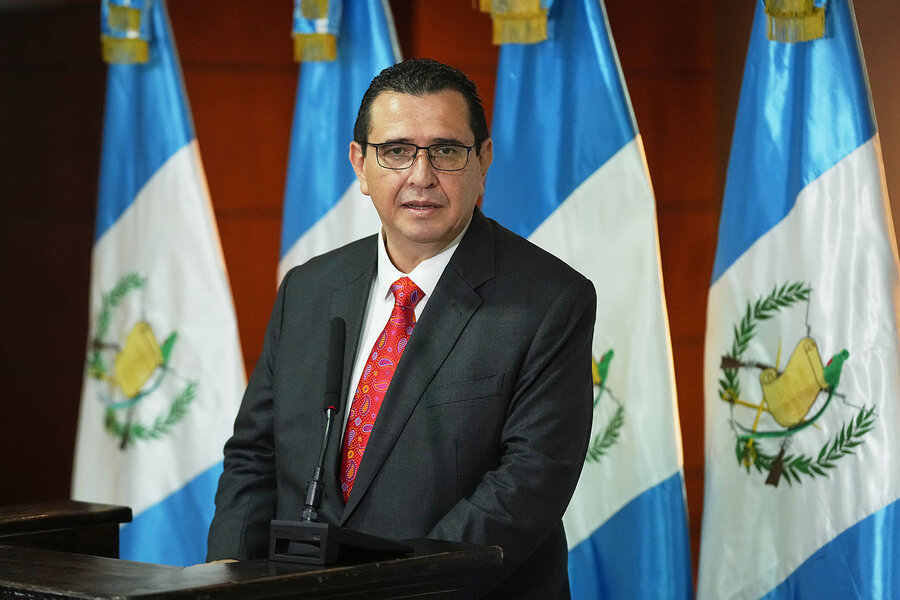
When Gabriel García Luna took office as Guatemala’s attorney general in May, it was a pivot away from years of internationally condemned corruption in the Public Prosecutor’s Office, and signaled an opportunity to rebuild.Three months in, Mr. García Luna has already started to clean house. But just how radically he can walk back the corruption that plagued this office over the past eight years – and its meddling in the stewardship of Guatemala’s president – will continue to be tested.Guatemala’s former chief prosecutor, María Consuelo Porras, was accused of gutting the Public Prosecutor’s Office of career lawyers, undermining anti-corruption efforts, and chipping away at democracy and the rule of law. She took steps to keep anti-corruption President Bernardo Arévalo out of office, and many point to her role in complicating his political projects. She was sanctioned for corruption by more than 40 countries, including the United States. Why We Wrote This After 8 years defined by corruption and impunity in the Public Prosecutor’s Office, can new Attorney General Gabriel García Luna put Guatemala back on track? Mr. García Luna has ousted Ms. Porras’ key allies, and he has launched a committee to review cases of those criminalized under her administration. His office is working closely with the Inter-American Commission on Human Rights, which scheduled an early August hearing to review cases of individuals who denounced political persecution under Ms. Porras. It’s giving some, such as Juan Francisco Sandoval, a former head of Guatemala’s Special Prosecutor’s Office Against Impunity (FECI), and who was pushed into exile by Ms. Porras’ office, cautious hope that the public could one day regain confidence in the justice system here. “This closes a phase marked by the deterioration and manipulation of the justice system,” Mr. Sandoval says. “Credibility has to be restored. There was a time when the Public Prosecutor’s Office was an institution that inspired the most public trust. ... We all have high expectations” for Mr. García Luna.Strides and setbacks in justice Guatemala was once seen as a regional model for tackling corruption through its International Commission against Impunity in Guatemala, or CICIG, which countries such as El Salvador and Honduras tried to emulate. The commission, which operated from 2007 to 2019, was backed by the United Nations and worked alongside Guatemalan prosecutors to investigate organized crime, corruption, and illicit networks.As it investigated increasingly powerful businesspeople and politicians, including a sitting president and vice president, some critics feared it was overstepping its mandate, becoming too influential in domestic politics. When Ms. Porras took over as attorney general in 2018, she didn’t have a close relationship with CICIG leadership. A year later, its charter was not renewed by the Guatemalan government. Ms. Porras conducted investigations aimed at criminalizing judges, prosecutors, journalists, and human rights defenders – at least 79 of whom were living in exile by 2023 due to fears of unjust imprisonment. That same year, she launched what the Organization of American States described as an “attempted coup” against Mr. Arévalo to keep him from taking office. He ran on a pro-democracy platform, blaming the country’s widespread corruption for hollowing out the state’s ability to deliver security, justice, education, and economic opportunities.Ms. Porras tried to hold on to a position of power before her second consecutive term as attorney general expired this year, unsuccessfully running for a seat on the Constitutional Court as well as a third term as attorney general. On May 15, Mr. García Luna was sworn in as Guatemala’s new top prosecutor.Reforming an “institution of repression” Mr. García Luna took office with the eyes of the entire country upon him. A career judge, he previously served as a criminal-law adviser to the Office of the Solicitor General, and president of the nation’s Judicial Disciplinary Board. “Everyone has a concept of a Public Prosecutor’s Office that can be used in a certain way, and we can no longer have that,” he told The Associated Press in July. “It is not a political entity, nor a political weapon for anyone, and I do not intend to repeat the actions taken in previous administrations.”Though Mr. García Luna’s appointment feels like the end of a difficult period for Guatemala’s democracy, his most revolutionary work might be the baseline task of getting the nation back on track to follow – and trust – the rule of law, experts say.Mr. García Luna is now “at the helm of the most important institution of repression,” says Edgar Ortíz Romero, an expert in constitutional law, referring to the Public Prosecutor’s Office. “He has the task of dismantling that mechanism of repression and reorienting it toward what it should be about: Justice and public safety.”Already, Mr. García Luna has closed FECI, the special office on impunity, which had become politicized under Ms. Porras’ leadership. He also dismissed at least eight high-profile prosecutors closely aligned with the former attorney general.Mr. Sandoval warns that there are no quick fixes to the challenges of the Public Prosecutor’s Office. “Many prosecutors and specialized investigators left (their jobs under Ms. Porras), and the office has been weakened,” he says. Claudia Paz y Paz, who served as attorney general from 2010 to 2014 and went into exile in 2024 “for fear of being criminalized by the Public Prosecutor’s Office,” says a four-year term as attorney general might not be enough time to fix all of its challenges. But, she says, “it’s enough time to make progress on the things that are most important.” For the nearly three years that Mr. Arévalo has been in office, his efforts to create change in the country, such as filing corruption complaints or trying to replace Ms. Porras, were repeatedly spoiled by intervention or investigations by the Public Prosecutor’s Office. Many, including members of Guatemala’s more than 22 Maya Indigenous groups that were key in bringing Mr. Arévalo to the presidency, are hopeful Mr. García Luna’s appointment could spell broader change in the country. But, it wasn’t just Ms. Porras getting in the president’s way, observers say. Mr. Arévalo has no formal governing coalition in the legislature: His Movimiento Semilla party lost its legal registration as a political party this year and is barred from participating in 2027 general elections. He was able to pass some reforms, including anti-money-laundering legislation and ethics reforms within the executive branch, but a lot of his energy has been focused on preserving democratic institutions under repeated legal challenges from Ms. Porras’ team.Public opinion for the president is low, with some 52% of Guatemalans qualifying his work thus far as bad or very bad, according to a May poll by CID Gallup. In that sense, Mr. García Luna’s appointment might be “too little too late” to clear governing hurdles for the president, says Mr. Ortiz, the constitutional law expert. “Obviously, I think the way [Arévalo] can govern will change because there will be less repression,” he says. But, the “chances of making major changes were in the first year – not the third.”
Guatemala’s next chapter: How change in the public prosecutor’s office raises hope for democracy
Full Article
Original Source
Read the full article at Csmonitor →KhanList aggregates and links to publicly available news content. We do not host full articles from third-party sources. Always verify important information with original sources.