
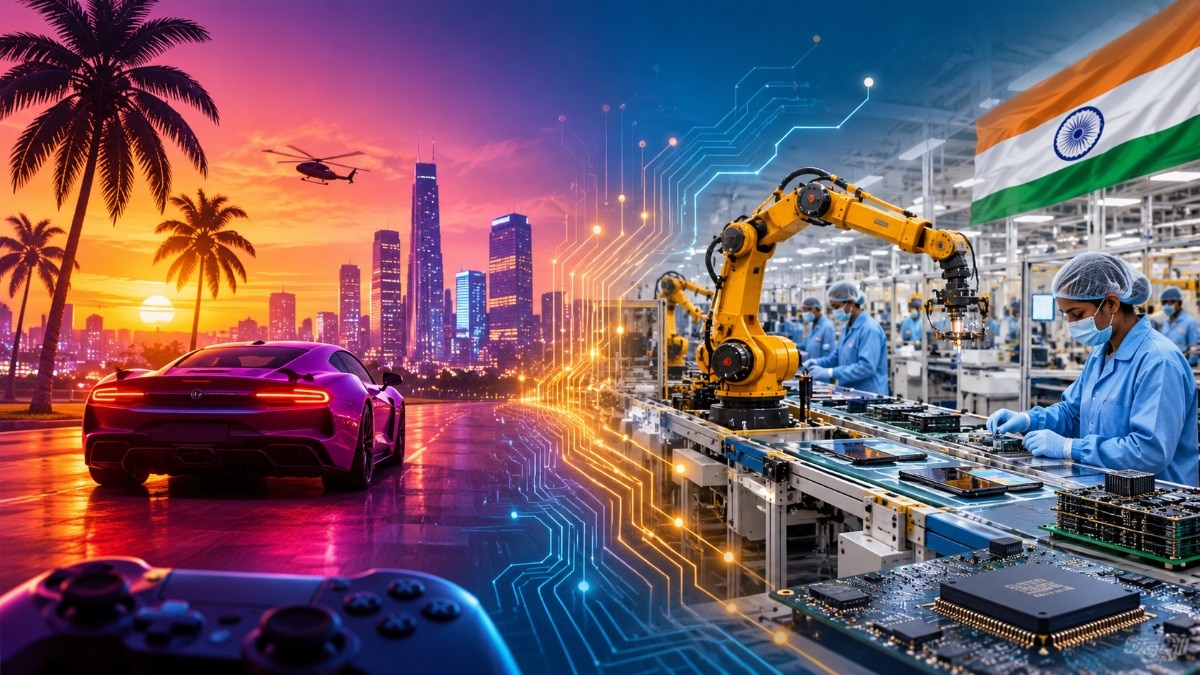
When Grand Theft Auto V was released in 2013, India's electronics manufacturing industry was still at a relatively early stage. More than a decade later, with GTA VI now out, the country has transformed into a major electronics manufacturing hub. How did India make this remarkable leap?A social media post by Prakash Dadlani has brought this change into focus, comparing India's manufacturing journey between the two game releases. The post highlights how electronics production has risen from around Rs 1.9 lakh crore to Rs 13 lakh crore, while mobile phone production has increased from approximately Rs 18,000 crore to Rs 6 lakh crore.This transformation has been closely linked to the government's push to strengthen domestic manufacturing under its Make in India and Atmanirbhar Bharat initiatives. While Make in India, launched in September 2014, sought to position the country as a global manufacturing and investment destination, Atmanirbhar Bharat, introduced in 2020, placed greater emphasis on building domestic capabilities, reducing import dependence and strengthening supply chains.Together with incentives such as the Production Linked Incentive (PLI) scheme and the Electronics Components Manufacturing Scheme (ECMS), these initiatives have helped attract investments, expand manufacturing capacity and encourage companies to manufacture more products in India. ELECTRONICS PRODUCTION RISES NEARLY EIGHT-FOLDIndia's electronics manufacturing industry has expanded rapidly over the past decade. According to a Press Information Bureau (PIB) factsheet published in September 2026, production of electronic goods, which stood at around Rs 1.9 lakh crore in 2014-15, reached approximately Rs 13.11 lakh crore in 2025-26. The sector also recorded 15.8% growth in production during 2025-26 over the previous year.The growth has been accompanied by a sharp rise in exports. Electronics exports increased from around Rs 38,000 crore in 2014-15 to approximately Rs 3.3 lakh crore in 2024-25, an eight-fold increase, stated the Ministry of Electronics and Information Technology (MeitY), in March 2026. The growth marks a significant shift in India's electronics manufacturing landscape. The expansion of domestic production has strengthened the country's manufacturing capabilities and helped it become more integrated into global supply chains.The Make in India initiative was an important starting point in this journey. Launched on September 25, 2014, it aimed to facilitate investment, encourage innovation, improve infrastructure and make India a hub for manufacturing, design and innovation. Electronics was among the sectors identified as having significant potential to boost domestic production and exports.The subsequent Atmanirbhar Bharat push gave further momentum to this objective by focusing on reducing dependence on imports and strengthening domestic manufacturing capabilities. Electronics became one of the key sectors targeted through production-linked incentives and other manufacturing support schemes.MOBILE PHONE PRODUCTION RISES AROUND 28 TIMESMobile phones have been among the biggest drivers of India's electronics manufacturing growth.In 2014-15, India produced mobile phones worth approximately Rs 18,000 crore. By 2024-25, the value had surged to around Rs 5.45 lakh crore, marking a nearly 28-fold increase, according to government data published in October 2025.The number of manufacturing facilities has also expanded sharply. India had just two mobile manufacturing units in 2014. Today, the country has more than 300 operational mobile manufacturing units, according to government data.India has also moved from being a major importer of mobile phones to becoming a net exporter. According to a government statement released in April 2026, around 75% of India's mobile phone demand was met through imports in 2014-15. By 2024-25, imported phones accounted for just 0.02% of domestic demand.Mobile phone exports have recorded an equally significant rise. According to government data, exports increased from around Rs 1,500 crore in 2014-15 to Rs 2.59 lakh crore in 2025-26, a jump of nearly 165 times.The expansion has helped India become the world's second-largest mobile phone manufacturer by volume.HOW MAKE IN INDIA AND ATMANIRBHAR BHARAT BOOSTED MANUFACTURINGThe government's manufacturing push has evolved through several initiatives over the past decade. Make in India focused on attracting domestic and foreign investment, improving the ease of doing business and developing India as a global manufacturing destination.Atmanirbhar Bharat, announced in May 2020, further strengthened the focus on self-reliance by encouraging domestic production, reducing import dependence and building resilient supply chains. In electronics, this translated into a greater emphasis on manufacturing mobile phones, components, semiconductors and other critical inputs within the country.One of the key measures was the Production Linked Incentive (PLI) scheme for large-scale electronics manufacturing, launched in 2020. It was designed to encourage companies to increase domestic production, attract investments and strengthen India's position in global supply chains by offering incentives linked to incremental production and sales.According to MeitY data released in April 2026, 32 beneficiary companies were approved under the scheme. By February 2026, the scheme had attracted investments of Rs 17,519 crore, against a target of Rs 7,000 crore.Cumulative production under the scheme stood at Rs 11.01 lakh crore, exceeding the target of Rs 8.12 lakh crore. Exports reached Rs 6.20 lakh crore, against a target of Rs 4.87 lakh crore. The scheme had also generated 1,85,175 direct jobs by February 2026, the release mentioned.Alongside the PLI scheme, the government has introduced measures to encourage the domestic manufacturing of electronic components, sub-assemblies and other inputs.One such initiative is the Electronics Components Manufacturing Scheme (ECMS), notified in April 2025. It aims to strengthen domestic manufacturing of components such as printed circuit boards, camera modules, passive components, electro-mechanical parts and other critical inputs.The Union Budget 2026-27 increased the scheme's outlay from Rs 22,919 crore to Rs 40,000 crore. In an update published in August 2026, MeitY said 106 projects had been approved across 15 states, involving investments of Rs 69,548 crore. Of these, 38 plants had started manufacturing, while another 16 were at advanced stages of construction or machinery installation.The approved projects are expected to generate production worth Rs 5.34 lakh crore, according to the ministry.SMARTPHONES BECOME INDIA'S BIGGEST EXPORT COMMODITYThe growth in mobile manufacturing is increasingly visible in India's export performance.Smartphones emerged as India's largest exported commodity in calendar year 2025, according to data from the Directorate General of Commercial Intelligence and Statistics (DGCIS), cited by the Ministry of Electronics and IT in April 2026.Smartphone exports were valued at Rs 2,62,452 crore in 2025, placing them ahead of other major export categories such as automotive diesel fuel and cut and polished diamonds.The rise has been supported by investments from global companies and their suppliers, which have expanded their manufacturing operations in India. The country has become an important production base for companies looking to diversify their supply chains.The industry has also emerged as a major source of employment. A PIB factsheet published in September 2026 estimates that the mobile manufacturing segment supports around 12 lakh jobs, with women accounting for nearly 70% of the workforce.BUT IS INDIA MANUFACTURING ENOUGH COMPONENTS LOCALLY?Despite the impressive rise in production and exports, a key question remains: how much of the value of an electronic product is actually created in India?Manufacturing a finished smartphone in the country does not necessarily mean that all its components are made domestically. Several high-value components and inputs may still be imported and assembled locally.In a statement released on April 1, 2026, the Ministry of Electronics and IT said industry estimates put domestic value addition in electronics manufacturing at around 18-20%.This means that while India has significantly expanded its ability to manufacture and assemble electronic products, there is still considerable scope to deepen local component production.The next phase of growth will depend on building capabilities across the entire supply chain, including semiconductors, display components, printed circuit boards, camera modules and other critical inputs.The ECMS is intended to address this gap by encouraging investments in component manufacturing and reducing dependence on imported inputs.India's electronics manufacturing journey has clearly come a long way from the two mobile manufacturing units it had in 2014. Production, exports, investments and factory capacity have all expanded substantially. Make in India helped put manufacturing at the centre of the country's growth ambitions, while Atmanirbhar Bharat reinforced the need to build domestic capabilities.But the bigger test will be whether the country can move beyond assembling finished products to manufacturing a larger share of the components and technologies that go into them. That will determine how far India can go in its ambition to become a global electronics manufacturing hub.- Ends
GTA V to GTA VI: How India became an electronics manufacturing powerhouse
Full Article
Original Source
Read the full article at Indiatoday →KhanList aggregates and links to publicly available news content. We do not host full articles from third-party sources. Always verify important information with original sources.