
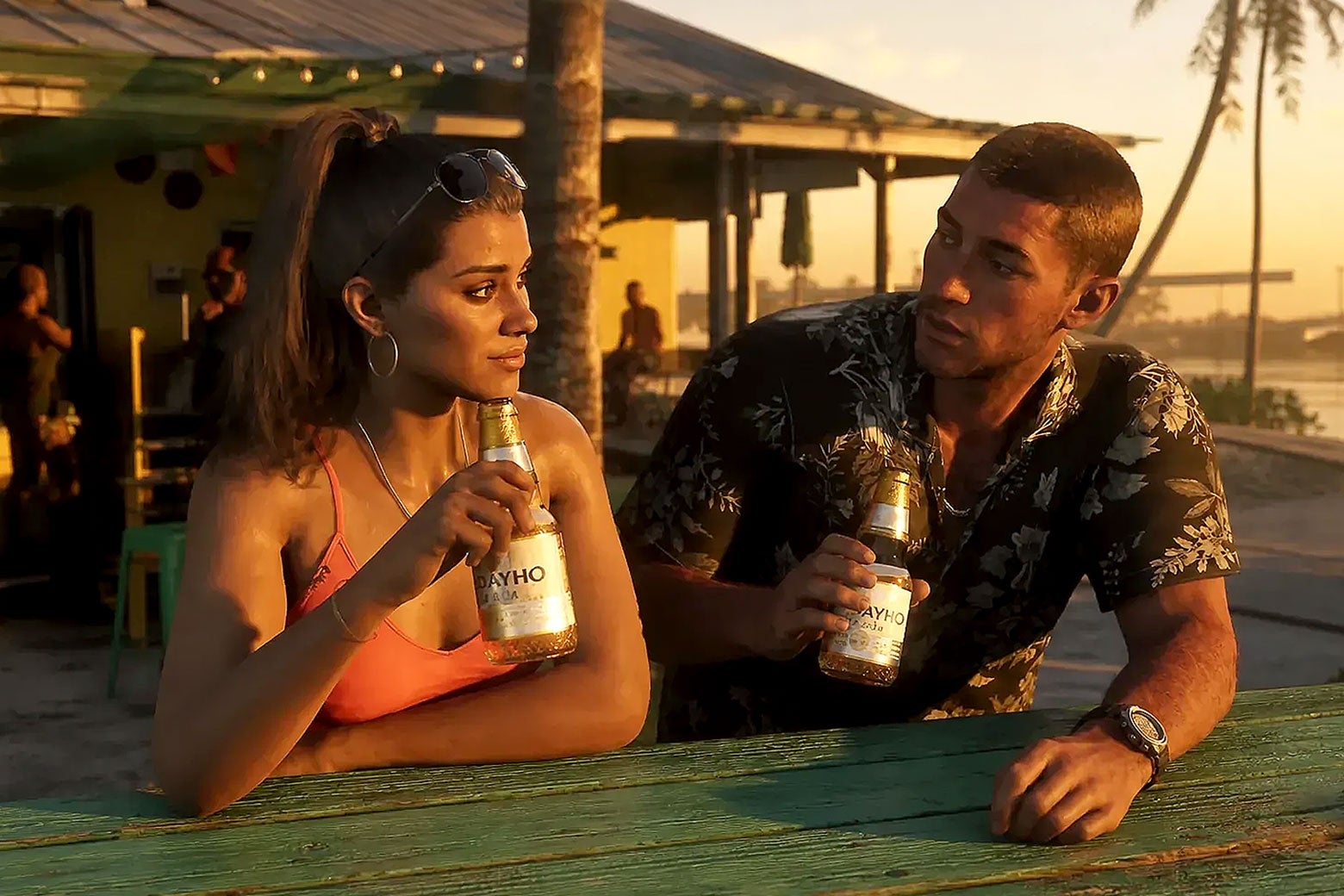
Video Games Grand Theft Auto Needed to Grow Up. It Found a Radical Way to Do So. GTA 6 gives its players something to live for. By Enter your email to receive alerts for this author. Sign in or create an account to better manage your email preferences. Unsubscribe from email alerts Are you sure you want to unsubscribe from email alerts for Luke Winkie? Nov 20, 20263:54 PM Rockstar Games Sign up for the Slatest to get the most insightful analysis, criticism, and advice out there, delivered to your inbox daily. Grand Theft Auto VI opens with a destabilizing twist. The flashbulb image of the 29-year-old franchise is a man with a rocket launcher blowing up cop cars. It is arbitrary drive-bys with semiautomatic rifles or clubbing streetwalkers to death with baseball bats. It is—as has been repeated on Fox News ad nauseam for decades—a playground of pure destruction, the darkest expression of id. And for the first 30 minutes of the latest entry, which has made history as perhaps the biggest video-game release ever, it appears as if the new installment is prepared to follow the same pattern. Our hero, Lucia, is down bad in a coffee shop, sipping on ice waters, when a desperately stupid idea crosses her mind. She retrieves a pistol from her trunk and sticks up the check-cashing joint across the street. Lucia bags the money in plain sight of a nearby patrol squad. A chase ensues. Lucia hops fences and cuts through alleyways, but before long she is tased, smothered, and eventually cuffed—sent off to prison for a nine-month bid. Before getting booked, however, she begs the officers to let her return to the coffee shop. She’s left something important there. It’s her toddler, Tomas, crying his eyes out. Just like that, a Grand Theft Auto protagonist finally has something to live for. This revelation was kept under wraps throughout GTA 6’s long, long prerelease cycle of hints, teases, and innuendo. The nature of modern triple-A video game development necessitates supersized gestation periods; the previous entry, GTA 5, was released 13 years ago. (To put that in perspective, I have memories of purchasing it—on disc! At a GameStop!—as a college senior.) Suspended in those intermediary doldrums, avid fans of the series had sketched out a loose idea of what was in store. We knew that GTA 6 centered on a Bonnie-and-Clyde romance between a woman named Lucia Caminos and her on-again, off-again boyfriend Jason Duval. We knew that it was set in Vice City, a neon-soaked facsimile of Miami, as well as its surrounding glades and sandbanks. But most importantly, we knew that Rockstar Games, the studio behind the franchise, had long shed its fetish for nihilism, as evidenced by the increasingly Scorsesean texture in its most recent offerings. The maniac violence no longer gelled with the company’s outsized narrative ambition. One way or another, Grand Theft Auto needed to grow up. What was less clear, however, was how Grand Theft Auto would grow up, or if it was even possible. The franchise’s founding principle is freedom, manifested by granting permission to players to pursue all the dark thoughts they can conjure. Shoot up night clubs, harass pedestrians, drive a semitruck down the sidewalk—it doesn’t matter, GTA is radically nonjudgmental. And yet, as the video game industry matured and Rockstar itself aimed higher, that freedom proved to be a problem for the kinds of stories the studio wanted to tell. What comes to mind is 2008’s Grand Theft Auto IV, a chilly immigrant saga starring a veteran of the Yugoslav Wars who gets enmeshed in the criminal underworld mostly because he’d like to escape his cousin’s dank apartment. Niko’s is a gritty, sober tale—but it could also be easily punctured by the wayward player’s ability to break into a corporate compound, steal a helicopter, and crash it into the Statue of Liberty, just for kicks. That’s not something you can hold against the person holding the controller: To play a video game is to always be poking at the outer limits of what is possible, to witness all the ways it allows you to sin. The profanity of the medium is a feature, not a bug. It’s just the way things work. Enter: Tomas, the blond-haired child who haunts every inch of the Grand Theft Auto VI narrative. Lucia and Jason see him only through flashbacks or in videos sent to their smartphones. The crux of the early plot beats are structured around the ways and means this family can be reunited. Lucia needs to avoid recidivism, and Jason has to build up his credit score and open up a bank account in the first place. Unlike in previous entries in the series, the light at the end of the tunnel here is not a criminal empire or one last big score. Instead, it is the faint hope that all the forces conspiring against Jason and Lucia will fail, and that these two can build a happy family. Rockstar has finally found a way to engender sympathy in its notoriously anarchic players, to convince them—naturally, without coercion—to immerse themselves as citizens of the world, where passing NPCs weren’t target practice. I guess all the studio needed to do was make us parents. In practice, that means I’ve been going about the early missions of GTA 6 as nonviolently as possible. My civilian body count is zero, and I hope to keep it that way. When I get up to dirty business, I put forth a smooth operation. (Recently, one of Jason’s dirtbag friends asked him to steal a car from police impound. I could’ve gone in guns blazing and racked up a butcher’s bill, but instead I found a work-around by sneaking past a gap in the barbed wire, hot-wiring the vehicle, and crashing through the fence.) These decisions tie into an in-game barometer that measures just how psychopathic of a criminal you’ve become, judged by the amount of carnage you’ve left in your wake. Pushing the body count past the brink would’ve been the goal 20 years ago, but here, the impulse is tempered by the knowledge that it will have a tangible impact on the ending you see when the credits finally roll. Rockstar attempted a mechanic like this in the studio’s previous release, 2018’s Western epic Red Dead Redemption 2. But there, the scolding felt more hollow, more moralistic, like a finger wagging at you for having fun in a video game. In that sense, one of the great triumphs of Grand Theft Auto VI is how subtly Rockstar has persuaded us to play ball. I mean, there is a family to fight for. This fundamental departure might signal a shift in the artistry of video games writ large. Much has already been made of how, in GTA 6’s first chapters, Jason is tasked with preparing his home for Lucia’s imminent release from jail. He installs drywall and fixes the roofing; he can buy her flowers, or even a necklace. He purchases groceries at the store. That all of these mundanities are somehow engaging is a testament to the game’s unmatched verisimilitude; when rendered this seamlessly, with such vivid detail, painting the bedroom is genuinely thrilling. It has also aggravated some of the most eccentric fringes of the manosphere—looksmaxxing pioneer Clavicular, hardcore misogynistic Twitch streamer Asmongold—who are aghast that the biggest video game of the century would allow players to treat women with kindness. (It ought to be mentioned that much of the right-wing reaction seems like a contrived attempt to scandalize liberals. As I’ve written here recently, I do think men are ready to be normal again.) But when I play Grand Theft Auto VI, what I think about most is that I am now a 35-year-old man, and in fact that the median age of American gamers has climbed to 37. So many of us are dispossessed of our juvenile fantasies. These days, we have wives and girlfriends whom we’d be willing to paint for. We have futures we dream about, and contingencies to manage. We have all stared into the abyss of our savings. Because of that, I wonder if gamers are less compelled by the hostile cynicism Grand Theft Auto used to embody. Maybe we are ready to grow up right alongside the series. Because, just like Jason and Lucia, we have something to live for too. Children Family Parenting Video Games
GTA 6 Has a Major Twist. It’s Game-Changing in Every Sense of the Word.
Full Article
Original Source
Read the full article at Slate →KhanList aggregates and links to publicly available news content. We do not host full articles from third-party sources. Always verify important information with original sources.