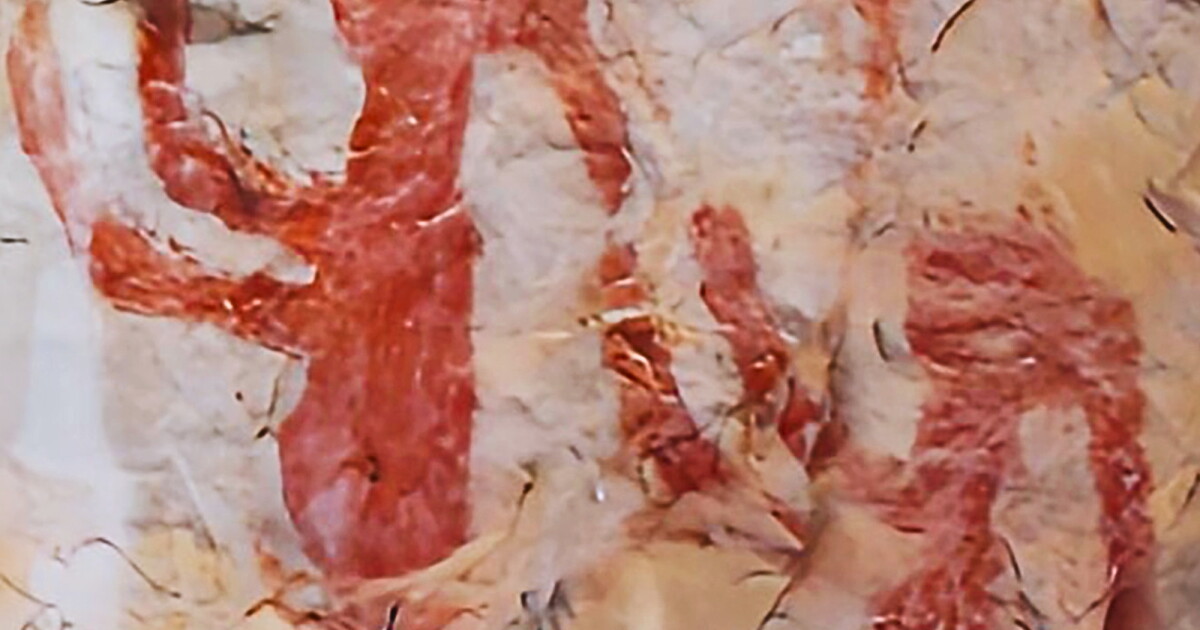
An extensive gallery of ancient rock art paintings in Southern China has long intrigued archaeologists by somehow surviving the brutal tropical elements for around 2,000 years.It now seems a secret ingredient may be responsible for their resilience, one found inside our own bodies.An analysis led by researchers from Shandong University has confirmed components of human blood as binding agents for the red pigments used to create the artworks, which could explain why the famous paintings still look fresh after generations of exposure to heat and monsoonal moisture.Known as the Zuojiang Huashan Rock Art Cultural Landscape, the UNESCO-protected assembly contains thousands of bright red human figures, animals, and objects painted on the limestone cliffs overlooking the ZuǒJiāng, or Zuo River. These ancient paintings have survived despite facing hundreds of centuries of harsh weatherRolf Mueller/Wikimedia Commons Archaeologists suspect the images are the work of the Lạc Việt (or Luoyue, as it’s known in Mandarin) – a group of matrilineal cultures living near what is today the border between China and Vietnam until roughly 100 CE. Radiocarbon dating indicates some of the earliest paintings could be nearly 2,400 years old. Yet if the art pieces have been out in the open for all that time, how have they remained in such remarkable condition, especially given their location on crumbling limestone in a subtropical monsoon climate? Rock paintings in Indonesian caves could date back around 70,000 years, yet their remarkable state of preservation may be attributed at least in part to a stable microclimate, far from rain, heat, and wind.Whatever glue the artists used for the Huashan gallery, it had to be remarkably sticky to withstand century after century of weathering.To get a better idea of what the paint may contain, a team of researchers collected samples from fallen rock fragments from three different sites and subjected them to a series of screens.Three of the tests used different wavelengths of light to excite the chemical components and sift out identifying signatures from their glow. A fourth analysis methodically pieced together protein fragments, building a library of organic materials present in the paintings.The results suggest the bright red pigment came from a clay rich in tiny particles of iron oxide, or haematite. To bind it, the artists crafted a mortar using a mix of slaked lime (calcium hydroxide) and blood. Human blood. Diagram of the production process and bonding mechanism of the Huashan rock art. The blue and red arrows show human activity, while the green arrows show naturally occurring chemical and biological reactionsWen et al., J. Archaeol. Sci, 2026 Blood might seem like an unusual, even slightly morbid, additive to paint. Yet all manner of proteins have been used throughout time to bind paint to a surface, from milk casein to egg albumin.It’s not even the first time blood has been identified as a binder source in Paleolithic paintings. Rock art in Australia’s Northern Territory, dated to around 20,000 years ago, was found last century to contain clear traces of human blood.The amount of blood required to make the medium would be fairly small, the recent Chinese study found, and was probably mixed with blood from at least two species of herbivorous animals. So we’re not talking “human sacrifice” levels of paint.In fact, the team suggests the material may have been collected during births – a suitable symbol of fertility in a society led by women.Despite the new information, questions remain. Why did the artists climb to such heights, risking life and limb, to create the artwork? What do the images mean?Future studies could continue to shed light on the history of these magnificent artworks. For visitors keen to get a closer look at these ancient blood-bound paintings, a cruise down the Ming River could provide an ideal opportunity to experience a resilient piece of China’s history.This research was published in the Journal of Archaeological Science.Source: Phys.org
Gruesome ingredient has kept these 2,000-year-old rock artworks alive
Full Article
Original Source
Read the full article at Newatlas →KhanList aggregates and links to publicly available news content. We do not host full articles from third-party sources. Always verify important information with original sources.