
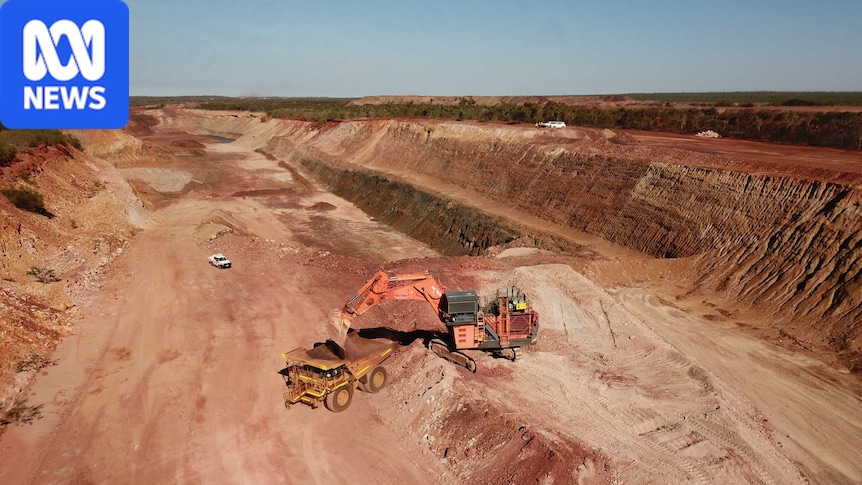
Northern Territory Indigenous traditional owners fed up with collapsed mining companies not being made to put enough money aside to clean up their operations are threatening to start negotiating rehabilitation guarantees as a condition of allowing new mines.Northern Land Council (NLC) chief executive Yuseph Deen said traditional owners across the NT had been shocked to discover the Territory government was holding a $6.2 million rehabilitation security bond from the Nathan River Resources iron ore mine, which went into receivership owing $360 million in May.He said a report the NLC had commissioned demonstrated that number would be "grossly inadequate" for the mine's rehabilitation."What you'll find is that most of the abandoned mining projects are on Aboriginal estates, so predominantly Aboriginal landowners miss out," he said.Yuseph Deen says traditional owners are increasingly concerned about collapsed mines not being rehabilitated. (ABC News: James Elton)"In this particular situation, where the mining company has gone into receivership, that means there is an opportunity cost, both economic and in terms of destruction of cultural sites."Mining bonds need a lot more work to go into them in terms of the amount of money that the Northern Territory government holds against those activities."The ABC has obtained a copy of the NLC-commissioned Nathan River Resources mine report, which estimates rehabilitating the operation would cost between $108 million and $1.1 billion.The report estimates rehabilitation of the Nathan River Resources mine would cost much more than the amount being held by the NT government. (ABC News: Pete Garnish)The report's author, Darwin environmental consultancy EcOz, said it used both the NT and NSW governments' mine security calculators to model the costs of either making the Nathan River Resources site safe while leaving waste rock dumps and mine pits in place, or completely rehabilitating the mine and its associated port loading and haul road infrastructure.The company provided low, moderate and high monetary estimates for each option.It estimated making the site safe following mining, while leaving the waste dump and pits in place, would cost between $108 million and $295 million, and that the cost of complete rehabilitation would be between $402 million and $1.1 billion.The Nathan River Resources project is an open-pit iron ore mine in Roper Bar in the remote Northern Territory. (Supplied: Nathan River Resources)"The security held by the Northern Territory government is an order of magnitude less than the lowest-cost scenario for works that are unlikely to meet the expectation of the land owners and will require monitoring and maintenance in perpetuity," the report said.Earlier this year, NT Electrical Trades Union organiser David Hayes said he had received reports from workers concerned about apparent pollution caused by the mine.The ABC obtained pictures of seemingly polluted waterways near the mine, taken last year.Concerns about apparent pollution at the mine were raised earlier this year. (Supplied)At the time, the NT Department of Lands, Planning and Environment said the pictures related to an incident reported to the NT's pollution hotline in December, which was still being investigated.Indigenous people own more than 50 per cent of the NT's landmass.Call for guarantees on mine remediationThe report recommended that the NLC — which facilitates negotiations with mining and gas companies wanting to operate on Indigenous land — should help traditional owners include their rehabilitation requirements as a condition for future mines."High level closure objectives and expectations should be considered for inclusion in Northern Land Council agreements with mining companies from the exploration stage," it said.Mr Deen said traditional owners were so concerned, they were planning to start requiring companies to guarantee mine remediation before allowing them to start new operations."To ensure that extra conditions are put in place for the land to be rehabilitated is something that traditional owners are considering," he said."That is the pathway that traditional owners are forced into, to ensure that there are conditions within the mining agreements, as they are negotiated with traditional owners."The Nathan River Resources iron ore mine is located in the Gulf of Carpentaria. (Supplied: Nathan River Resources)The Department of Lands, Planning and Environment said in a statement that it was sure the Nathan River Resources mine bond was adequate."The $6.2 million security that is currently held is the amount calculated as being required to remediate and rehabilitate the site based on current levels of approved disturbance," a spokesperson said."Additional security payments are required before Nathan River Resources is authorised to commence any future stages of ground disturbing works."The department spokesperson added that responsibility for calculating mine bonds was moved to the agency from the mining department two years ago, and said it "conducts an independent assessment of the security requirements".Risk assessments 'patchy'Corinne Unger, a research fellow at the University of Queensland's Centre for Social Responsibility in Mining, said the NT could improve its mine bond calculations by requiring its treasury department to take a lead on assessing liabilities, similar to Queensland."I'd recommend that treasury take a very close look at how the liability is accumulating and how the financial provisioning is addressing it and to what degree," she said.Corinne Unger says the NT government should consider involving its treasury department in calculating mining liabilities. (ABC News: Mark Leonardi)Dr Unger said the approach Australian states and territories used to assess the risks of dealing with abandoned mines appeared "patchy"."It's patchy and stop-start. You can see over time there has been a concerted effort to catch up, to understand, to develop inventories, to assess risks, and then there's a falling off — there is this fragmented approach," she said.Mr Deen said traditional owners were determined to see requirements for rehabilitation on their land strengthened."Because the collapsed mines are predominantly on Indigenous estates, there's a sense that if they were on other private landholders' country, something probably would have been done by now," he said.
'Grossly inadequate': NT traditional owners plan to mandate mine rehabilitation
Full Article
Original Source
Read the full article at Abc →KhanList aggregates and links to publicly available news content. We do not host full articles from third-party sources. Always verify important information with original sources.