
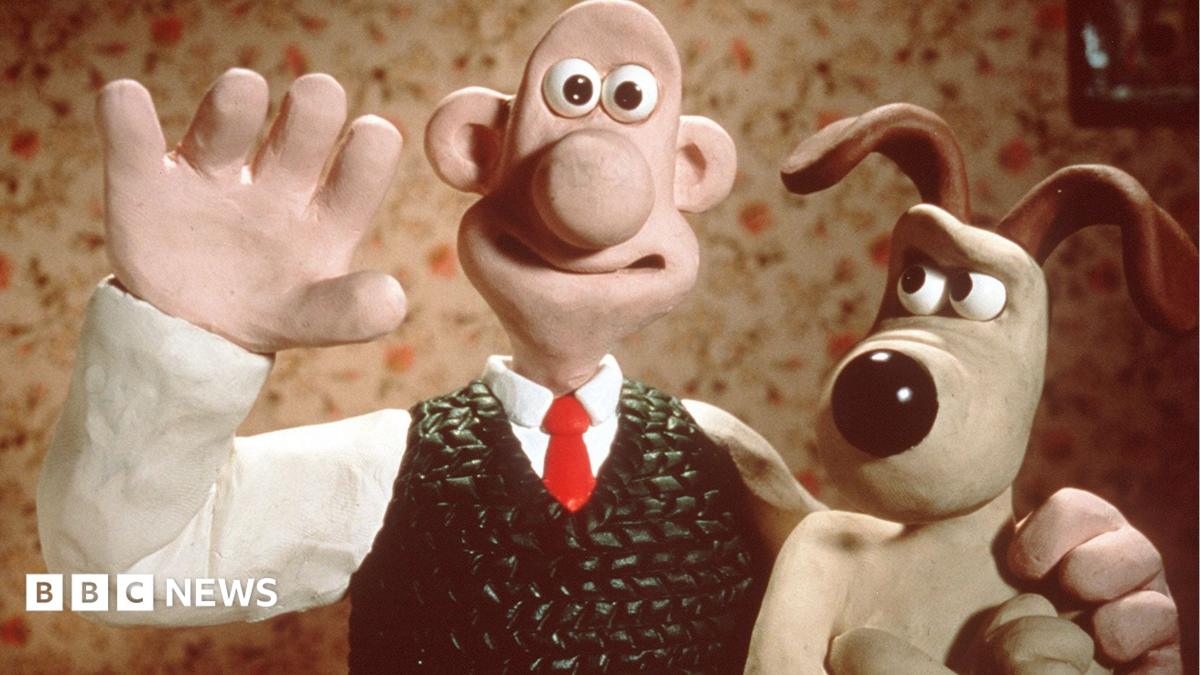
Wallace and Gromit became Aardman's most famous characters after animator Nick Park joined the studio in 1985.But Gromit was not always a dog."I had this idea of an English guy who builds a rocket, in the basement of his house," recalled Park."I was thinking he may have a pet, probably a cat."The switch was surprisingly simple."I started modelling the cat, and it was just very difficult, so I thought I'd do a dog instead!"Park was developing A Grand Day Out at the National Film and Television School in London when Lord and Sproxton came to speak to students."We met him and thought, 'Oh, he's good'. In fact, he's very good. Now I know him, he's actually a genius," said Lord.The combination was electric. A Grand Day Out was nominated for an Oscar in 1990, losing only to another Aardman production, Creature Comforts, also directed by Park.Pointing to a poster of Wallace and Gromit floating over Bristol in a hot-air balloon, Lord reflected on their appeal."When they appear on the screen, you laugh before they do anything."Park later won three more Oscars. Perhaps it was just as well he never mastered Gromit the Cat.By the mid-1990s, Wallace and Gromit had made Aardman one of the most talked-about names in animation.That success led to an unlikely meeting with Steven Spielberg.At dinner with Spielberg and DreamWorks chief executive Jeffrey Katzenberg, they pitched what became Chicken Run."We want to do The Great Escape," Lord told Spielberg."But with chickens.""I had always been a fan of Aardman," Katzenberg said. "And I had this secret ambition that someday there would be a way to work together."Park remembered Spielberg's response."Spielberg said, 'The Great Escape is one of my favourite films, and I have 300 chickens on my ranch!' So it went very well."No-one had ever made a 90-minute stop-motion feature from modelling clay. The budget was more than £20m, and Aardman insisted every frame would be shot in Bristol.The gamble paid off. Chicken Run took more than $220m (£165m) worldwide and remains the highest-grossing stop-motion film ever made."It was just so easy to squash him up and reform him as a dog, or a submarine, or a bird or anything," Lord said.Morph became a hit with children and parents alike, and remains a fixture at Aardman's Bristol headquarters.Back in 1989, Lord told a BBC West documentary The Animators he "hoped Morph will still be around in 30 years or so, and still be loved."It has been 37 years since he said that, and an Aardman exhibition at Bristol's MShed Museum was recently packed with Morph superfans.But Lord, now the studio's creative director, still comes into the office and playfully reshapes Morph while chatting.I asked him what Wallace would make of it all."Oh, he'd probably just say 'Cracking careers lads!'" he smiled.
'Gromit was nearly a cat!': Secrets from 50 years of Aardman
Full Article
Original Source
Read the full article at Bbc →KhanList aggregates and links to publicly available news content. We do not host full articles from third-party sources. Always verify important information with original sources.