
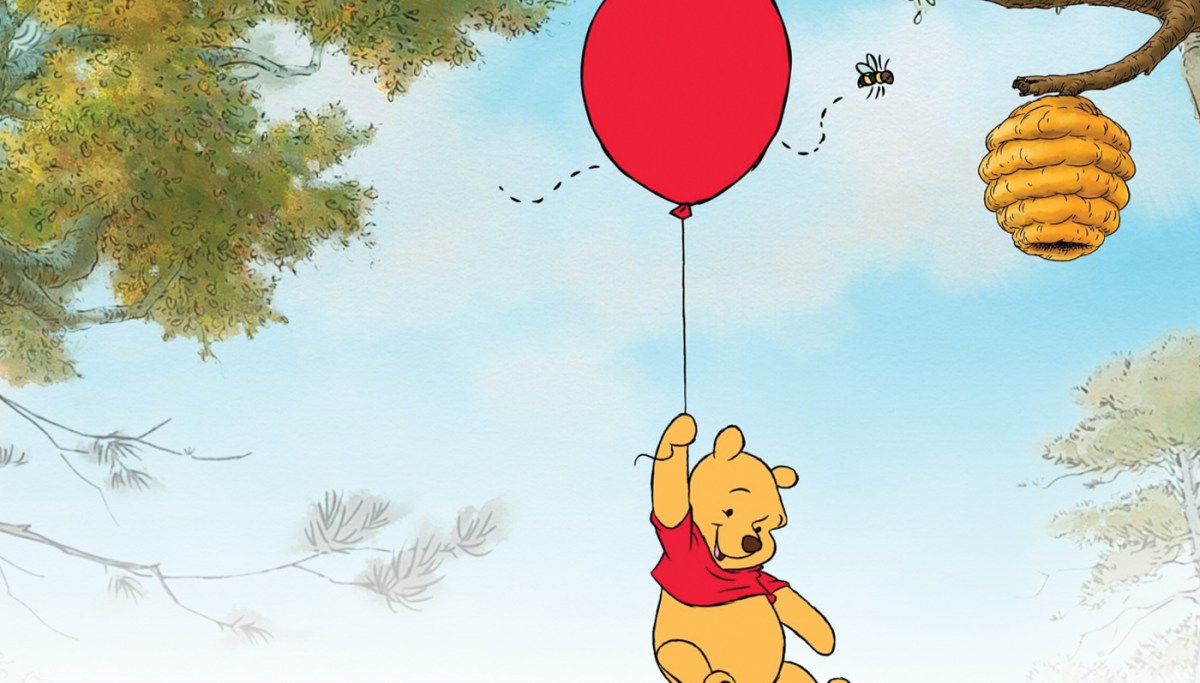
One of the most popular and beloved characters in children’s literature, Winnie-the-Pooh, recently became a centenarian. Created by the brilliant English writer A.A. Milne, the self-described “bear of very little brain” who carried a “hunny” pot and had great adventures with friends including Christopher Robin, Piglet, and Eeyore has long been a source of pleasure and amusement with young and old readers alike.Now that Winnie-the-Pooh has turned 100, it’s worth exploring what the anthropomorphic teddy bear has meant to our society — and what he still means today.Winnie-the-Pooh was first published on Oct. 14, 1926. Milne had already introduced his main protagonist in a 1924 poetry collection, When We Were Very Young. It was based on a stuffed toy he had purchased at Harrod’s department store for his son, Christopher Robin Milne, in 1921 — and which the latter had named Mr. Edward Bear. The Penguin Young Readers Group noted the book of poetry was “an immediate and huge success.” Several early articles about the teddy bear, both as Edward and Winnie-the-Pooh, appeared in publications such as Punch and the Evening News to similar acclaim and fanfare between 1924 and 1925. Winnie-the-Pooh’s origins have a surprising Canadian connection, too.(Courtesy of Disney) The starting point is Harry Colebourn, who was born in Birmingham, England, and emigrated to Canada when he was 18. He was a veterinarian who served as an officer in the Royal Canadian Army Veterinary Corps during World War I. Just before going across the Atlantic to fight for his country, Colebourn happened to come upon a hunter who was selling a female black bear cub in White River, Ontario. He purchased the cub for $20 and named her “Winnie” after his adopted city of Winnipeg, Manitoba. She traveled overseas with her new owner to Salisbury Plain, England, and became the unofficial mascot of the Fort Garry Horse, a cavalry regiment linked to the Royal Canadian Army Veterinary Corps, as well as a pet for the 2nd Canadian Infantry Brigade.Colebourn was ultimately stationed in France for three years. He wasn’t able to take Winnie with him, so he left her in the care of the London Zoo in England. While he visited “his beloved Winnie when he was on leave from France,” according to its website, “he ultimately decided that the Zoo was the best place for her to live.” Colebourn donated Winnie “permanently in gratitude for her care” in 1919, and she would become one of its favorite attractions.As fate would have it, one of Winnie’s great admirers was Christopher Robin Milne. He started visiting the black bear at the London Zoo in 1924. He became so enamored with Winnie that he changed his own teddy bear’s name from Edward to Winnie-the-Pooh.How did this young boy come up with such an unusual name?Author Christopher Klein mentioned the most commonly accepted theory in an Oct. 13, 2016, piece for History.com: It was “an amalgamation of the black bear’s name and a moniker he had bestowed upon a swan he used to feed in the morning” — there’s a brief reference to Pooh the swan in When We Were Very Young. Milne’s introduction in Winnie-the-Pooh provided an amusing additional layer: “Now this bear’s name is Winnie, which shows what a good name for bears it is, but the funny thing is that we can’t remember whether Winnie is called after Pooh, or Pooh after Winnie. We did know once, but we have forgotten.” Other theories have been presented, too. Author and columnist William Safire once speculated it may have had something to do with Pooh-Bah, a popular character in Gilbert and Sullivan’s The Mikado, but he couldn’t say this with the utmost confidence.What is clear is that Christopher Robin Milne’s infatuation with Winnie inspired his father and English illustrator E. H. Shepard to collaborate on a book of children’s stories. Winnie-the-Pooh was the main character who combined a litany of endearing qualities such as naivety, curiosity and fierce loyalty. His one human friend, a young boy named Christopher Robin, was an obvious inclusion. Some of his son’s other stuffed toys were transformed into Piglet, Kanga and her son Roo, the eternal optimist Tigger, and the pessimistic, albeit kind-hearted, Eeyore. Milne came up with Owl and Rabbit for his book series, while newer characters such as Gopher and Lottie the Otter arrived later through modern adaptations.What about the Hundred Acre Wood? That was apparently inspired by Ashdown Forest in East Sussex, England. It’s an idyllic medieval hunting forest which, according to its website, has a “rich human history from Kings and commoners to smuggling and industry dating back centuries” — the perfect place for Winnie-the-Pooh and his friends to discover nature, search for the imaginary Hefalumps, and play an occasional game of Poohsticks.The Penguin Young Readers Group pointed out that Winnie-the-Pooh, much like When We Were Very Young, “was another tremendous success” and critics hailed it as a “masterpiece.” It was released in the United States and the United Kingdom at the same time, which turned out to be a brilliant marketing strategy. Millions of readers, both young and old, have devoured the original books ever since, along with another poetry collection, Now We Are Six (1927), and the equally enjoyable second book of children’s stories, The House at Pooh Corner (1928).There was one notable exception to the rule. Far-left writer and critic Dorothy Parker thoroughly disliked The House at Pooh Corner. How do we know this for sure? She wrote in her Oct. 12, 1928, review for the New Yorker that Winnie-the-Pooh’s use of the word “hummy” as he was humming a little tune outside of Piglet’s home “marks the first place … at which Tonstant Weader Fwowed up.” Ah, there’s always got to be a killjoy in the audience!In reality, Milne’s stories and poetry collections have been a joy to read for over a century. Whether it’s Winnie-the-Pooh running out of honey and climbing a tree to get some more, searching high and low for Eeyore’s missing tail, or helping Piglet get back into his home after a terrible flood, every tale contains wonderful quotes, well-constructed passages, and meaningful life lessons. Here are a few examples: Piglet once asked his closest friend, “We’ll be Friends Forever, won’t we, Pooh?” to which the silly old bear replied, “Even longer.” This intriguing Winnie-the-Pooh line, “I always get to where I am going by walking away from where I have been,” is a simple yet effective assessment of how we all get from one place to another. There’s also plenty of wisdom in Piglet’s apt description of himself: “The things that make me different are the things that make me.”That’s why the stories of Winnie-the-Pooh and his friends in the Hundred Acre Wood have maintained a significant fan base and long-lasting appeal. BBC’s The Big Read, a survey on the public broadcaster where over 700,000 people in the U.K. voted on “the nation’s best-loved novel,” ranked Milne’s Winnie-the-Pooh, the original collection of short stories, at No. 7. It was also ranked No. 26 on the School Library Journal’s list of top 100 children’s chapter books in 2012. There was a bestselling children’s book featuring Winnie-the-Pooh and Queen Elizabeth II during their respective 90th birthdays in 2016. A Latin translation published in 1958, Winnie ille Pu, became the first foreign-language book to top the New York Times Best Sellers list. There have also been well-received modern adaptations such as David Benedictus’s Return to the Hundred Acre Wood in 2009, a star on the Hollywood Walk of Fame, U.K. postage stamps by Royal Mail, games, toys, clothing, records, Walt Disney animated films, radio serials, theatre productions, and more.Winnie-the-Pooh has succeeded in capturing and maintaining the imagination of readers for longer than other classic children’s stories such as King Arthur, Robin Hood, The Hardy Boys, Nancy Drew, and Little Golden Books. Even in this age of modern technology, where iPhones, gaming and streaming services have far more influence and impact than the printed word, Milne’s books haven’t been viewed as a “bother,” but more like a brother-in-arms.A DELIGHTFUL NEW COLLECTION OF ‘NANCY’ COMIC STRIPSHow so? Winnie-the-Pooh, Piglet, Eeyore, Christopher Robin and everyone else in the Hundred Acre Wood constantly remind us of what the innocence of childhood really is and always should be. Hours of fun playing without a care in the world, for instance. The importance of friendship and loyalty. A sense of self-discovery. Using your imagination to the fullest. Trying new things and meeting new people. Problem-solving. Learning to adapt to different situations. And, above all, an endless number of adventures to be had.Will there always be a place for Winnie-the-Pooh and his friends on our bookshelves — and in our hearts? As long as there’s plenty of honey, friendship, and adventures to go around, it certainly seems like it.Michael Taube, a columnist for the National Post, Troy Media, and Loonie Politics, was a speechwriter for former Canadian Prime Minister Stephen Harper.
Grin and bear it: Winnie-the-Pooh turns 100
Full Article
Original Source
Read the full article at Washingtonexaminer →KhanList aggregates and links to publicly available news content. We do not host full articles from third-party sources. Always verify important information with original sources.