
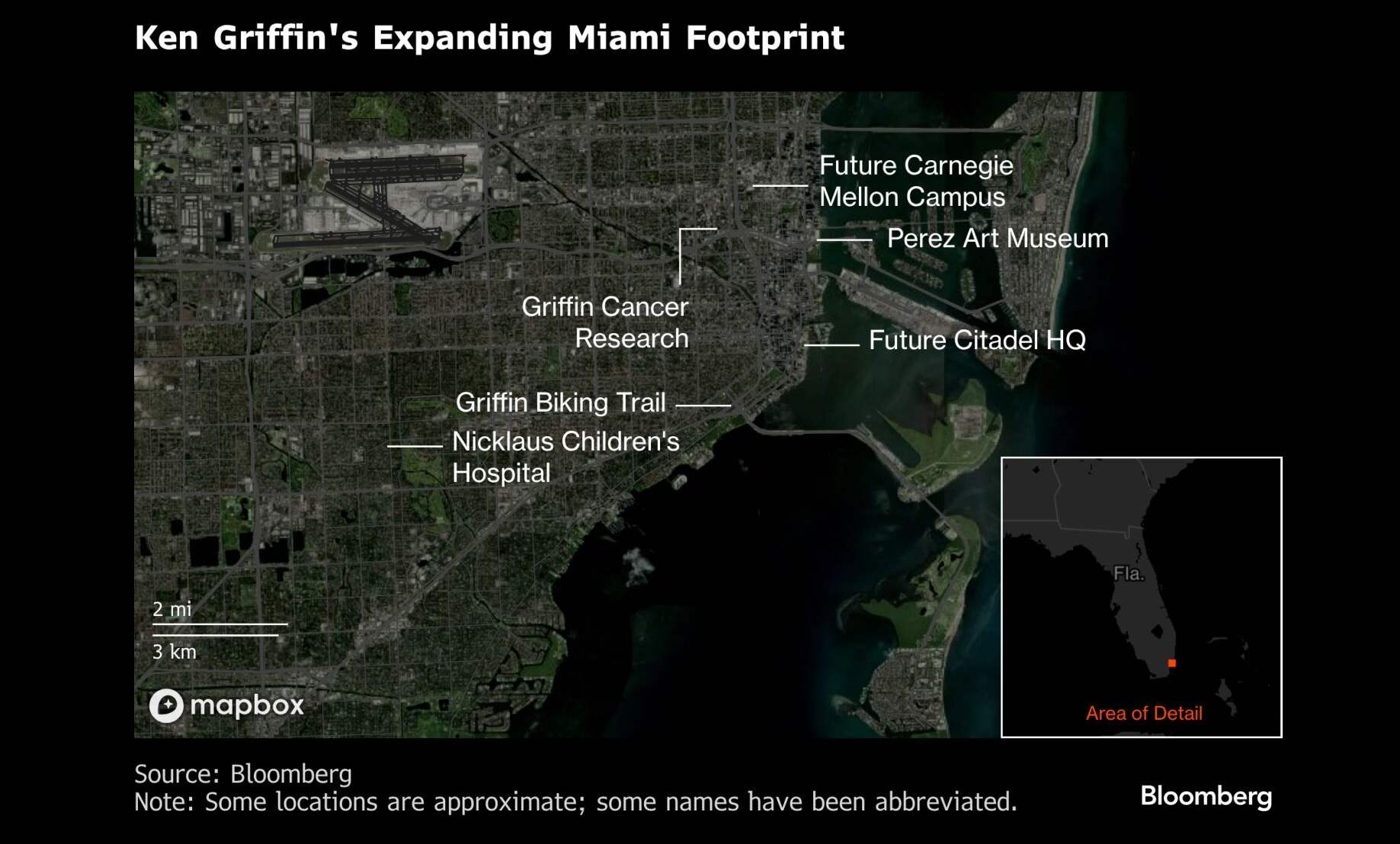
Ken Griffin has spent years trying to reshape Miami from a playground for the world’s wealthy into a high-finance and technology hub. That effort has largely centered on the city’s burgeoning Brickell financial district, where Griffin is constructing a headquarters for his Citadel empire. With a $2 billion donation to build a Carnegie Mellon University campus in Miami’s Wynwood neighborhood, Griffin is betting that he can complete the transformation. “The magnitude of this gift represents the magnitude of the aspiration,” Griffin said in an interview with Bloomberg Television. Griffin envisions the university as an educational incubator where engineering talent will be prepared to work at Citadel or to start businesses that will draw investment to South Florida for generations. CMU Miami will bring hundreds of technology companies, startups and career opportunities to the city, Griffin said in the TV interview, which will impact “both the people of Miami and the greater prosperity of our nation.” Since leaving Chicago in 2022, Griffin has taken dramatic steps to make his presence felt in Miami. He is building a multibillion-dollar headquarters for Citadel unrivaled by any company in the city, a sprawling family compound on the elite enclave of Star Island, and a private marina for his yachts. The Griffin name seems to be everywhere in Miami — a legacy of giving hundreds of millions to myriad causes and a concerted campaign to secure support from local business and political leaders. There’s the Kenneth C. Griffin Center at Baptist Health Miami Neuroscience Institute, where he has given $50 million. He has given $10 million to the Perez Art Museum Miami, where 10 paintings that he owns by the late Jean-Michel Basquiat hang in the Kenneth C. Griffin Gallery. Construction cranes near the future Carnegie Mellon University Miami campus site. Bloomberg photo. The University of Miami, where he has given $50 million, has the Kenneth C. Griffin Cancer Research Building, and Nicklaus Children’s Hospital, the recipients of $25 million, has the Kenneth C. Griffin Surgical Tower. Bikers and runners traverse the Kenneth C. Griffin Urban Trail, which the financier supported with a $5 million gift. The Carnegie Mellon extension campus speaks to Griffin’s broader plans to shape Miami’s politics, schools and economy. He has spent years talking up Miami as a safe, business-friendly refuge from Chicago, where he built Citadel and a fortune that now tops $57 billion, according to the Bloomberg Billionaires Index. During the Covid-19 pandemic, Griffin left Chicago amid deep acrimony with local political leaders over quality-of-life issues like crime. Griffin has long said that great universities are critical to Miami’s emergence as a world-class city. The idea harkens back to America’s late 19th century Gilded Age, when rich benefactors including Cornelius Vanderbilt and John D. Rockefeller founded iconic institutions like Vanderbilt University and the University of Chicago. Converting Miami into a business-forward city with elite institutions of higher learning where young people stay and build their fortunes is likely to be challenging. A recent influx of wealthy transplants has helped drive up housing costs, creating concerns about affordability. And there is unease about climate risks, from rising sea levels to more powerful hurricanes. Heavy traffic and a dearth of elite schools have also given some prospective residents pause. Additionally, Florida has been undergoing a conservative overhaul in education, led by Governor Ron DeSantis, that has alienated many academics and raised questions about the future of the state’s primary and secondary schools and its universities. “Ken Griffin is making a bet that a new university can overcome what is basically a hostile environment for intellectual freedom and creativity,” said Mitchell Moss, a professor of urban planning and policy at New York University. “Florida is a great place to live but we don’t know it’s a great place to learn.” Griffin has joined forces with another tycoon trying to reshape South Florida. Billionaire developer Stephen Ross left New York during the pandemic and turned his focus and fortune to transforming West Palm Beach into a “model city.” Griffin and Ross teamed up on a $10 million campaign to convince business leaders that South Florida is “the center for the next generation of growth.” But growing pains remain. Wealthy newcomers struggle to get spaces for their kids in Miami’s handful of top private schools, and exclusive golf and country clubs wait lists have grown to years. The region of 6 million people has dismal public transportation and infamous traffic. Griffin co-founded the Partnership for Miami, a business-led group seeking to address what they view as the city’s most pressing problems. He founded the organization alongside Miami tycoons Orlando Bravo and real estate developer Ana-Marie Codina. “Griffin and Ross have come to recognize that economic development in Miami isn’t what it is in the rest of the country,” said Ned Murray, the director of the Metropolitan Center at Florida International University. “We’ve got to do better.” –With assistance from Amanda Gordon and Janet Lorin. Copyright 2026 Bloomberg. Topics Education Universities
Griffin’s University Plan Turbocharges Miami Transformation
Full Article
Original Source
Read the full article at Insurancejournal →KhanList aggregates and links to publicly available news content. We do not host full articles from third-party sources. Always verify important information with original sources.