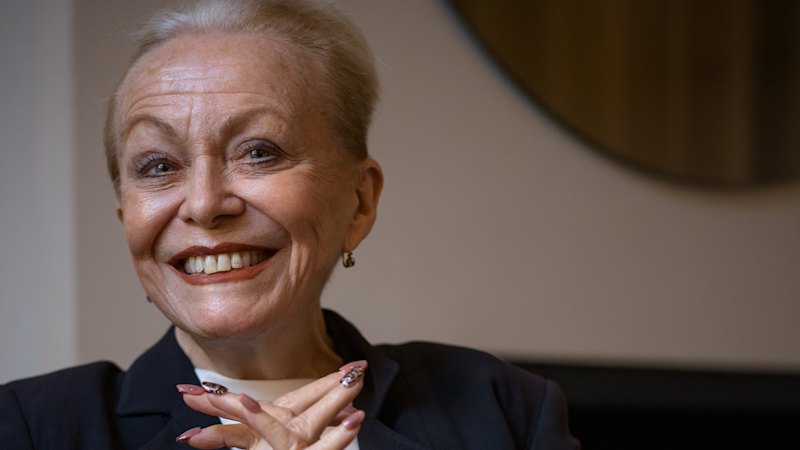
When Americans accuse Jacki Weaver of “putting on” an Australian accent, she takes it as a compliment. “They get a shock when they hear me speak,” says the acclaimed actor. “It’s very funny.”The confusion is understandable: 16 years ago, Weaver moved to the United States to capitalise on the success of David Michod’s Animal Kingdom. Her chilling performance as crime matriarch Janine “Smurf” Cody earned her a swag of awards, and she was nominated for a Golden Globe and an Oscar.Since then, Weaver, 79, has appeared in dozens of critically lauded American films including Silver Linings Playbook, The Disaster Artist and Bird Box. And she’s not slowing down: over the past 15 months, she’s filmed three movies, a TV pilot and a six-part series. “In my dotage, I’m still pedalling away,” she says.What makes Weaver’s Hollywood career even more remarkable is the fact it began when she was 63.“I’m in and out of the church because the politics bothers me,” says Weaver, who plays a nun on a mission in her new film, Holy Days.Dean MacKenzie“I would have been too shy to [pursue acting in the US] in my 20s,” she says. “It was sort of put in my lap … I never would have gotten to Hollywood if it hadn’t been for Animal Kingdom. David Michod changed my life.”Weaver has always had a gift for accents, mastering numerous English, Irish, Scottish, Welsh and Australian brogues. (When she was a girl, her English mother, Edith, enrolled her in elocution lessons after deeming her broad vowels “a matter of concern”.) More recently, she’s played characters from “California, New York and all over America”.It was a delight, therefore, to use her own accent in Holy Days, a warm-hearted comedy-drama about three nuns on a road trip to save their imperilled convent. Set in New Zealand in the 1970s, it stars Weaver as the Australian Sister Mary Clare, who lives in the decaying building with Sister Agnes (Judy Davis) and Sister Luke (Miriam Margolyes).Adapted from Joy Cowley’s novel, it tells the story of Brian Collins (Elijah Tamati), a young boy devastated by the death of his mother, Paula (played by his real mum, Renaye Tamati). Terrified by the prospect of his father marrying his new girlfriend, he finds solace in the company of the eccentric nuns.But when the trio learn that developers intend to tear down their convent, they race to the Southern Alps to seek help from a Maori nun-turned-lawyer. Brian invites himself along for the ride, hoping to find his mother at the top of her ancestral mountain, Aoraki.In her directorial debut, actor Nat Boltt – who also plays Brian’s soon-to-be stepmum, Liz – wrote the script after a conversation with her three-year-old son.“He asked me if we would die together,” Boltt has said. “It was that terrible moment when the question of death arose – how it happens, and what it means – and I tried to think of what to say to introduce this huge concept to a little person. ‘No, darling,’ I answered, ‘we won’t die together. With any luck, I’ll go first and you’ll live a long life … I’ll be there for you when it’s your time to die’.”This did little to ease her son’s mind.“He cried, then I cried,” Boltt recalled. “It sparked questions about how we, particularly in Western cultures, approach death … this idea haunts and fascinates me because it strikes at the very core of Western discomfort with mortality.”As it happens, Weaver speaks to me from Perth just three days before her third husband, Derryn Hinch, died at 82. At his state funeral in Melbourne, she honoured the man known as the Human Headline via satellite from the West Australian outback, where she is currently filming. Referring to him as “Joby” – a nickname derived from their courtship, when she called him Joe to throw others off the scent – she moved attendees to tears when she said: “I’ve loved you from the very start to the very end. Good night, sweet dreams. Good night, Joby. I love you.”“I’m of an age where I’ve seen a lot of death,” Weaver says. “I once said very lightheartedly, ‘I know more dead people than I know live people now’. But I think that’s one of the things that happens when you get to a certain age.”How did she learn to live with this grief?“I don’t think you ever totally learn to live with it,” she replies. “Grief never stops, but it slowly gets softer and gentler. I find writing about how I feel helpful. We need to weep; that releases endorphins that help our sadness. But I think the best antidote to grief is working hard.”Over the years, Weaver has often been described as “bubbly”. It’s a curious term: although it suggests a warm demeanour (which, in her case, is accurate), it also implies a tendency towards garrulousness. Yet Weaver, who was the dux of Hornsby Girls High School, is intelligent and considered. Since the start of her career, she’s been drawn to roles – many in government-funded educational films – addressing controversial topics, from workers’ rights to dissatisfied housewives being “treated” with excessive quantities of Valium.“It’s not just a pose to say that I’m introverted.”Jacki WeaverIn 1978, she won a Logie for her portrayal of postnatal depression in the Channel Nine telemovie Do I Have To Kill My Child?. The film drew the kind of ratings typically reserved for major sporting events, and Weaver found herself repeatedly stopped on the street by mothers who told her: “I thought I was the only one.”Perhaps the “bubbly” adjective reflects assumptions arising from her appearance: large blue eyes, blonde hair and a petite, 151-centimetre frame. She frequently played characters much younger than her actual age, and had to fight for the meatier roles she craved.After playing a woman with postnatal depression in a Logie-winning telemovie, Weaver was stopped on the street by mothers who told her: “I thought I was the only one.”Nine NetworkFor years, Weaver’s Wikipedia page falsely stated that she was a veteran soap star who had appeared in The Young Doctors and racy series such as The Box and Number 96.“But I’ve never been on a daily serial and I’ve never followed them,” she says. “I’m not having a go at the genre; it just never happened. Wikipedia gets a lot of things wrong. They also said I divorced Derryn twice and I didn’t; we only had one divorce. It was ridiculous … one of my young friends got on there and corrected it.”In fact, Weaver and Hinch married in the early 1980s and separated in the mid-1990s before renewing their vows shortly after. They divorced in 1998 but remained exceptionally close, often speaking a few times a day. (“He texted me the night that he died,” she said in her video tribute at his funeral.)As she recounted in her 2005 memoir, Much Love, Jac: “Countless magazine and newspaper articles over 24 years have bleated: how can she love him? Why? Many women have loved Hinch, and many women still love him and they understand. The corny but unavoidable truth is that I fell for him totally on our first date – a Melbourne Football Club function, of all things, surrounded by Aussie Rules officials at a fundraising dinner.”Since 2003, Weaver has been married to South African actor Sean Taylor, her fourth husband. (She has one son, Dylan, from her relationship with English producer John Walters, who was almost 30 years her senior.) Although she never wed Richard Wherrett, she considers the late theatre director one of the great loves of her life.Weaver in the early 1970s.Lee Pearce“You should have seen him in the ’70s,” she told Good Weekend in 1998. “He was so handsome, as well as charming and funny and good fun and affectionate. Everything except heterosexual.”Weaver lived with Wherrett as he was dying from HIV-induced liver failure in 2001, nursing him in his final days. When I ask about her capacity to maintain close friendships with former partners, she jokingly deflects by stating: “I’m a really nice woman [but] I don’t think I have a right to give marital advice to anybody.”Those who know her, however, often remark on her kindness.“I’ve been unkind many times before and hated myself for it,” she admits. “But I do think kindness is missing at the moment all around the world. I think it’s the most important virtue because it leads to fulfilling all the other virtues.”Like many actors, Weaver is an introvert. At parties, she and her husband will find a quiet corner and chat to each other – until her manager nudges her to “get out there and circulate”.“If you can immerse yourself as much as possible in [a character], it gives you a great understanding of how the world works,” she says. “It’s not just a pose to say that I’m introverted. I’ve done tests and I’ve got friends who are psychologists, and they’ll all tell you, ‘Yes, she’s an introvert’.”The same could be said of her character in Holy Days. Sister Mary Clare is astute, wise and determined – yet her quiet nature means these virtues are often overlooked by others. “She’s a shrinking violet for much of the film, because she’s been put upon by stronger people her whole life,” Weaver explains. “She’s one of those people who’s been hiding her light under a bushel, but then she comes into her own because of the circumstances.”When Mary Clare was young, her convent was the heart of the local community. But as broader social shifts led to the diminution of religion in people’s daily lives, it fell into disrepair. Mary Clare is left feeling daunted and overwhelmed, as though the ground is shifting beneath her feet.From left: Judy Davis, Eiljah Tamati, Miriam Margolyes and Weaver in Holy Days.Kismet“I think people will identify with that,” Weaver says. “A lot of us tend to live quiet lives and then suddenly change is thrust upon us. How we cope with that is a measure of our character.”For Weaver, the chance to work with Davis, 71, and Margolyes, 85, was too good to pass up.“These three nuns [we play] don’t have blood family; they are each other’s family and I find that very, very moving,” she says. “But I wouldn’t be a good proselytiser for the church because I’m sort of like a boundary rider. I’m in and out of the church because the politics bothers me. I grew up Anglican and I find the Episcopalian church [as the Anglican Church is known in the US] very wise and sensible in America. Having female priests and allowing priests to marry is really important, and I think that’s where the Catholic Church is treading on its own toes.”Weaver’s chilling portrayal of crime matriarch Janine “Smurf” Cody in the 2010 Australian film Animal Kingdom helped launch her Hollywood career.Sony Pictures ClassicsWeaver was born in 1947 in the Sydney suburb of Hurstville. So speedy was her arrival that her mother gave birth to her in the hospital foyer.Her father, Arthur, read Shakespeare to his daughter from a young age. “I learned to read from about three or four,” says Weaver, who has a younger brother, Rodney. “I’ve always loved to tell stories; pretending to be someone else and looking and speaking differently.”She believes her parents knew she’d become an actor before she did.“I was an odd and eccentric child from the moment I could speak, and I think they just accepted that’s what I was going to do,” she recalls. “It was a foregone conclusion from when I was a toddler.”Weaver scored her first professional role in a 1962 pantomime at the Phillip Street Theatre, earning £30 a week to play Cinderella, an enormous sum for a schoolgirl. But it wasn’t the money that dazzled her; she simply fell in love with performing.A decade later, she was cast in David Williamson’s play The Removalists, a brutal commentary on male violence. Weaver, who also starred in the 1975 film adaptation, played a woman mercilessly beaten by her husband.Weaver has appeared in almost 100 stage productions including The Blonde, The Brunette & The Vengeful Redhead in 2005.Stuart Campbell“The audience was very close to the stage, and there was a violent fight where fake blood was being thrown around,” she says. “If you were too close, you’d get hit with blood, which was quite nauseating. And this poor woman who was pregnant rushed downstairs and vomited in the foyer.”Weaver happened to be the only cast member not on stage at that moment, so it fell to her to clean up the mess. “The cast used to sell the tickets, make the costumes, clean the toilets – everything,” she says.To describe Weaver’s creative output as prolific is an understatement: she has appeared in more than 50 films (including Australian classics such as Alvin Purple and Picnic at Hanging Rock); more than 50 TV series (from Homicide to the American neo-Western drama Yellowstone); and almost 100 stage productions (including A Streetcar Named Desire, Ben-Hur and Death of a Salesman).Surprisingly, she doesn’t always watch her own movies and TV shows. The 2018 post-apocalyptic thriller Bird Box is a case in point: while she loved working on the film, she opted not to see it because she hates feeling frightened.It was a different story with Holy Days, which Boltt had spent a decade bringing to fruition.“That’s one of the reasons I wanted to do it,” Weaver says. “I love young directors who toil away, never lose faith and finally get their films up. Without those people, we’d miss out on some really good films.”Holy Days is in cinemas on August 6.To read more from Spectrum, visit our page here.Want more movies and TV?Sign up to our Screening Room newsletter for must-see movies, interviews and film news.Get The Watchlist newsletter for the latest TV and streaming recommendations.Stop scrolling and try this: Why it pays to immerse yourself in a good TV series or film.It may offend the book’s rusted-on fans, but Netflix’s My Brilliant Career series should be approached with an open mind.
‘Grief never stops’: Jacki Weaver on love, loss and the antidote to sadness
Full Article
Original Source
Read the full article at Smh →KhanList aggregates and links to publicly available news content. We do not host full articles from third-party sources. Always verify important information with original sources.