
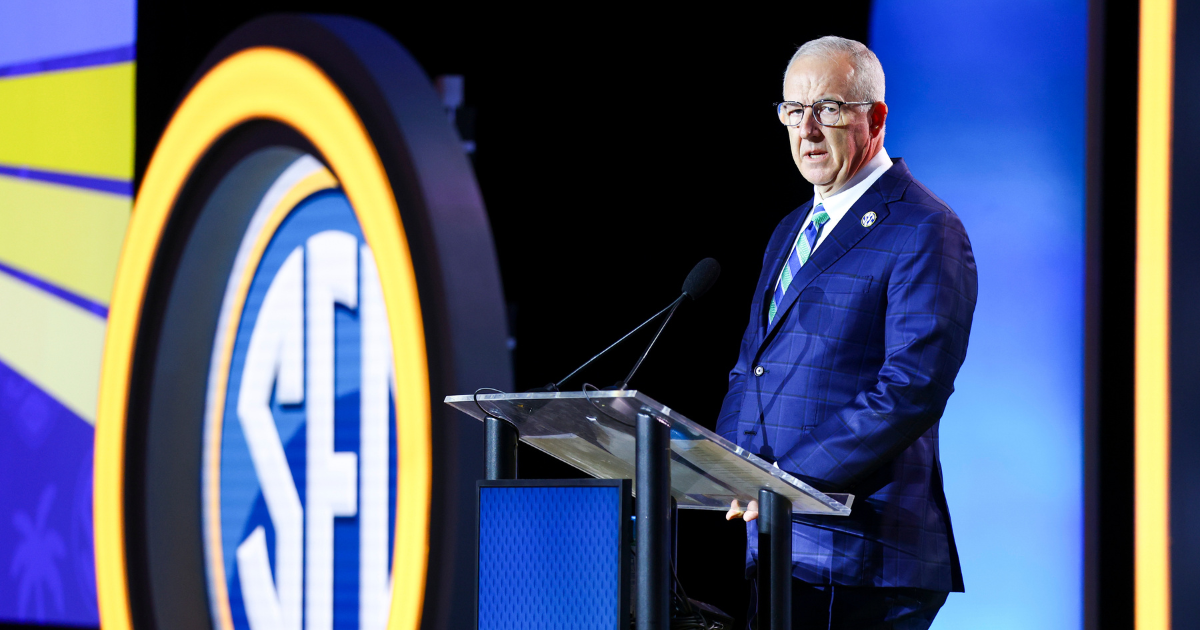
Talking season offers a stage for head coaches to market their programs with an assortment of media hits and one big state of the program address. That’s what gets most of the attention at SEC Media Days but the most important words typically come from the commissioner. That was true once again in 2026. Greg Sankey covered a lot in his opening address. At the Tampa Marriott Water Street and JW Marriot on Monday morning, Sankey opened his 12th football season as the leader of the Southeastern Conference by dishing on the need for legislation, the conference’s new schedule model, the recent chatter about the conference taking on self-govenance, and the status of conference championship games with more playoff expansion right around the corner. This is what KSR learned in Baker Mayfield‘s town. The SEC is still calling for help from Congress The Wild West era of college athletics has not gone away. Transfer portal, NIL, and the abolishment of the amateurism model has brought sweeping changes that no one was ready for. Leaders quickly decided that the best path forward was to go to Capitol Hill and lobby for congressional help. That has turned into a half-decade of going to Washington D.C. and trying to get a bill passed while also working on the House settlement. That ultimately led to the SCORE Act failing in the House of Representatives. Despite the failures, the SEC is still all-in on pushing for legislation instead of shifting to a model of player employment and collective bargaining. One of our greatest responsibilities is to establish a stable national framework for college athletics. For more than six years those of us in the conference office, the leaders on our university campuses, Southeastern Conference student-athletes and policy makers have worked in good faith seeking the return of national standards through federal legislation. These efforts have demonstrated not only how complex these issues have become because also have reinforced my belief that Congressional action remains a needed path to provide that long-term stability. At its core, it sounded like a straightforward objective. One national standard, a national framework with rules that can be consistently enforced, because student-athletes, coaches and universities deserve to compete under consistent standards, regardless of geography. Greg Sankey The SEC is not changing its tune on these matters. That has been the case since the COVID-19 season ended and NIL took off. After being all-in on the SCORE Act, the SEC is now publicly supporting the Protect College Sports Act despite having some issues with the pooling of media rights presented in the initial version of this bipartisan bill. “We appreciate the tremendous efforts that have gone into these legislative drafting initiatives,” Sankey said. “We’re engaged specifically now in ongoing dialogue around improving the Protect College Sports Act.” “That Senate bill contains many provisions that we support and we think are both healthy for college athletics and the participants in college athletics.” The SEC likes that the new bill provides scholarship protection, oversees agent activity, and rules on transfer eligibility. Sankey made it known multiple times that the SEC supports this new legislation but does want some changes made. The league is asking for four principles to be a part of the proposal: national standards, national framework, transparency and accountability, and fair and consistent standards. That will allow college athletics to enforce rules with no threat of outside litigation, replace the creation of patchwork state laws created to make players eligible, eliminate loopholes for lawsuits, and have no mandated outcomes in the bill. We are not on Capitol Hill but Sankey was wearing his lobbying hat in the Sunshine State. The SEC is not ready to quit the push for Congressional help despite needing some alterations made to the latest bill. The more things change, the more they stay the same. SEC is discussing self-governance The SCORE Act failed. What happens if the Protect College Sports Act fails? The SEC could need to find an alternative plan. There are essentially no rules being forced right now. Greg Sankey and the SEC may take matters into their owns hands in the near future. A recent report said that the SEC was discussing self-governance as an alternative option in the future. Sankey confirmed that on Monday. So they’re real. People have talked about that. They’ve opined about the frustrations that bring them to the point of saying we should look at something significantly different. I do not believe that is a leverage point. I think that’s just honest communication. What I think is important is those comments represent a high level of frustration with the circumstance in which we find ourselves. We have regulated ourselves more progressively than other colleagues by choice, across our league. We’ve had different academic eligibility restrictions in the past. So we have different transfer restrictions in the past. Greg Sankey The SEC famously would not allow intraconference transfers during the spring portal window. Sankey has a background in compliance that led former SEC commissioner Mike Slive bringing him to Birmingham. The league seems open a self-governance break off if it comes to that and is at least entertaining building a structure to enforce rules and regulations. It would likely be spearheaded by the commisioner. What happens with the Protect College Sports Act will determine the next move for Sankey and SEC leadership. A surprising twist could be self-governance. That would be quite the experiment in a league known for pushing the envelope when it comes to rule following. Defending the new scheduling model The SEC will finally play a nine-game schedule in 2026 after years of debate and negotiations both inside and outside of the league. That will create some more compelling television inventory for Mickey Mouse but it will add an extra loss at least eight teams in the conference. That could ultimately hurt playoff resumes. With no playoff expansion arriving in 2026, some coaches have been outspoken about this move. There’s some frustration within the conference. Greg Sankey went on the defense in Tampa. We and I recognize that a nine-game Southeastern Conference football schedule, coupled with our expectation that we maintain a high-quality non-conference opponent, creates one of the most — in fact, I’m going to scratch what I wrote. It creates, without question, the most demanding sets of football schedules in all of college football. But these decisions were made after years of thoughtful discussion, careful analysis, and spirited debate, which led us to the conclusion that the nine-game schedule was appropriate. The nine-game schedule reflects confidence in our universities, our student-athletes and in our football programs. It preserves great rivalries, historic rivalries, many of which are played every year. It creates more compelling conference matchups and reinforces our long-standing commitment to competitive excellence. When you look at our schedule, no one has created the kind of weekly competition that exists in the Southeastern Conference. It’s competition that our fans will experience every week because we believe we’re the best conference in college football. If so, we should also embrace the challenges with a difficult and challenging conference schedule, the best schedule in college football. It will challenge our teams. It will prepare them for the highest level of competition. It reflects who we are as a conference. Greg Sankey The SEC has not had a team reach the national championship game since Georgia obliterated TCU to end the 2022 season. Sankey shared that this league remains the best in the sport at SEC Media Days. The conference is the most watched and the numbers continue to say that is the best from top-to-bottom, but that also means more losses and perhaps weaker resumes when adding another league game will arrive in 2026. Getting to this point was not an easy feat for Sankey and there are some skeptical of this move. The commissioner believes it was the best for the brand. We’ll find out in the very near future if that is true. The SEC Championship Game could be ending soon. The 35th SEC Championship Game will take place this December in Atlanta. One of the league’s most transcendent ideas has turned into one of the biggest events in the sport. The creation of this game ultimately changed how all conferences scheduled. The game has been a college football staple for decades. But things change. College football leaders — mainly Greg Sankey and Big Ten commissioner Tony Petitti — must come to an agreement on the new playoff format. That has not happened yet but the expectation is that it will happen. The added playoff games mean that a subtraction of games must come from somewhere else. A sacrifice must be made. It sounds like conference championship weekend could be that sacrifice. I think even the move to 12 has created pressure around championship games. We’ve talked through the factors that support the pro list, and we’ve talked about some of the con list, the negatives that need to be considered. And we have some time. We will have a conference championship game the first Saturday in December of 2026. We have contracts and plans in place well beyond that. But we have time for consideration. One of the factors for us is what will happen with that College Football Playoff. Greg Sankey Nothing will be final until agreement about the new playoff model arrives. Things can change, but the trend meters are telling us that the tentpole event in Atlanta could coming to an end soon. Playing a championship game just does not seem feasible in college football’s new world order that could include winning four playoff games or more to take home a national title.
Greg Sankey’s 2026 State of the SEC: Pushing for federal legislation, defending the schedule model, and current state of conference championship games
Full Article
Original Source
Read the full article at On3 →KhanList aggregates and links to publicly available news content. We do not host full articles from third-party sources. Always verify important information with original sources.