
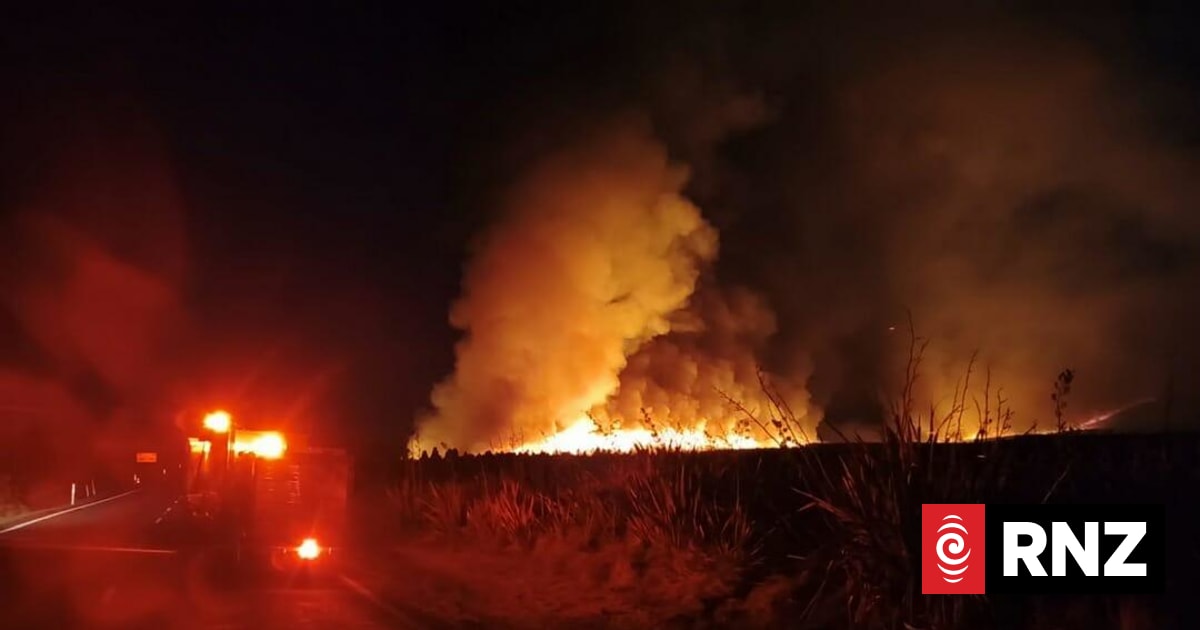
Greenhouse gas levels in the atmosphere hit record heights last year, a new global report says.The World Meteorological Organization (WMO) released its annual Greenhouse Gas Bulletin for 2025 overnight, showing that concentrations of all three major greenhouse gases - carbon dioxide, methane, and nitrous oxide, have continued to grow.Carbon dioxide, which persists in the atmosphere for millennia, has reached a concentration of 426.8 parts per million - a 13 percent increase since the first bulletin was published in 2004 and a 153 percent increase on the 1750 pre-Industrial level.The report is published each year just before the annual climate change Conference of Parties (COP), which kicks off this year in Antalya, Türkiye on 9 November.Earlier this month, New Zealand's own greenhouse gas monitoring - which feeds into global records and the WMO report - found concentrations at the monitoring station at Baring Head in Wellington had also hit record levels.The WMO warned that the rate of increase was also speeding up over time, and that the "exceptionally strong" El Niño this year is likely to make the problem worse."Every additional part per million matters because it traps additional heat," WMO deputy secretary-general Ko Barrett said."In effect, we are supercharging the ocean and the atmosphere. That means that heatwaves, tropical cyclones, and rainstorms are intensifying faster than our historical baselines prepared us for."Flooding in Kaikōura amid a red heavy rain warning in July 2026 (file photo). The WMO report said the atmosphere is being supercharged leading to more rainstorms, tropical cyclones and heatwaves.RNZ / Nathan McKinnonThe increase in 2025 was slightly smaller than the previous year, partly because forests and other land-based carbon sinks had had time to recover from a strong El Niño in 2023/2024, Barrett said.However, that sounded a warning for this year, she said."The exceptionally strong El Niño in 2026 sets the stage for another surge in CO2 levels. The risks of reduced CO2 uptake by a warming ocean are also increasing."El Niño creates hotter, drier, windier conditions on this side of the Pacific, including in New Zealand - although it is felt more strongly in countries like Australia and Indonesia.That can drive drought and wildfire, limiting and even reversing the uptake of carbon dioxide by forests and wetlands.Analysis that New Zealand scientists from Earth Sciences New Zealand (ESNZ) contributed to in the report showed that methane from wildfires in 2023 increased enough to change the 'fingerprint' of the gas in the atmosphere between 2023 and 2025."This is not just a blip in the atmospheric record," ESNZ atmospheric scientist Peter Sperlich said."This is the first time that wildfires have become so big that they've released methane at a level we can detect in methane ... records at global scale."Methane is a short-lived gas but has incredible warming potential over the few decades it persists in the atmosphere.Sperlich's colleague, ESNZ changing atmosphere chief scientist Sara Mikaloff, said their research showed the potential for large-scale wildfires - themselves driven by climate change - "to drive an even greater increase in global methane emissions and accelerate climate change"."The more quickly we act to reduce emissions, the more straightforward it will be to stabilise climate."
Greenhouse gas levels again hit record high in 2025
Full Article
Original Source
Read the full article at Rnz →KhanList aggregates and links to publicly available news content. We do not host full articles from third-party sources. Always verify important information with original sources.