
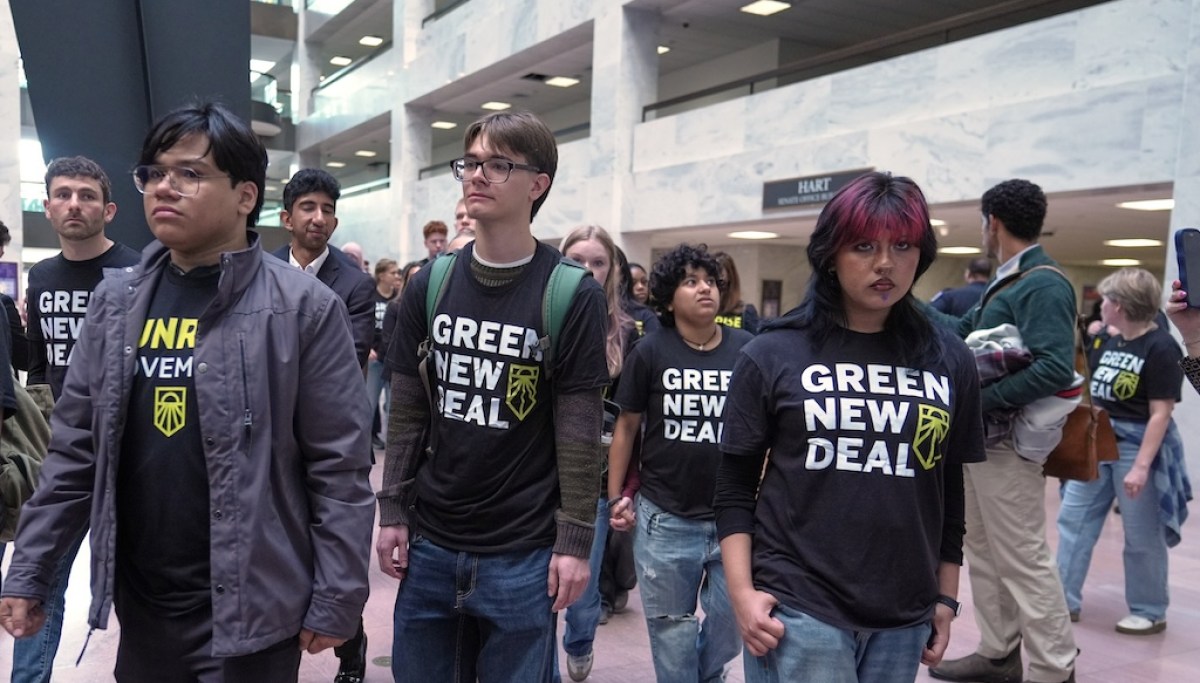
Green groups are scrambling to convince on-the-fence Democrats in the House of Representatives to kill the Senate-passed bipartisan bill that would overhaul bedrock environmental laws to make it easier to build energy and infrastructure projects.The left-of-center organizations are hoping that they can block the bill, the Bipartisan American Affordability and Jobs Act, by leveraging growing opposition amongst House Democrats, a packed calendar, and Republican absences when Congress returns after the Thanksgiving holiday.But they have only a few days to rally opposition, as the bill’s sponsors aim to get it to President Donald Trump’s desk quickly. SENATE PASSES HISTORIC BILL TO CUT ENVIRONMENTAL RED TAPE ON ENERGY PROJECTSWith the bill having passed the Senate, one environmental group lobbyist involved in the discussions, who was granted anonymity to speak freely, described the next few days and possibly weeks as the “only chance” to delay the bill, or broader permitting reform, to the next Congress.“It’s the last stop before it goes to Trump’s desk,” they said.Better known as BAAJA, the bill passed the Senate last week in a 62-33 vote, with 14 Democrats and one independent who caucuses with Democrats voting in favor of the legislation.The legislation would accelerate federal permits and approvals for projects such as pipelines, power lines, renewable energy projects, and more. Proponents of the bill — on both sides of the aisle — argue that these laws have created unnecessary red tape, making it difficult to build in the United States because of the threat of legal challenges and regulatory delays.The bill has support from some climate hawks, such as co-sponsor Sen. Sheldon Whitehouse (D-RI), who argue that it would allow for more transmission infrastructure to be built, allowing more clean energy to be connected to the grid, accelerating the phase-out of fossil fuels, and slowing the rise of greenhouse gas emissions.But it would speed up construction in large by overhauling some of the oldest environmental laws on the books, including the National Environmental Policy Act, the Clean Water Act, the Endangered Species Act, and the National Historic Preservation Act.That is a step too far for a range of environmentalists and tribal groups, such as the Sierra Club, Natural Resources Defense Council, and Earthjustice, who say that the harms caused by the changes to the environmental laws would outweigh the benefits of the bill.HERE’S WHAT’S IN THE BIPARTISAN MEGABILL MEANT TO ALLOW THE US TO BUILD AGAINBigger chamber, bigger challenges The House has 435 voting members (setting aside vacancies), more than quadrupling the number of lawmakers lobbyists have to target compared to the Senate.“With the Senate, there are just fewer members, so having one-off meetings with each office and going into each office was the play,” another lobbyist involved in discussions said, calling the House “a whole different animal in a lot of ways.”While several Democrats have voiced their opposition to the legislation, hundreds of lawmakers have remained silent on it.“Over 200 Democrats have said nothing yet,” the lobbyist said, calling it a “black box.”“We’re trying to do the most high-impact things that we can to get as much paper in front of as many people as possible,” the lobbyist added.Yet most members of the House have already left Washington, D.C., for Thanksgiving. This is forcing groups to rely on phone calls and emails to plead their case.A lobbyist with a conservation nonprofit group, also granted anonymity to speak freely, told the Washington Examiner that phone calls are “not enough” to get the message across.“I’m reaching out to offices where I have close staff-level relationships for those kinds of conversations,” the lobbyist said. “I’m sending our opposition statement to every House Dem office and Republican office, just so they have that basic level of information.”Some organizations have moved to directly partner with vocal bill opponents in the House, such as Reps. Jared Huffman (D-CA) and Melanie Stansbury (D-NM). Both Democrats joined groups such as Earthjustice, the Natural Resources Defense Council, and the Wilderness Society on a press call this week to appeal to members to reject the bill.Others are also highlighting modeling of the economic and environmental impacts of the legislation. But that isn’t always helpful for their message, since some analyses have found the measure would lower costs and cut emissions.“A lot of folks in the Senate and beyond are talking about this bill as a way to address affordability, and I can understand the appeal of that,” Lisa Frank, executive director of Environment America, told the Washington Examiner. “It’s certainly something voters are concerned about.”Frank said most of the modeling conducted, however, has focused on specific provisions, not the legislation as a whole. She pointed to research conducted by the Rhodium Group earlier this month, which estimated that BAAJA would lower electricity bills by $50-$78 annually in 2040.For Frank, that still feels like a “terrible trade-off” for the changes to environmental laws.Another tactic groups are using is pointing to the fact that the legislation has moved so quickly through Congress, as the text was only released at the end of September.The conservation nonprofit lobbyist told the Washington Examiner that a bill of this size and importance should have more time for consideration, deliberation, and public engagement.“The bill has definitely not had enough time for staff to wrap their heads around it,” the lobbyist said.Ticking clock Since BAAJA passed the Senate, several organizations said they were concerned that House Speaker Mike Johnson (R-LA) would try and move the bill under suspension of the rules as soon as the Monday after Thanksgiving.This fast-tracked procedure would allow Republicans to pass the bill quickly, limiting debate on the floor and blocking floor amendments. Under this process, they would need to secure a two-thirds majority vote to successfully pass the bill.Not only would Republicans need a significant number of Democratic votes, they would also need to ensure each of their members returns to Washington after the holiday.Johnson was forced to postpone a vote last week because there weren’t enough members in town. On Friday, the Republican leader issued a letter to the caucus asking everyone to return to Washington after the holiday.Meanwhile, more liberals in the House Democratic Caucus have expressed their opposition to the bill as written, including Reps. Mike Levin (D-CA) and Sean Casten (D-IL).House Republicans appeared to feel the pressure of absences and a lack of Democratic votes earlier this week, with Punchbowl News reporting Tuesday evening that leadership was planning to bring the bill forward under a rule, requiring a simple majority vote to pass.The vote, now expected next week, could be complicated further, as Politico reported some Democrats are seeking an open amendment process on the bill. If successful, this would send the legislation back to the Senate for consideration with just three weeks left on the legislative calendar.Passing BAAJA at that stage would grow even more difficult, as both chambers are still considering multiple must-pass measures. This includes government funding and the National Defense Authorization Act.“There’s so many more important must-pass, expiring bills that should be part of the lame duck,” said the environmental group lobbyist, who also doubted that there is any pathway to amend the bill in a meaningful way.“It is not credible to think that there is an opportunity to debate on amendments and fix the most harmful positions,” the lobbyist said.Momentum from the Senate When BAAJA passed in the Senate last week, more Democrats voted against the legislation than negotiators had hoped, in part because they were unable to put any Republican or Democratic amendments to a vote on the floor.Negotiators attempted to put together a package of amendments to vote on, but they were stymied by Sens. Ron Wyden (D-OR) and Jeff Merkley (D-OR).The two Democrats blocked amendment votes to demand provisions cracking down on data centers and retaining certain environmental protections. Some fellow Democrats accused Merkley of purposefully tanking the bill, as their colleagues in the House would be wary of supporting the bill without tweaks.And while several green groups would have liked to see changes made to the legislation, they plan to use the existing text to their favor to block the bill entirely.“There were some minor technical amendments … but none of the substantive changes that people were seeking,” the conservation nonprofit lobbyist said. “I think it’s a lot less likely that House Democrats would support it in the absence of an amended version.”GREEN GROUPS SPLIT AS PERMITTING REFORM BILL CREATES FORK IN THE ROAD Frank told the Washington Examiner that Environment America hopes House members will realize that “there aren’t going to be significant changes made.”“They should reject this deal and start again to make a much better one,” she said.
Green groups plot last stand against permitting reform bill in the House
Full Article
Original Source
Read the full article at Washingtonexaminer →KhanList aggregates and links to publicly available news content. We do not host full articles from third-party sources. Always verify important information with original sources.