
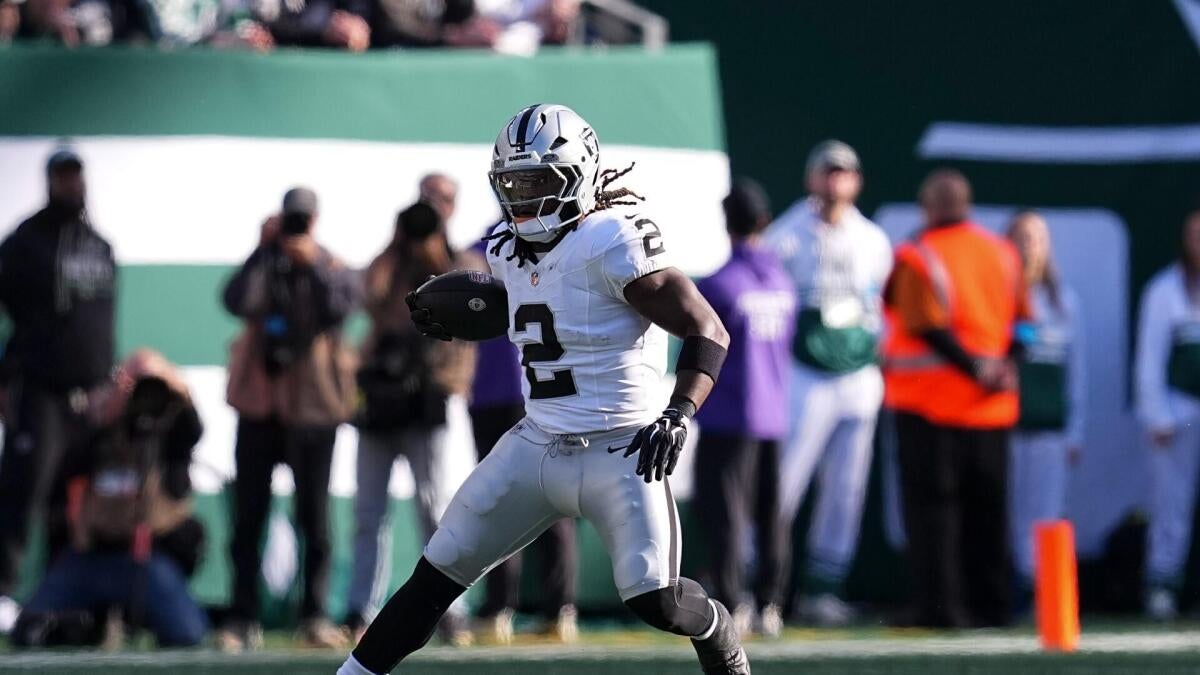
The Raiders drafted Ashton Jeanty sixth overall in 2025 because they believed he could transform their running game. Twenty-five games later, they're giving the ball to a fourth-round rookie instead.Jeanty had just two carries for nine yards in the Week 8 win over the Jets. Mike Washington Jr., the Raiders' fourth-round pick this past April, had 25 carries for 83 yards. Jeanty's workload has declined or remained unchanged every week this season, from 23 carries in Week 1 to two against New York last Sunday.And according to ESPN's Dan Graziano, the Raiders initially believed Jeanty's preseason ankle injury contributed to his struggles. But he's been healthy enough to practice and play, and the team wants to see more. Las Vegas hopes the reduced workload serves as a wake-up call and is prepared to keep giving Washington more carries if Jeanty doesn't respond. Perhaps just as telling: First-year coach Klint Kubiak wasn't there when the Raiders drafted Jeanty, and he clearly doesn't feel an obligation to play him.Meanwhile, in Arizona, Jeremiyah Love's rookie season has gone from disappointing to downright frustrating. The Cardinals selected him third overall in April, making him the highest-drafted running back since Saquon Barkley went No. 2 in 2018. Love has 268 rushing yards and one touchdown in six games, averaging just 3.5 yards per carry. And now he's headed to injured reserve with a high ankle sprain, his second ankle injury of the season.To be clear, this isn't about labeling anyone with the "B" word just yet. Jeanty has dealt with injuries and an offensive line that has been, to put it kindly, inconsistent. He's also been productive as a receiver (though that's not why you draft a running back sixth overall). Love, meanwhile, hasn't been healthy enough to weigh in on much of anything beyond this one question we keep coming back to:How exceptional does a running back need to be to justify a premium draft pick, and how often do teams actually get it right? Because it's not just about whether the running back can play. It's also about who else was available.The price of passing on somebody elseLet's start with Jeanty.After Las Vegas took him sixth overall, the next three selections were right tackle Armand Membou, wide receiver Tetairoa McMillan and left tackle Kelvin Banks Jr. The Raiders also passed on guard Tyler Booker, who went 12th.And it's not like 2025 was short on running backs. Quinshon Judkins went 36th and TreVeyon Henderson 38th. Both had productive rookie seasons, with Henderson finishing just 189 scrimmage yards behind Jeanty despite 86 fewer carries. Would Las Vegas have been better off drafting Membou or Banks or Booker, bolstering the offensive line and addressing running back later? We can't answer that definitively after a season and a half. But given the Raiders' offensive-line problems, it's certainly reasonable to ask.The same applies to Arizona. After Love went third, WR Carnell Tate, LB Arvell Reese, CB Mansoor Delane and LT Spencer Fano were taken with four of the next six selections. All were, to varying degrees, positions of need for Cardinals. None were running backs.And history offers some reminders about the consequences of getting that decision wrong. In 2017, Jacksonville selected Leonard Fournette fourth overall. Six picks later, Kansas City drafted Patrick Mahomes. Marshon Lattimore went 11th and Marlon Humphrey 16th. Meanwhile, Dalvin Cook went No. 41 overall, Alvin Kamara 67th and Kareem Hunt 86th.Fournette wasn't a bust. He rushed for more than 1,000 yards twice in Jacksonville. But Kamara, selected 63 picks later, actually outproduced him over their first three seasons. A year later, the Giants drafted Barkley second overall. Quenton Nelson went sixth, Josh Allen seventh and Minkah Fitzpatrick 11th. Nick Chubb lasted until the second round.Barkley became one of the league's most talented running backs and eventually won a Super Bowl with the Eagles. But remember, Eli Manning was 37 when the Giants drafted Barkley, and GM Dave Gettleman passed on the opportunity to take his eventual replacement. Josh Allen was still available. A year later, New York used the sixth overall pick on Daniel Jones, who replaced Manning after just two games in 2019. So the Giants got a terrific running back, but at what cost? They could've had their franchise quarterback in 2018 and waited until Round 2 for Nick Chubb. And then there's Ezekiel Elliott. Dallas drafted him fourth in 2016, immediately ahead of CB Jalen Ramsey, LT Ronnie Stanley and DL DeForest Buckner. Derrick Henry went 45th.Elliott was terrific. He led the NFL in rushing as a rookie, helped Dallas win 13 games and managed more than 5,200 scrimmage yards in his first three seasons. And that's what makes this a nuanced conversation. Even when a team gets the running back right, it can still be fair to question whether the pick was the best use of its resources.Of course, hindsight makes every draft look easier. Nobody knew exactly how those careers would unfold, and finding the next Henry or Kamara isn't as simple as pointing to their names years later. What are the odds of actually landing a great running back?We looked at all 53 running backs drafted in the first round from 2000 through 2023, measuring their production over their first three NFL seasons. Twenty-nine, or 54.7%, had at least 3,000 scrimmage yards. Only 11 reached 4,000, and just seven topped 5,000.That's roughly one in five reaching 4,000 yards and fewer than one in seven getting to 5,000. And yes, it's a demanding standard – but it should be. Especially when we're talking about a top-10 pick.There's a counterargument here, of course: First-round running backs are much more likely to produce than later-round picks. But that's also true of first-rounders at just about every position. Teams invest heavily in them, which means more playing time, more opportunities and often a longer leash when things aren't going well. And that brings us back to the distinction between being productive and being exceptional. Especially when you're passing on potential franchise-changing players at other positions.The hits, misses and cheaper alternativesLet's take a look at what teams paid for some notable first-round backs, and what they received in return.First-round RBs: Original rookie contracts and productionPlayerPickRookie salary as % of capFirst 3 years: scrimmage yardsTrent Richardson (2012)34.2%2,944Leonard Fournette (2017)44.1%3,640Ezekiel Elliott (2016)44.0%5,247Saquon Barkley (2018)24.4%3,563Todd Gurley (2015)102.4%4,599Christian McCaffrey (2017)82.6%5,443Bijan Robinson (2023)82.4%5,648Jahmyr Gibbs (2023)122.0%5,029Source: NFL rushing/receiving data, Over the Cap. Salary figures represent the average annual value of each player's original rookie contract as a percentage of the NFL salary cap when he was drafted.Now compare those results with some of the running backs taken after Round 1.Day 2 and Day 3 running back standoutsPlayer (year, round)PickRookie salary as % of capFirst 3 years: scrimmage yardsDerrick Henry (2016, R2)450.9%2,665Alvin Kamara (2017, R3)670.6%4,476Nick Chubb (2018, R2)351.0%4,134Jonathan Taylor (2020, R2)411.0%4,643De'Von Achane (2023, R3)840.6%4,334David Montgomery (2019, R3)730.5%3,732Kyren Williams (2022, R5)1640.5%3,046Aaron Jones (2017, R5)1820.4%2,962Source: NFL rushing/receiving data, Over the Cap. Some of these comparisons are remarkable. Kamara produced 836 more scrimmage yards than Fournette over their first three seasons, despite New Orleans investing a third-round pick and a fraction of the salary-cap commitment.Chubb outproduced Barkley over the same period, although Barkley tore his ACL in Week 2 of the 2020 season and missed the final 14 games. And Achane, selected 84th in 2023, produced 4,334 scrimmage yards in his first three seasons, nearly 77% of Robinson's total and 86% of Gibbs'. Achane's 2026 season, however, ended after just three games when he suffered a torn ACL.There's also Henry, whose relatively modest early career production demonstrates why three-year comparisons don't tell the entire story. He eventually became one of the NFL's most dominant running backs. But (and there's always a but) …Everybody wants the next Kamara. Good luck finding him.Over the summer, we examined whether Bijan Robinson and Jahmyr Gibbs were worth paying, and one of the biggest questions was how difficult it would be to replace their production with a cheaper alternative.Turns out, it's a lot harder than you'd think. Looking at every running back drafted from 2016-23, a randomly selected Day 2 back had only a 10% chance of reaching 70% of Robinson's first-three-year production. For Gibbs, the probability was 20%.Put another way: Not one Day 2 back matched either player's total production, and the odds were even worse on Day 3.That's the part that gets lost when we point to Kamara, Chubb, Taylor or Achane as evidence that teams should never draft running backs early. For every one of those success stories, there are plenty of later-round backs who never became meaningful contributors. And those teams, just like the rest of us, didn't know on draft day which players would become stars.So while it's tempting to say Jacksonville should've waited for Kamara or Dallas should've taken Henry instead of Elliott, that's hindsight talking.Robinson and Gibbs are special players, and finding another one is a little more involved than wishing it into existence. But there's another distinction worth making: Paying a running back after he's proven he's one of the best in the league isn't the same as spending a top-five pick hoping he'll get there.Draft capital buys opportunity. Does it buy better performance?And while first-round running backs generally get more opportunities, that doesn't necessarily make them more effective.When we compared backs drafted from 2016-23 who had at least 100 carries in a season during their first three years, the efficiency differences between Round 1 and Day 2 were surprisingly small.First-rounders averaged 2.93 yards after contact per attempt, compared with 3.10 for Day 2 backs. Their PFF rushing grades were nearly identical, 76.4 to 76.7. That doesn't mean every Day 2 running back is just as talented as a first-rounder. It does suggest that the ones who earn meaningful playing time can be every bit as effective.Here's something else we found: Drafting a first-round running back often improves the running game. What it doesn't necessarily do is improve the entire offense.We looked at 48 first-round RB selections and compared how those offenses performed before and after the draft. Even after accounting for how good or bad the teams were beforehand, there was little evidence that adding a first-round back consistently made the offense better. Which makes sense. A running back can't block for himself, fix the passing game or make up for poor quarterback play.Just ask the Raiders.So when is a running back worth the investment?This brings us back to Jeanty and Love. Jeanty's original four-year rookie contract is worth approximately $35.9 million, averaging nearly $9 million a year. Love's is worth roughly $53 million, or $13.3 million a year. Neither player has come close to delivering the impact his team envisioned when making that investment, although both have plenty of time to change that.And that's the issue. When you draft a running back that high, you're not just hoping he'll become a good NFL player. You're expecting a Bijan Robinson-Jahmyr Gibbs-level difference-maker who can elevate the entire offense.Otherwise, why pass on a potentially elite tackle or pass rusher?None of this means teams should avoid running backs early in the first round. We've already shown that those picks improve their chances of finding productive players (again, if you missed it). But there's a difference between identifying the next Robinson or Gibbs and putting him in a position to succeed.Jeanty and Love might eventually become the players Las Vegas and Arizona envisioned. It's much too early to suggest otherwise. But when teams spend top-10 picks on running backs, being good isn't good enough.They're betting that the player will be exceptional enough to justify passing on everybody to get him.
Great player, bad pick? Ashton Jeanty, Jeremiyah Love and the high price of drafting a RB in the top 10
Full Article
Original Source
Read the full article at Cbssports →KhanList aggregates and links to publicly available news content. We do not host full articles from third-party sources. Always verify important information with original sources.