
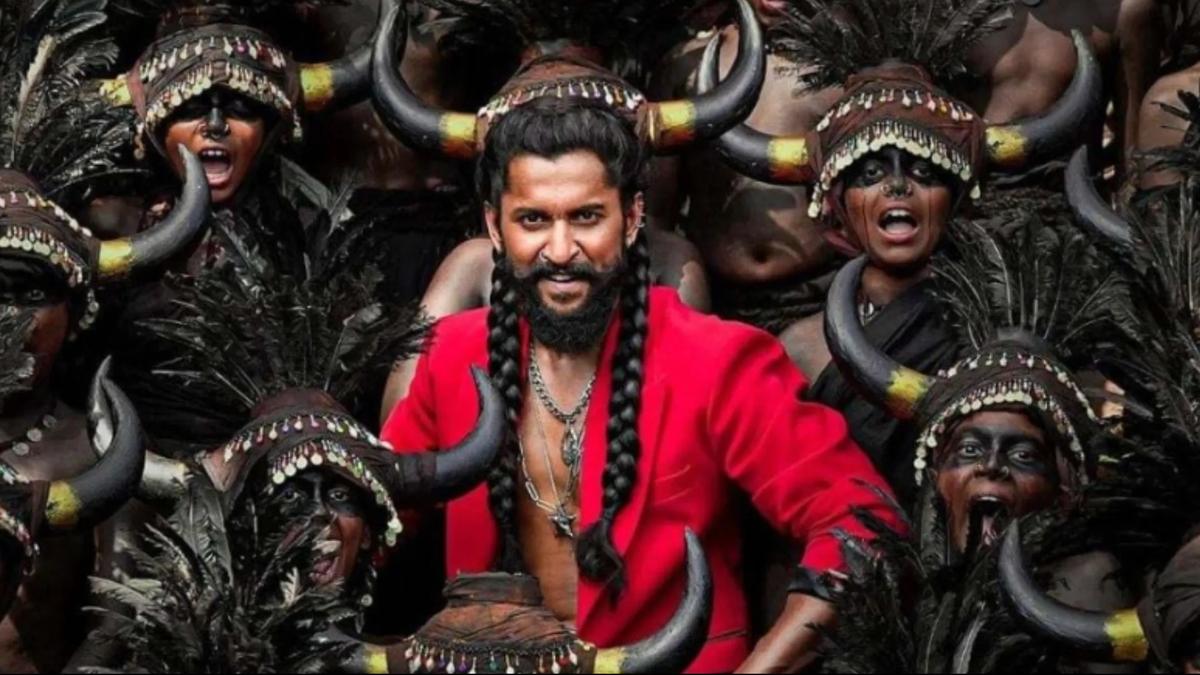
The men on the big screen are angry — at themselves, at those around them, and at the fate meted out to them. They seek redemption and tackle the world’s grandest problems, all while refusing to engage in self-introspection.Centuries ago, William Shakespeare was renowned for the inventive ways his characters met their ends. Our filmmakers now seem to be in a contest to outdo him, using the choicest of weapons to kill people. The KGF franchise, Akhanda, Animal, and Dhurandhar have pushed the limits such that a mere act of violence is not enough. It has to be intoxicating, repulsive and mind-numbing at once.Among this year’s major releases — Toxic, Jailer 2, Irumudi, Lenin, The Paradise, and to an extent Ranabaali — violence has become a form of self-expression for the protagonists. The line between the conventional hero and the villain feels thinner than ever.The Paradise begins with a sequence in which a henchman tortures a pregnant woman, forcing her to deliver twins through electrocution. Later, her grown-up son, Jadal (Nani), smashes a goon’s face into a moving wall-mounted fan to protect his love interest. A woman is disrobed in public, another pregnant woman takes her own life, and sickles are repeatedly used to crush the hands of an entire community.Ranabaali features a titular character (Vijay Deverakonda) who beheads the man out to kill him and places his skull under a chariot in the middle of a procession, framing it as an act of divine rage. Among the atrocities committed by the British, a child’s ears are severed, and a boy is thrown into a boiling pot. Minutes before her death, an injured pivotal character asks her husband to tear open her belly to deliver their baby. Director Rahul Sankrityan has stated that the violence was toned down, compared to what he had learnt from historical records.Screenwriter Vasant Jurru argues that historical reality does not justify every creative choice. Violence, he says, is effective when driven by emotion. Without that emotional connection, graphic imagery can gross audiences out. “Suggestion is more powerful than the actual act.” The question then is whether showing gruesome details add anything to the story.Geetu Mohandas’s Toxic, set against the criminal underworld of 1940s Goa, has Yash’s Raya turning his violence inward, fuelled by ego and substance abuse. The women — his sister Ganga (Nayanthara), Nadia (Kiara Advani), and Melissa (Rukmini Vasanth) — become casualties of his spiral into self-destruction. While the film aims to subvert the male lead’s violent rage, portraying him as a victim of a toxic upbringing, it repeatedly subjects viewers to gory action sequences to drive its message home. A scene from ‘Toxic’ | Photo Credit: Special Arrangement In Irumudi, the saviour is Trinadh Rama Kasu (Ravi Teja), an alcoholic husband who spells trouble at home and has a doting daughter. He then sets out to protect the women of his village from notorious men, which effectively means almost every man apart from the protagonist. A cop is magically absent in crucial situations.Girls are repeatedly harassed, abused, and make the leading man a hero. Meanwhile, the men casually discuss how to raise a girl child right. All of this is linked to the protagonist’s Sabarimala penance, casting him as a divine messenger. The film almost feels like a companion piece to Vijay Sethupathi’s Maharaja, where debates raged around its exploitative portrayal of violence directed at women.Kavitha Gudapati, an organisational psychologist, sees a troubling pattern in such narratives: the patriarchal idea that men are saviours and women and children must suffer before the masculine hero awakens. She equates the vulgarity of the violence to soft porn, arguing that its titillating, larger-than-life portrayal of male power risks normalising unhealthy ideas of masculinity among young audiences.The divine framing, she argues, can make violence appear righteous, even God-like. “The strength is in vulnerability,” she says, warning that repeatedly presenting brutality as heroic risks normalising an unhealthy idea of masculinity.The violence in Lenin, set in the 1990s, is comparatively muted, but the patterns are similar. The protagonist (Akhil Akkineni), having lost a loved one and his eyesight, appears weary after a stint in jail but remains committed to avenging his loss. Women are meek objects for men to protect, fight over, and avenge — collateral damage in an endless cycle of male posturing.Jailer 2 still positions Muthuvel Pandian (Rajinikanth), a retired cop, as the ultimate protector of his family and relies on several problematic tropes found in these films. Its violence is stylised to befit a popcorn entertainer, and the film is unafraid to mock its own absurdities. Rajinikanth in ‘Jailer 2’ | Photo Credit: Special Arrangement Writer-filmmaker Venkat Siddareddy believes Jailer 2 offers an important distinction. Its violence is brisk and slick, without taking itself too seriously. By contrast, prolonged bodily violence can become almost a parody of the genre. “You don’t really need to kill someone to make a hero. Without the writing to make us feel for a character, violence is merely a shortcut,” he says.While fury, the objectification of women, and violence directed at women and children were prevalent to varying degrees in 1970s and 1980s Hindi and Telugu cinema, what has changed is the visual language and the idea of heroism.With melodrama elevated to stratospheric levels, violence in these films is no longer merely a plot device to resolve conflict; it is the selling point. Done-to-death slow motion, deafening background scores, and torture milked to the hilt amplify the spectacle. The added mythological dimension lends greater legitimacy to the man’s actions. Severed heads, once associated with crude villains, have increasingly become a brand of heroism.Kavitha distinguishes between anger channelled towards justice and anger that remains unprocessed. “Rage and anger can be sacred. Anger signals that a boundary has been crossed. When processed and channelled towards justice, it can be transformative. When left unexamined, it becomes violence without purpose.” Kavitha adds that these heroes rarely have rounded character arcs; their coping mechanism is simply to kill.However, some films have made the effort to be an antidote, reflecting on the pointlessness of vengeance.Karthik Subbaraj’s critically acclaimed Tamil film Dorothy offers another counterpoint, exploring acceptance and gender fluidity while recognising toxic masculinity as a disease and challenging the idea of women as repositories of family honour.Baththa is even more heartwarming. A school-going boy who fears a ruthless gangster is locked in a toilet, where a near-death experience and their exchanges push the titular character to reconsider his existence and the futility of his anger. At its heart, the film is about a man who uses violence to mask his insecurities. Here, violence is not viewed as a source of power but a weakness. Vijay Deverakonda in Ranabaali | Photo Credit: Special Arrangement Though graphic violence sells like no other genre today, fatigue appears to have set in. While Irumudi and Lenin were major theatrical successes, buoyed by factors beyond violence, including music, performances, and tight screenplays, audiences called out many of their inherently problematic themes after their OTT releases.Nani has acknowledged the mixed reception to The Paradise, admitting that they could have done a lot better. Toxic, despite receiving some appreciation for its underlying critique of violence, was a washout at the theatres. The violence directed at women and children in Ranabaali has also drawn flak.An emerging filmmaker, speaking on condition of anonymity, cautions against confusing criticism of violent spectacles with a call for self-censorship. “We aren’t living in an ideal utopia, and because violence exists everywhere in the real world, artists must have the freedom to depict it. However, I draw a strict line against the glorification of violence. Unless a filmmaker can justify why those brutal elements are necessary for the story, glorification is problematic.”A ray of hope is the success of the Samantha-headlined Maa Inti Bangaram, where action is woven into the narrative without needless bloodshed and gore.Siddareddy believes the current template, shaped by films such as KGF, Pushpa, RRR, and Kantara, may be nearing the end of its cycle. He asserts that action will not go out of style. It awaits the next toy to latch onto, even as the formula of hyper-masculine violence at the expense of women and children begins to show signs of fatigue.
Graphic violence in cinema: How much is too much?
Full Article
Original Source
Read the full article at Thehindu →KhanList aggregates and links to publicly available news content. We do not host full articles from third-party sources. Always verify important information with original sources.