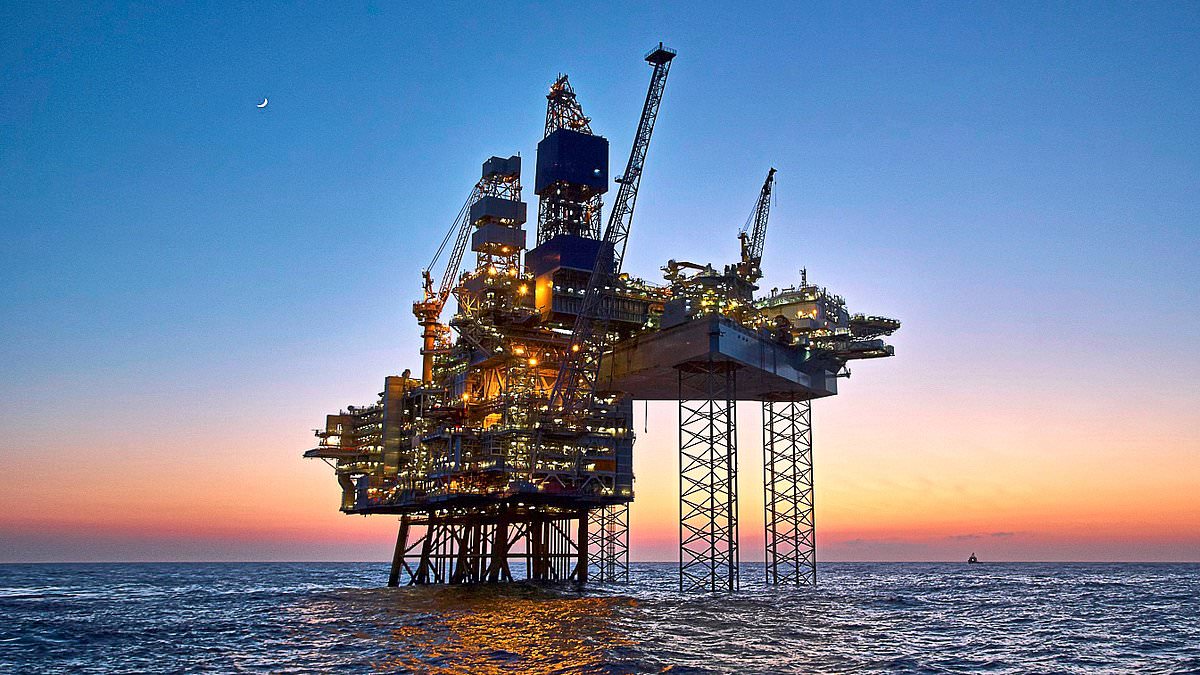
When Queen Elizabeth II stepped into BP's spotlessly clean new control room at Dyce, near Aberdeen, on November 3, 1975, she declared the day one 'of outstanding significance in the history of the United Kingdom'.Pressing a gold-plated button in front of a host of dignitaries, including Labour Prime Minister Harold Wilson, Her Majesty duly switched on Britain's North Sea oil bonanza.It came five years and 14 days after BP hit paydirt when it discovered the vast Forties oilfield on the UK Continental Shelf 170 miles from Aberdeen. It was the first British oil strike in the North Sea.Now, finally, the assembled audience of drillers, mechanics, roustabouts, welders and storemen who made it possible could expect the good times to flow along with the millions of pounds of 'black gold' now being injected straight into the UK economy under the fascinated gaze of its monarch.Members of Wilson's Cabinet and a delegation of American oil tycoons who were also on hand would have been rubbing their hands at the glut of money that was about to gush from this subsea Klondike.The Forties rapidly came to symbolise Britain's North Sea oil boom. Within three years, the field was pumping 500,000 barrels per day to BP's refinery at Grangemouth, near Falkirk.The boom came not a moment too soon for Britain after the energy crisis of 1973 quadrupled the world oil price and the nation would quickly come to rely on Brent crude to fuel jobs, tax revenue, electricity, petrol and heating.The economy of the North East would change out of all recognition, too, as the old fishing port of Aberdeen transformed into the heart of Europe's new energy revolution.An offshore oil and gas platform on a production site near Aberdeen, once home to the highest concentration of millionaires in Britain - and now a city hit by decline Queen Elizabeth II switched on Britain's North Sea oil at Dyce, near Aberdeen, on November 3, 1975, declaring the day 'one of outstanding significance in the history of the UK' The first-ever BrewDog pub on Aberdeen's Gallowgate (pictured) is now boarded up. There are projections that as many as 200,000 well-paid jobs could soon disappear in the Granite City Labour's refusal to allow new drilling in the North Sea dealt a body blow to a city already reeling from the 2014 slump in the oil price - with empty stores illustrating the decline Former Energy Secretary Ed Miliband (left), now Foreign Secretary, led the Labour government's 'Net Zero' policy drive under ex-Prime Minister Sir Keir Starmer (right)Labour's 2024 general election manifesto promised to ban new drilling licences for the sake of the climate, but Andy Burnham says he wants 'a change of emphasis' on North Sea projectsIn less than a decade, thousands of people poured in from across the globe to stake their claim in this black gold rush. Many, inevitably, came from the oilfields of Texas, and Aberdeen would soon ring to the familiar sounds of American burger joints and helicopters ferrying 'oilies' to and from the rigs in the 'Foggy Forties'.For years Aberdeen was a boomtown which boasted the highest concentration of millionaires in Britain and one of the lowest rates of unemployment. By 1981, the UK was a net exporter of oil. As more big fields were discovered and other producers moved in, oil revenues powered the boom of the 1980s. The industry survived the horrors of Piper Alpha, the threat of strikes, and protests by environmentalists and powered on.But the North Sea's glory days are well behind it. Westminster's growing obsession with Net Zero environmental policies and the present Labour Government's refusal to allow new drilling in the North Sea have dealt a body blow to a city already reeling from a 2014 slump in the oil price.About 180 of the UK's 280 current oil and gas fields are expected to shut over the next five years, while new fossil fuel production licences were banned in 2024 by then-Energy Secretary Ed Miliband.Many of the high-class hotels, bars and restaurants which sprang up to empty the wallets of a burgeoning class of highly paid offshore workers during their two weeks' shore leave are gone. In the heyday of North Sea oil, 'Granite City' Aberdeen could boast Britain's biggest concentration of millionaires Boarded-up and shut-down shops are now a more familiar sight across the Scottish city Former oil rig workers Mac and Bert said the oil industry in Scotland has 'gone to s***e' Property prices have sunk to 2007 levels, top name stores John Lewis, Debenhams and Marks and Spencer have closed and the main shopping thoroughfare is flooded with vape and charity shops.Beggars and jobless teenagers are a routine sight hanging about around the city centre, while struggling families queue for handouts at foodbanks. Unemployment in 232,000-population Aberdeen is 3.9 per cent, just under the overall Scotland average of 4 per cent and the UK-wide 4.5 per cent.And more than one in five people in Aberdeen, 20.1 per cent of working age between 16 and 64, are said to have given up working or looking for work, rendering some 32,000 'economically inactive'.Meanwhile Shell's imposing brutalist headquarters that once looked out over Aberdeen's commercial port, is now a pile of dust and stones – demolished.Now, the unthinkable has finally happened – the company which started the ball rolling is to sell up.BP announced yesterday it had placed its entire North Sea business on the market, ending 60 years of production in the area by the oil giant.There are projections that as many as 200,000 well-paid jobs could soon disappear. Despite insisting there was still 'untapped potential' in the North Sea earlier this year, BP chief executive Meg O'Neill now insisted: 'We believe our North Sea business will be better positioned as part of another company.'Ministers were told the announcement should serve as a 'deadly serious wake up call' over the future of Britain's huge natural resource – and came just a day after Mr Burnham admitted North Sea oil revenues could ease the cost-of-living crisis.He hinted at a shift in Labour's ideological ban on new oil and gas drilling, which is part of the party's 2024 manifesto, saying that at a time of tight public finances the North Sea was a resource 'we can't ignore'.Experts have predicted that lifting the ban imposed by Mr Miliband when he was energy secretary could generate £25billion in extra tax revenues for the UK over the next decade and support thousands of jobs.But industry figures suggested BP had decided not to stick around to see whether Mr Burnham can re-energise UK energy policy.Many in Aberdeen greeted the news with a sense of bitter resignation.Offshore worker Michael Donaldson, 51, from Aberdeenshire, said: 'This is just another big company dumping Aberdeen.'They have made their money and are now getting away when there is not much left.'There is still plenty of oil and gas there, but not enough for big firms like BP and Shell, who have already disappeared. This is no surprise, why would the big companies stay here?'John Mathers, 45, said: 'Aberdeen was already dead, and now this has put the final nail in the coffin. No one will work here now. They have better money-making places to be. No surprise.'Others reflected a growing anger at a political shift away from the oil and gas sector. Stevie, 40, a taxi driver from Aberdeen, said: 'We don't have a government that is willing to invest in the North Sea.'Rather than waiting for a dilly-dallying government to make the important decisions on drilling, [BP] will go somewhere that will give the go ahead.'He added: 'Our energy bills are the highest in Europe. Why? We did not invest the money like Norway.' Russell Borthwick, chief executive of Aberdeen & Grampian Chamber of Commerce, said the announcement was 'another stark reminder that confidence in the UK Continental Shelf has been badly shaken after years of policy uncertainty, punitive taxation and mixed messages about the future of the industry'.He said: '[It] should be a defining moment for the new Prime Minister. How many more jobs need to be lost before the UK Government acts?'Former oil rig workers meanwhile saw the writing on the wall years ago for their industry. Retired pump engineer Mac, 70, previously told the Daily Mail: 'I worked offshore for more than 40 years in the North Sea and in other parts of the world. And to be honest the oil industry in Scotland has all gone to s***e – and that happened a long time ago.'I worked for Shell at [the] Brent Charlie [fixed platform]. The food was good, the accommodation was good, and the money was good.'But in the Nineties we started getting pay cuts - that's when it started going wrong.'Meanwhile retired lift inspector Bert, 65, claimed the cut in pay ruined the industry, adding: 'I worked offshore as a lifting inspector. To be honest I miss it, despite the weather and the rough conditions.'But now the lads working out there are earning half of what we were earning back in the Eighties.'For many years, the political will to drill was unquestioned giving free rein to an army of engineers to surmount major logistical problems to assemble a network of wells, rigs and platforms to extract oil from the ocean floor.The late oil tycoon, Sir Ian Wood, once marvelled at how the early pioneers tackled the challenges thrown up by the North Sea.He said: 'It was a project of a scale that I don't think Scotland had ever seen before - not just in terms of size, but the sheer groundbreaking technology that was involved.'Frankly, it was science fiction-type engineering developments.'Jim Hunter, emeritus professor of history at the University of the Highlands and Islands, studied the social impact of oil-related developments in the Highlands and Islands and was struck by the speed of change oil brought.The sudden population boom meant new schools, homes and shops were thrown up overnight, lending Aberdeen a cosmopolitan air.But the rapid expansion felt two-dimensional: 'There was something of a Wild West feel to it. Some places experienced massive population growth, together with land speculation and much else,' Professor Hunter once recalled.'In Aberdeen, government and local authorities seemed totally bowled over by the sudden availability of jobs. 'No thought was given to the longer term -which is why offshore oil has come and gone and left nothing terribly tangible behind it.'But as long as the Government backed oil and gas, there was no problem. In 1980, newly elected Prime Minister Margaret Thatcher donned a survival suit and flew out to the Forties Delta rig to symbolise her support for the industry.Some commentators – including Sir Tony Blair – have put Lady Thatcher's subsequent electoral success down to the impact of North Sea oil.But she has been widely criticised for not diverting some of the proceeds from oil revenues into a sovereign fund like Norway did when the going was good.Over time, the political tide has changed as has the North Sea's productivity – from accounting for 10.4 per cent of Britain's gross domestic product in 1982, the energy industry represented only 4.4 per cent by 2011.As the new Energy Secretary, Miatta Fahnbulleh, one of Mr Burnham's key allies, knows she will have to tackle these issues head on.But notably she hid from scrutiny on her first official visit to Aberdeen to meet oil and gas executives on July 23, just after being appointed to the Cabinet.She excluded the media and failed to issue a read-out after meeting North Sea leaders in a UK Government office in Scotland's energy capital.The former economist has previously opposed new oil and gas fields and called for Net Zero targets to be accelerated. The Scottish Tories claimed she was scared of defending Labour's ban on new drilling and a 78 per cent windfall tax on energy firms, which are blamed for 1,000 job losses per month.As Energy Secretary, she will also take the key decision on whether to licence the massive Rosebank oil and Jackdaw gas projects inherited by Labour.Backed by the last government, the fields which can supply 10 per cent of UK needs, were delayed and reassessed because of legal challenges.But amid the political changes in Britain, BP has nevertheless pressed ahead with its own plans to slim down the company. Yesterday is not the first time BP has given up once vital North Sea assets. The Forties field itself, which at its peak produced 500,000 barrels a day (bpd) and provided the UK with one fifth of its annual oil needs, was an early casualty. It was producing just 45,000 bpd by 2003 when the firm sold it to the US-based Apache Corporation.In 2017, Sir Jim Ratcliffe's Ineos bought the 240-mile-long Forties Pipeline System from BP.The sale of its remaining North Sea assets – it has five production hubs, including two in the central North Sea and three west of Shetland together producing 117,000bpd, and employs about 1,100 people – could potentially bring in £2billion.Last month, the FT reported the company was seeking a deal with Ithaca Energy for around this amount before the talks fell through.Whoever buys BP, it will be the end of an era.After starting it all six decades ago, the famous BP logo will vanish from the North Sea. Gone forever.
'Granite City' Aberdeen once boasted Britain's biggest concentration of millionaires...now the former boom town is being abandoned by BP in a fresh setback
Full Article
Original Source
Read the full article at Dailymail →KhanList aggregates and links to publicly available news content. We do not host full articles from third-party sources. Always verify important information with original sources.