
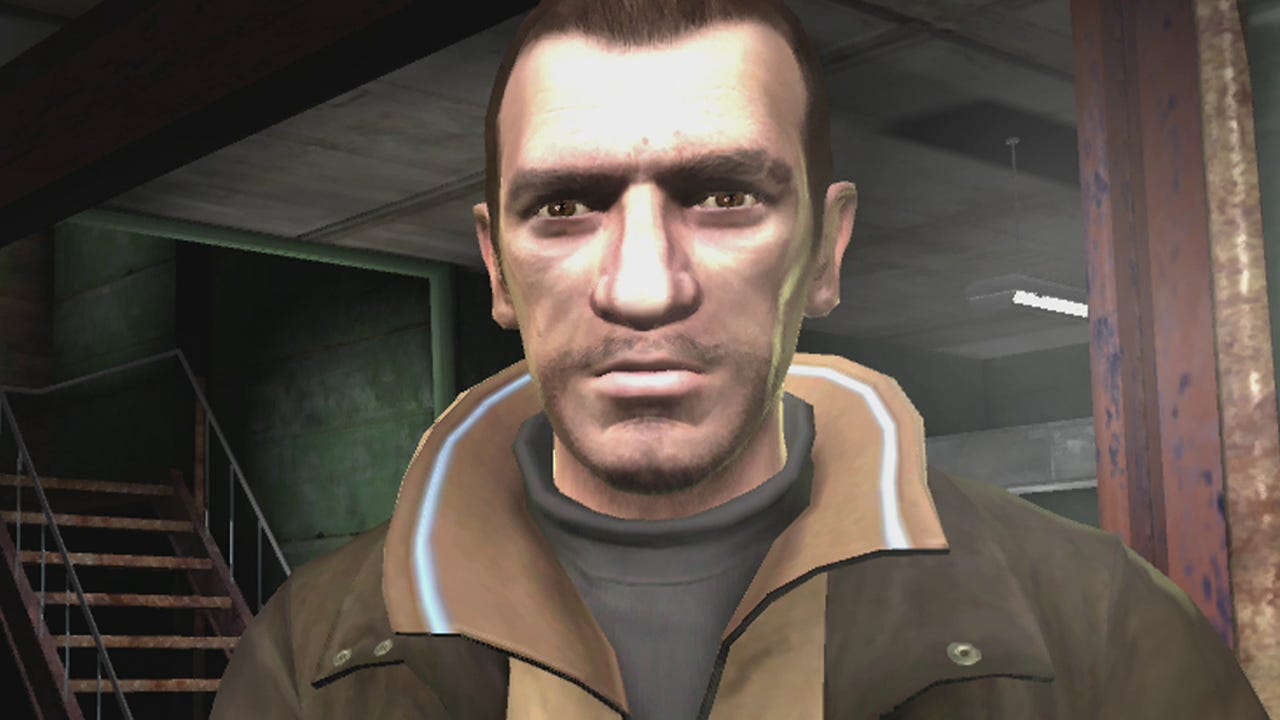
I’m taking a look back at each of the core Grand Theft Auto games and replaying them in the lead-up to the arrival of Grand Theft Auto 6. What we’ll be putting together won’t be traditional re-reviews, and they won’t come with any new IGN score, but they will re-examine what made each GTA remarkable upon the time of its release. By the end of the project, using GTA’s previously six-star wanted level, you should be able to get an idea of where each of these games roughly rank in my long-term love for this series. Today it’s time to revisit Liberty City in Grand Theft Auto IV.Grand Theft Auto IV is smaller than GTA: San Andreas. Significantly so, if you exclude water, as its land area is reportedly around only one-quarter the size of San Andreas’s physical real estate. GTA IV also has markedly reduced vehicle variety, with much fewer of them overall and zero car customisation. It has no asset management, less mission variety, no RPG-inspired skill system, a pretty paltry list of cheats, and the only thing you can alter about lead character Niko Bellic is his outfit. In fact, if you weren’t around for the arrival of GTA IV, I think it’s fair enough that you may actually find yourself a little confused about its place in the series pantheon. That is, how could this apparently smaller game with overtly fewer features than its predecessor have instantly become not only the highest-rated GTA in the history of the series, but one of the highest rated games of all time, full stop? Well, the devil is in the details. Countless, unprecedented, incredible details."I'm walkin' here!"For all his faults as an Eastern European war veteran with a shady past and a short temper, who may or may not have spent 106 minutes trying to kill Owen Wilson back in 2001, Niko Bellic has actually carved out a place as one of the most likeable and accessible characters in the franchise. Lured by his cousin Roman’s lies of wealth and opportunity, it’s easy to both sympathise with Niko’s disappointment at his first encounter with the American Dream, and share in his distaste for the various bastards of Liberty City who seek to exploit him.Released in 2008, GTA IV was the first game in the series to be set in the present day since GTA III. In 2026, it’s an interesting snapshot of the world just prior to the smartphone takeover – back when the internet was still a destination you took time out to visit on a computer, social media was still a novelty rather than the worst thing to happen to humanity since disco music, and your radio would always let you know you were about to receive a mobile phone call. However, despite the 18 year gulf between its setting and today, GTA IV doesn’t feel remotely as retro as something like GTA: Vice City did in 2002 – even though there were only 16 years between its setting and the time of its release. The aesthetic distinctions between the ’80s and 2000s are, of course, profound. What are the visual differences between the 2000s and now, other than the fact The Rock used to have hair? It’s not a long list. Monoculture is dead, fashion is looping, and – as remarkably detailed as GTA IV is – I don’t think there’s anything Rockstar could have done to dodge this phenomenon, Dwayne Johnson’s shaven skull notwithstanding. Flashing LightsHowever, even though the feeling I glean from GTA IV being a depiction of a specific moment in time may not be as strong as that elicited by either GTA: Vice City or GTA: San Andreas, there is no denying what a victory it is in terms of its capacity to represent a true sense of place. GTA IV’s Liberty City wasn’t just one of the most convincing virtual cities of its generation; I honestly don’t think it’s an overstatement to say its commitment to tiny details still stands up to scrutiny today. Bright lights, big city.Revisiting GTA IV’s Liberty City in 2026 – a game that my Xbox 360 play data indicated to me I haven’t touched in around 14 years – I’m immediately reminded of how fastidiously crafted every corner of this world is. Yes, it’s a smaller environment than that of San Andreas, but it’s one that is so much more crowded, dense, and dripping with depth. It’s more immediate, more authentic, and more intimate than anything that came before it – and it’s still a more credible and convincing city than those in most of the open-world action games I’ve played since.It’s still a more credible and convincing city than those in most of the open-world action games I’ve played since.“Strolling though Star Junction – Liberty City’s glitzy Times Square proxy – I find myself in tourist mode. I’m too engaged by the fact there’s something to see, read, or admire everywhere I point the camera to be distracted by the temptation of causing anti-social chaos. Hoofing it through Hove Beach – inspired by Brooklyn’s Brighton Beach – and I’m once again impressed at how much mileage Rockstar extracts from the seemingly mundane. Garbage strewn on the sidewalks. Individualised storefronts that are faithful to the demographics of the area and are never repeated elsewhere around the city. Places with stories you’ll never get to the bottom of. Like, who is Mikey Pissroll, and how much better at pool is he than Anal Alan?Devastating nickname areas at Comrade's Bar.The architecture, the lighting, the lived-in grime; Liberty City here feels more than real. It feels aged. Rockstar didn’t just build streets; it built them, and then assaulted that asphalt with decades of simulated wear. As a result, those streets are a patchwork of potholes, road plates, and sporadic strips of more recently re-surfaced segments. The custom signwork, the bespoke graffiti – the fact that no piece of the city looks like any other. A multitude of elements combine to create what was an unprecedented sense of immersion at the time, and absolutely still holds up today. Sure, there’s an unavoidable murkiness to playing GTA IV on original hardware like the Xbox 360, where you’re obviously beholden to the resolution limitations of its age. It results in a soft and rather muted image, and one that’s admittedly exacerbated by the overly cool and slightly washed out colour palette Rockstar opted for. However, it’s still a stunning place to simply explore, whether walking, driving, or using public transport – which is a viable and realistic way to move around this tightly-packed urban metropolis.One VisionWhile Rockstar was committed to rebuilding its famous riff on New York City as realistically as possible within the fidelity it could muster at the time, it also placed an enormous emphasis on physical realism. The beating heart of this approach was NaturalMotion’s procedural character-animation technology, Euphoria – an animation and physics solution that completely transformed how people moved, reacted to impacts, and interacted with their surroundings. It wasn’t just a trivial technical flourish; it fundamentally altered the way the game felt to play, whether you were cutting enemies down with a barrage of bullets, or mercilessly bouncing them off the bonnet of an automobile. It reinvented GTA.[Euphoria] wasn’t just a trivial technical flourish; it fundamentally altered the way the game felt to play.... It reinvented GTA.“Traditional animation relies heavily on pre-authored movements, with developers creating and canning specific sequences that characters will perform in particular circumstances. That is, fill them with lead and they’ll sink to the ground the same way every time. Strike them with a car and they’ll fly up and flop down identically, regardless of the forces at work. Euphoria does away with all of this and, in 2008, it felt like a stunning glimpse of the future. Ditching those pre-determined animations, characters in GTA IV react realistically – both based on the forces impacting them, and the world within arm’s reach of them. A spray of gunfire may stagger an enemy into a railing behind, which they can tumble over dramatically. A well-placed shot may cause someone to lose their balance and fall off a ledge. Clipping someone in a car will skittle them in a totally different way to clobbering them head-on. One too many drinks may make putting one foot in front of the other temporarily tricky."I've been shot! How could this day get any wor-ARRGHHHHH!"The results are often wildly slapstick – like when Niko flies through the windscreen after neglecting to use a seatbelt, or when NPCs insist on clutching the door handle of your car as it begins to peel away. I still live for these moments. In fact, I’ll often hesitate before getting on the throttle to allow carjacking victims a brief window to grab on before I take them on a brief trip to destination road rash. I don’t know what that says about me. Nothing good, probably. So much of the endless experimentation on offer in GTA IV is a direct result of Euphoria, and the fact no two encounters will ever really play out the same way twice. But it also works because it’s part of a much wider commitment to granular realism. That is, what good is a world that oozes so much character and authenticity if the people feel painted on? Like they’re skating through it rather than actually inhabiting it? Everything about GTA IV is engineered to immerse us into its world; like we’re just another living, breathing citizen of Liberty City. Although not everyone in Liberty City ended the day living or breathing.Goodbye HorsesDespite the incredible critical acclaim GTA IV accumulated, it remains one of the more divisive games in the series. While I am quite partial to the slower nature of its more pragmatic story and straightforward missions as a change of pace, it wasn’t to everyone’s tastes, nor was the relationship system. It was a smart way to disseminate rewards for fostering relationships with your in-game friends, but it admittedly could’ve benefited from a larger range of activities to do with them around the city – and preferably ones that were a little more fun, too. As it stands, the relationship system is too chore-like, requiring you to repeat the same cycle: pick them up, head to one of a couple of venues, and drive them home.Maybe having top-end sports car leaning over like Pixar characters was pushing it a little.Similarly, GTA IV’s extremely weighty driving physics are another controversial topic. For mine, I’ve actually always been quite partial to the feel of GTA IV, particularly in certain cars where I think the exaggerated body roll and sluggish steering makes sense – like muscle cars and beefy 4x4s. I would’ve liked some more sharpness in its range of sports cars and supercars – they should have stiffer suspension as they ought to be the cars with the firmest rides – but I do much prefer GTA IV’s approach to damage modeling over GTA V.There also doesn’t seem to be any real consensus regarding the radio stations, either, with sentiment that swings between high praise for the outright station variety to claims the song list is the most forgettable in the series. I have to concede I lean towards the latter; coming off the immense highs of Vice City and San Andreas I remember being a little underwhelmed at the time – although the soundtrack expanded and improved quite noticeably following the arrival of The Lost and Damned and The Ballad of Gay Tony, the two smartest pieces of DLC Rockstar ever produced.But that’s a topic for a different day.VerdictSentimentally speaking, Grand Theft Auto IV isn’t my favourite of the series – but I would say it’s the one I respect the most. It was bold to dial things back from the unhinged freedom of San Andreas in favour of a slower paced and more grounded crime saga, but it was a decision that allowed Rockstar to establish the importance of having a city so detailed it became a character itself, as well as flex a tech solution for character animation that has gone on to be a defining pillar of the series’ brand of emergent, slapstick fun. Obsessively detailed and impressively timeless, GTA IV is the prototype for modern Grand Theft Auto.For more reflections on the incredible Grand Theft Auto series, you can read our new Legacy Reviews of Grand Theft Auto, Grand Theft Auto 2, Grand Theft Auto III, Grand Theft Auto: Vice City, and Grand Theft Auto: San Andreas.Luke Reilly is an award-winning journalist with 23 years of media experience across Official PlayStation Magazine, Australian 360, and IGN – which he joined in 2011. You can find him on Bluesky @mrlukereilly to ask him things about stuff.
Grand Theft Auto IV – The Legacy Review
Full Article
Original Source
Read the full article at Ign →KhanList aggregates and links to publicly available news content. We do not host full articles from third-party sources. Always verify important information with original sources.