
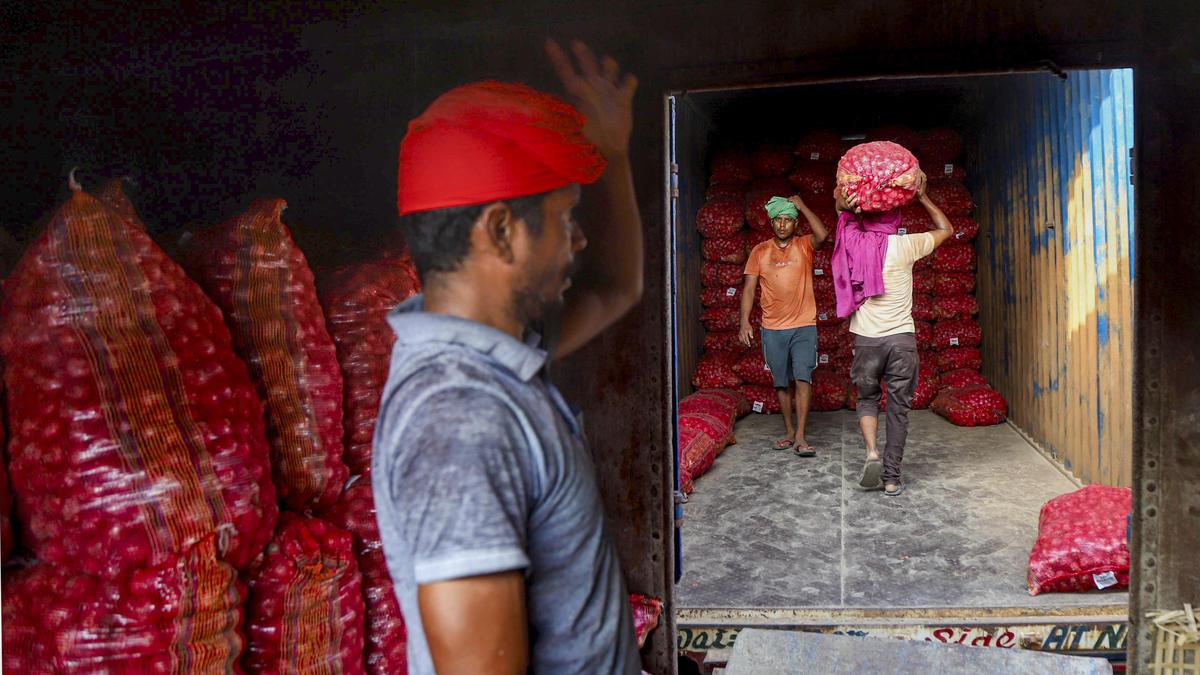
Workers unload sacks of onions from the "Kanda Express", a dedicated goods train transporting bulk onion consignments to the capital from Nashik, at Adarsh Nagar railway station, in New Delhi, Friday, Aug. 28, 2026. | Photo Credit: PTI The quality of the Centre's onion buffer stock is "good", Consumer Affairs Secretary Nidhi Khare said on Friday (August 28, 2026), asserting that for the first time this year the Central Warehousing Corporation (CWC) was roped in for storage to ensure better shelf life of the commodity.Ms. Khare refuted reports claiming that 30 of the 1.21 lakh tonne onion buffer maintained by the government had rotten. "Nothing of that kind has happened. Quality is good," she told PTI.Unlike previous years, when the onion buffer was stored with traders, the responsibility this time was entrusted to the CWC, with a third party assessing the quality of the stock at regular intervals, the secretary said.Explaining the science behind onion storage, Ms. Khare said the vegetable contains 90% water and retains its quality for three months post-harvest, after which it keeps shrinking every month as water vapourises. The extent of spoilage, she said, depends on storage conditions and ventilation.While some onion was procured in May, the bulk of the buffer stock was procured in June-July, which is why the quality remains good, she said, adding that onion recovery is estimated at 72% this year - up from 49% in 2022, 54% in 2023 and 63% in 2024.Onion is procured through agencies such as Nafed and NCCF.Knada Express reaches DelhiThe buffer stock is being transported in bulk through 'Kanda Express' - a dedicated rail rake - to Delhi, Chennai, Madurai, Ernakulam, and Guwahati. A consignment of 453 tonnes reached Delhi on Friday (August 28). The move is expected to boost supplies in Delhi-NCR and nearby cities and rein in prices, with the fall in retail rates likely to be visible within a week.Ms. Khare noted that mandi prices in Nashik have started easing following the initiative. It was unusual, she said, that the mandi price of onion in the producing centre of Nashik stood at ₹44/kg on August 24 - higher than the ₹25/kg retail price at the consumption centre of Delhi on the same day.Rajasthan and Madhya Pradesh, she added, are slowly emerging as major suppliers of onion to Delhi and other northern states. "There should not be a problem. The stock is good," she said.Ms. Khare said the kharif onion crop outlook is also promising, with the El Nino scare now over. She further allayed concerns over El Nino's impact on the rabi onion crop, saying irrigation has improved and water levels in key reservoirs remain healthy.Retail onion prices in the capital rose 88% to ₹62 per kg on Thursday (August 27), up from ₹33 per kg a year earlier, according to Consumer Affairs Ministry data. The all-India average retail price stood at ₹46.58 per kg, while the wholesale rate was ₹38.29 per kg on the same day.Despite the price spike, Ms. Khare said onion availability remains comfortable to meet domestic demand in the coming months, supported by an estimated 2025-26 production of 307.37 lakh tonnes - broadly on a par with the 307.67 lakh tonnes produced the previous year. Published - August 28, 2026 03:13 pm IST
Govt’s onion buffer stock quality ‘good’, storage with CWC aids shelf life: Consumer affairs secretary
Full Article
Original Source
Read the full article at Thehindu →KhanList aggregates and links to publicly available news content. We do not host full articles from third-party sources. Always verify important information with original sources.