
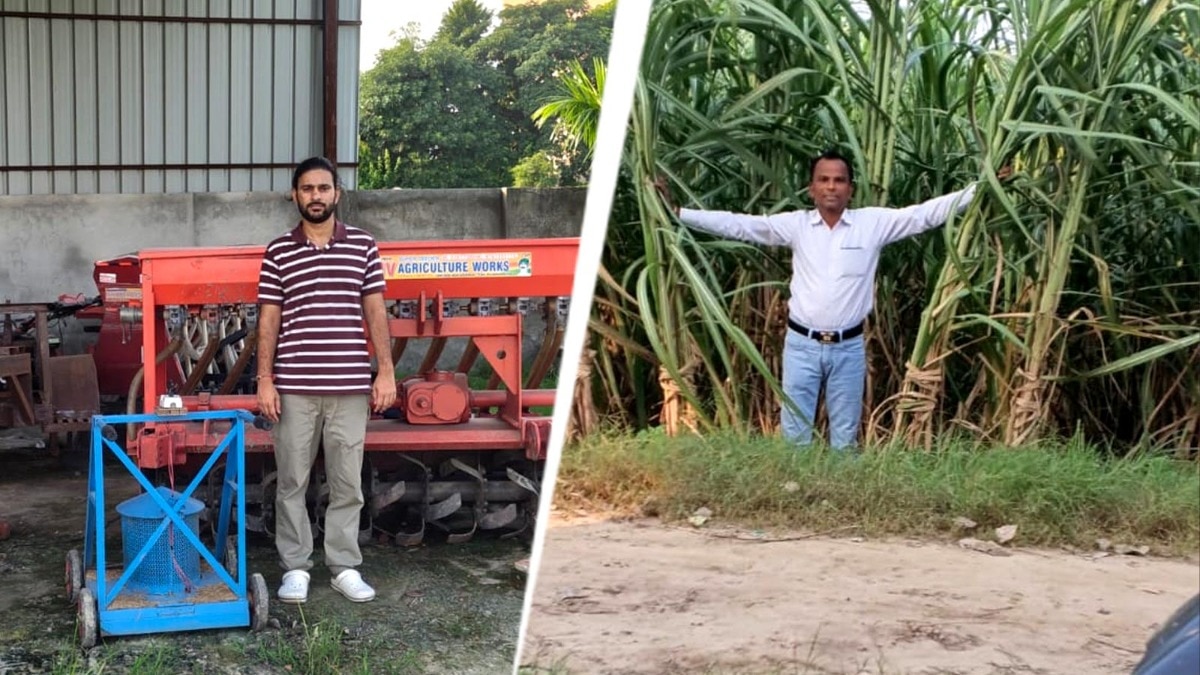
Government subsidy schemes are helping Meerut farmers buy modern machinery for cultivation. The shift is cutting labour and time costs while opening up rental income in rural areas.UP govt subsidies change farming economics as machines cut costs, boost incomes (Photos: ITG)Modern farm machinery, backed by government subsidies, is changing the economics of agriculture in rural Meerut, helping farmers reduce labour costs, save time and create new sources of income. Expensive agricultural equipment that was once beyond the reach of many farmers is becoming more accessible through subsidy schemes run by the Agriculture Department and programmes such as the Sub-Mission on Agricultural Mechanisation (SMAM).Depending on the category of equipment and the scheme, farmers can receive subsidies ranging from 40 per cent to 80 per cent. This has encouraged them to invest in tractors and machines such as super seeders, balers, rotavators, deep-ploughing equipment and harvesting machinery.The impact is being felt both in the fields and in farmers' earnings. Tasks that previously took two days can now be completed in a single day, reducing the dependence on farm labour and allowing farmers to cover larger areas in less time.For some farmers, the machines have also become a source of additional income. After using them on their own farms, they rent them out to other farmers in the area. FARMER GETS RS 24 LAKH SUBSIDYNand Kishore, a farmer from the Mawana area, said he benefited from the government's Farm Machinery Bank project. He invested in agricultural machinery worth around Rs 42 lakh, including a 75-horsepower tractor and several modern farm implements.According to Nand Kishore, the project provided him with a subsidy of nearly 80 per cent on an eligible investment of around Rs 30 lakh, giving him approximately Rs 24 lakh in government assistance. His machinery includes a baler, super seeder, wheat harvesting machine and equipment for deep ploughing, among others.Nand Kishore said the machines have reduced the time required for farm operations by around 50 per cent. Work that earlier took two days can now be completed in a day.He owns around six acres of land, where he mainly grows potatoes and sugarcane. With mechanisation, he said, his requirement for farm labour has also decreased.The machinery has opened another income stream for him. By renting out the equipment to other farmers, he earns an additional Rs 4 lakh to Rs 5 lakh a year, he said.MACHINERY OPENS UP ANOTHER INCOME STREAMNand Kishore said farmers can make better use of government schemes by staying informed about the subsidies and assistance available to them.He also said he did not face major difficulties in obtaining a loan for the machinery. After the Agriculture Department sent a letter to the bank, the loan process moved forward.For him, the benefit of mechanisation goes beyond making farm work easier. The machinery has reduced the time and labour required for cultivation while creating an additional source of family income.SUPER SEEDER, ROTAVATOR HELP CUT FARMING COSTSMeerut farmer Puneet Yadav said he also used government subsidies to purchase a tractor, super seeder and rotavator. He received subsidies of around 40 to 50 per cent on different agricultural implements.Yadav owns around 60 bighas of land and grows sugarcane and wheat. He also runs a Farmer Producer Company (FPO), which has a large number of farmers associated with it.According to Yadav, the biggest advantage of a super seeder is that it combines field preparation and sowing into a single operation. Earlier, the two processes had to be carried out separately, increasing both the time and labour involved.The machine also helps reduce seed consumption and can improve the efficiency of sowing. With less time and effort required to prepare the field, farmers can complete operations more quickly.SUBSIDIES DRIVE SHIFT TOWARDS MECHANISATIONGovernment subsidies on agricultural machinery are encouraging farmers to combine traditional farming practices with modern technology.Machines are increasingly being used for field preparation, sowing, harvesting and other farm operations, reducing the time required for each task. Lower dependence on manual labour can also bring down the overall cost of cultivation.At the same time, farmers who own modern machinery can rent it out to neighbouring farmers when it is not being used on their own land.This has created a wider economic benefit: machinery purchased with government support is not only helping farmers mechanise their own fields but is also emerging as a source of employment and supplementary income in rural areas.- EndsPublished By: Priyanka KumariPublished On: Sep 9, 2026 16:10 IST
Govt subsidies change Meerut farming economics as machines cut costs, boost incomes
Full Article
Original Source
Read the full article at Indiatoday →KhanList aggregates and links to publicly available news content. We do not host full articles from third-party sources. Always verify important information with original sources.