
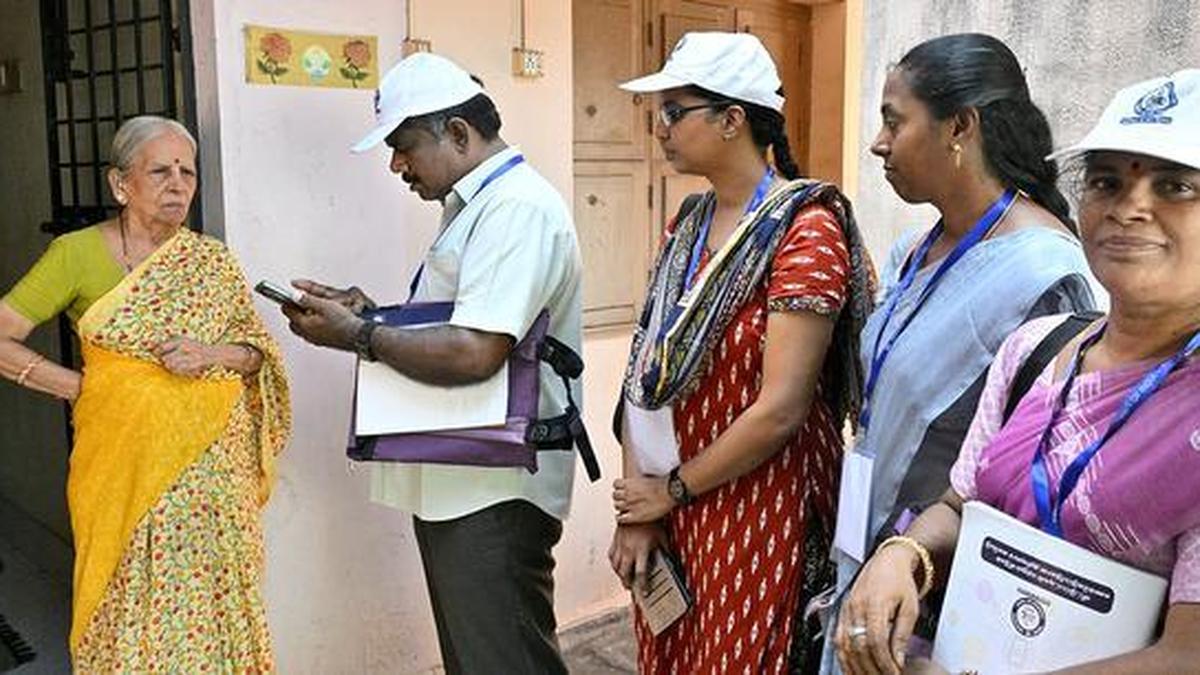
According to the officials, several entries in OBC lists do not represent a caste but describe “different groups of people, like those engaged in begging”. File. | Photo Credit: C. Venkatachalapathy The Union government had considered using the Central list and the States’ lists of Other Backward Classes (OBCs) while deciding that the 2027 Census will use an open-column method to enumerate castes, officials told The Hindu. However, following deliberations, it emerged that this would present a problem “because the list of OBCs is not a list of castes, it is a list of classes”, the officials said.According to the officials, several entries in OBC lists do not represent a caste but describe “different groups of people, like those engaged in begging”. A similar problem arose when considering the use of States’ lists. One official said these issues surfaced while the government was assessing whether the methodology used in State-conducted caste surveys, such as in Bihar and Telangana, could be replicated.The government is enumerating Scheduled Caste and Scheduled Tribe communities with the corresponding Presidential lists, as it has always done. But an open column for “all other castes” has prompted OBC groups and Opposition leaders, such as Rahul Gandhi and Mallikarjun Kharge, to demand that the communities be listed and enumerated specifically. They have questioned the utility of the open-column method.Opposition leaders and several scholars have argued that the open-column method could yield results similar to those of the Socio-Economic Caste Census of 2011, which threw up over 46 lakh caste names. The Narendra Modi government had cited this as a reason not to release the caste data from that exercise.Officials involved in the caste enumeration methodology said the options discussed had respective “pros and cons”, adding that the open-column method was finalised only after considering the other options at the “highest levels”.Officials said that while discussing the use of Central or State OBC lists to enumerate caste communities, the main issue was whether all communities listed could be counted as castes. The lists had entries such as “local borns” in the Andaman and Nicobar Islands, entries describing occupational groups, or those denoting a specific class of labourers (tea garden workers in Assam), or settlers, which would not qualify as castes.While both the Central and State lists of OBCs have such entries, they comprise a minority among the nearly 3,000 communities classified as OBC. Also, several communities that might be in the OBC lists of one State may be classified as either SC or ST in others.In a 2015 document on whether an OBC community can be classified based on caste alone, the National Commission for Backward Classes had concluded, “A caste can be and quite often is a social class in India… Since caste represents an existing, identifiable, social group/class encompassing an overwhelming minority of the country’s population, one can well begin with it and then go to other groups, sections, and classes.”A year after the BJP lost its majority in the 2024 Lok Sabha elections, in the lead-up to which the Opposition campaigned for a caste census, the Union Cabinet of the third Narendra Modi-led government approved a plan to include caste in the 2027 Census forms. One of the Opposition’s main arguments for the caste census was the need to enumerate the OBC population, a figure estimated so far on the 1931 caste census data. Published - September 03, 2026 10:17 pm IST
Government dropped use of OBC lists for Census as those featured ‘classes, not castes’, say officials
Full Article
Original Source
Read the full article at Thehindu →KhanList aggregates and links to publicly available news content. We do not host full articles from third-party sources. Always verify important information with original sources.