
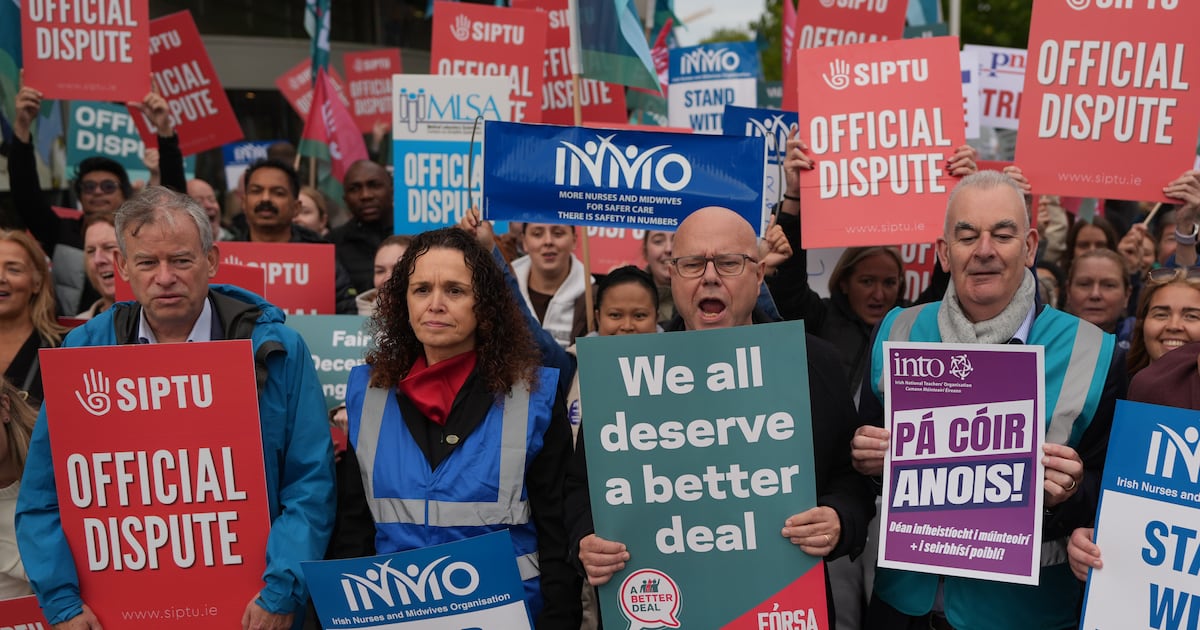
Just after 3pm on Thursday, Minister for Public Expenditure Jack Chambers stood up in the Dáil to respond to a Labour Party private members’ motion on this week’s one-day national strike by 300,000 public sector workers. Chambers ran through the well-ventilated position of the Government, arguing that the previous government’s agreement with unions had resulted in cumulative pay increases of 9.6 per cent at a time when cumulative inflation was 6.6 per cent. He stressed the principle of collective bargaining and its principle that nothing is agreed until everything is agreed. But he also displayed the more conciliatory language and tone evident this week, saying the Government was willing to prioritise pay.Then, right at the end of his contribution, Chambers dropped a zinger that made everybody in the chamber sit up. READ MORETurning to Labour leader Ivana Bacik and her colleagues, he said: “As this is a sensitive matter and work is ongoing, deputies will understand, I’m not in a position to provide specific or further detail at this time. However, I hope to be able to provide further details shortly and as part of an agreed way forward.”That was tantalising. Was a breakthrough imminent? Well, not quite. Later on in the afternoon, people on the Government side talked it down a little, saying it was not going to happen that night. But it gave enough hope that both sides could avert a second day of national shutdown next Wednesday. The all-out national strike that happened this week was once a common occurrence in Irish public life. The 1970s and 1980s were pockmarked by industrial action. In February 1979, for example, there was a crippling 19-week strike involving postal workers seeking 30 per cent increases in pay (inflation was out of control at the time). A deal struck by incoming taoiseach Charlie Haughey in 1987, with unions and employers on pay increases, formed the basis of the first national pay agreement. It led to industrial peace for a generation. During his 30-year career as a senior trade unionist, Bernard Harbor witnessed only one big national industrial dispute. It was the public service-wide strike in 2009, following the imposition of the pension levy and pay cuts when the Irish economy tanked.The atmosphere was forlorn. Public sector workers were angry at their unions after taking an effective 14 per cent pay cut. The public was unsympathetic towards them. The economy was in the doldrums.When Harbor visited the picket line on Wednesday, the mood was markedly different. It was enthusiastic and there was evident support from the wider public. Up to 2009, the national pay agreements were economy-wide, involving the public and private sectors. But after the crash, the agreements – Haddington Road and Croke Park – were public sector only. There were some skirmishes from time to time, but generally it restored a long period of industrial peace. Agreements like this usually take many months to negotiate. Initially, there are the talks about talks, before the substantive engagement begins. This time around it was left very late. From a union perspective, having everything on the table would mean the talks could be strung out for many months. Hence, the insistence that pay be dealt with first. But the Government was not prepared to do that. If pay was agreed, the unions would have no incentive to concede on productivity or efficiencies. The process broke down very early and the exchanges during the summer and into the early autumn were testy and gave little indication of a breakthrough. However, after weeks of stand-off, a letter from Chambers to the officers of the Irish Congress of Trade Unions public services committee on Monday gave the first inkling that there may be movement, albeit too late to stop the strike on Wednesday. Since then, there has been some movement. The Government has emphasised that, in addition to the €1.2 billion it has set aside, there is an additional unallocated fund of €1.6 billion, a portion of which can be deployed. With inflation for the 12 months to September 2026 running at 4.1 per cent, the unions’ chief negotiator Kevin Callinan has indicated the pay increases will have to at least match that. Union negotiators will not want to bring something back to their members that does not have the pay element up front in negotiations. The Government will have to show it can win agreement on better productivity. The “sensitive” nature of what is happening right now is trying to find a formula that allows both sides to show they have got a tangible result on the basis of talks.
Government and unions inching towards talks but no sign of white smoke
Full Article
Original Source
Read the full article at Irishtimes →KhanList aggregates and links to publicly available news content. We do not host full articles from third-party sources. Always verify important information with original sources.