
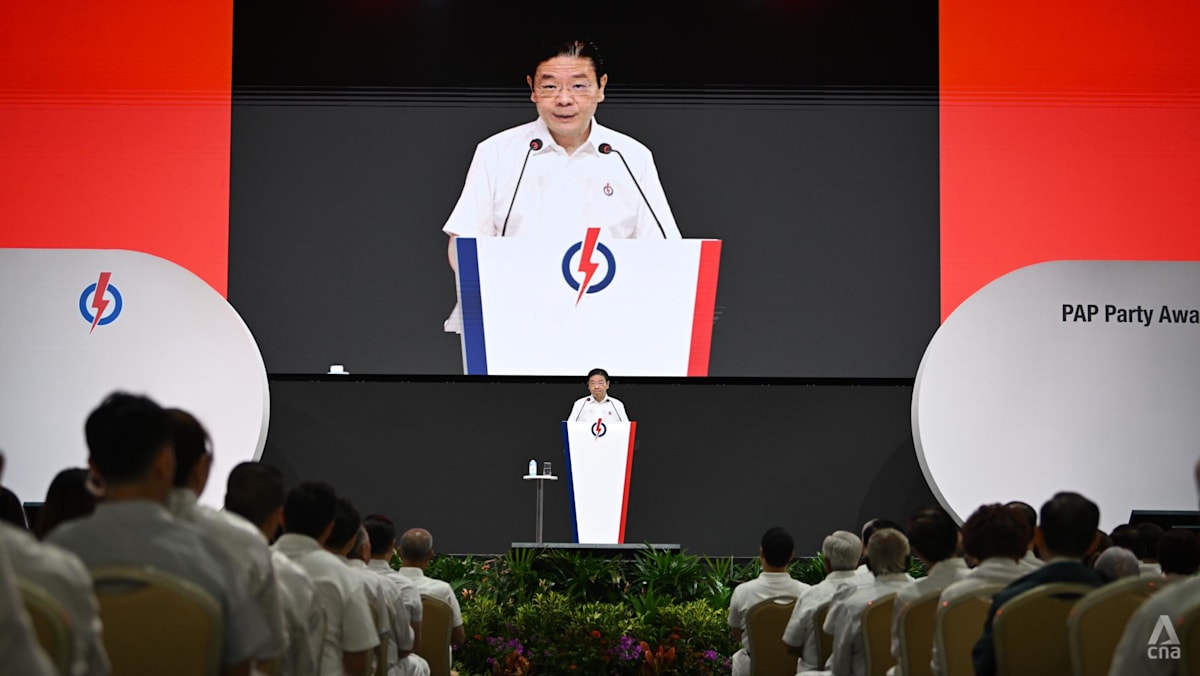
SINGAPORE: The challenge of governance is not just about balancing competing interests but also about confronting issues that would otherwise be politically easier to leave alone, said People's Action Party (PAP) secretary-general Lawrence Wong on Sunday (Oct 25).“But we must also guard against populism – the temptation to offer simplistic solutions instead of confronting difficult realities,” he said at the PAP's Awards and Conference, where cadres are expected to elect members of the party's 39th central executive committee (CEC).On Sunday, Mr Wong cited various issues – including housing, manpower and political salaries – that the party had to deal with head-on."The politically convenient option would have been to avoid the issue altogether – leave it to my successor to do. But we could not keep putting off a decision that matters for Singapore’s ability to build a strong political leadership team for the future," said Mr Wong of the revision of political salaries. "So I decided to address the issue openly in parliament, explain our decision, and take responsibility for it."In dealing with difficult issues, the PAP government's approach has been guided by constant principles: listening carefully, explaining the trade-offs honestly, making the decision and taking responsibility for the consequences.Mr Wong said that as the governing party, the PAP "cannot shy away from difficult decisions just because they are unpopular"."Nor can we tell people what they want to hear today, only to leave others to deal with the consequences tomorrow," said Mr Wong. "Because when we postpone a difficult decision, we do not make the problem disappear. We simply pass them on to those who come after us – and we often leave them with harder choices later," he added."So, comrades, we must have the courage to act – not just for Singaporeans today, but also for our children and grandchildren who will inherit the Singapore that we build."BALANCING COMPETING NEEDSMr Wong said that as part of governing for the long term, the government must not only deal with the concerns of today but also prepare Singapore for the future."That means looking ahead. Anticipating problems. And acting before they become more difficult to solve," he said.He cited Indonesia's recent announcement to cut gas exports to Singapore, and how Singapore has been preparing for such risks by investing in liquefied natural gas terminals to import natural gas from different countries without having to rely on pipelines in order to provide options in managing any disruptions.Beyond that, however, Singapore is also studying the potential of nuclear energy as an option for cleaner sources of power.Mr Wong said that the government takes understandable concerns surrounding nuclear energy "seriously"."But we should not rule out an option simply because it is difficult or controversial," he said. "We must assess the risks and trade-offs carefully, engage Singaporeans, and eventually make the right decision to secure our energy future."As the governing party, Mr Wong said that the PAP must deal with competing needs and interests from different groups and consider them against the "wider picture"."We cannot simply tell everyone what they want to hear, or promise everyone what they hope to get," he said.Members of Parliament (MPs) raise in the House issues that matter to their constituents and causes that they feel strongly for.The opposition Workers' Party (WP), too, speaks up on policy issues, said Mr Wong."But when you look at the positions they have taken over time, they are not always consistent or coherent," he said.One issue on which Mr Wong said the opposition party has shifted its position over the years was housing.In 2019, when the prices of public resale flats were falling, WP had argued that the government should build fewer new flats. By 2023, after the COVID-19 pandemic disrupted construction and led to a shortfall in new flats, the opposition was criticising the government for not building enough flats."Yet there was no acknowledgement of what it had advocated just a few years earlier," said Mr Wong.Another issue on which WP had changed its position was foreign manpower.WP had called for greater flexibility across industries back in 2012, when the PAP government tightened foreign worker policies.The opposition party then proposed zero growth in the foreign workforce during the debate on population policy, amid concerns over the projected population of 6.9 million, but more recently called for easing of foreign worker quotas when small and medium enterprises (SMEs) faced manpower shortages."You can see how their position seems to shift with the political winds. But foreign manpower policy cannot simply shift back and forth with the pressures of the moment," said Mr Wong, adding that any "relatively small adjustments" would bring about wider consequences.These issues show how the opposition has taken different positions at different times based on "what they believe will be popular", said Mr Wong."But these positions do not always add up to a coherent approach that takes account of the trade-offs or the longer-term consequences," he said."This is part of opposition politics. It is easier to argue for a particular position when you do not have to reconcile all the competing demands, or take responsibility for the outcome."Mr Wong said that governing is different, as it requires the party to make difficult choices that will stand the test of time and not just offer what sounds attractive today.He pointed to developments elsewhere in the world, where traditional political parties have lost ground and the "political centre" has weakened, and young people have taken to the streets in different countries from France to parts of Asia.While the immediate causes differ, the pressures of economic insecurity and affordability concerns are similar, said Mr Wong.“Quick fixes" may be tempting, but they do not solve the underlying problems, he cautioned."So the frustrations persist. Trust in institutions weakens. Politics becomes more polarised," said Mr Wong. "Then it becomes harder to find common ground, build consensus and make the difficult decisions needed for the common good." Prime Minister Lawrence Wong delivers an address at the 2026 PAP Party Awards and Conference on Oct 25, 2026. (Photo: CNA/Syamil Sapari) In Singapore, Mr Wong said the government must take worries about livelihoods and the future seriously, but must guard against populism."Above all, we must never allow our politics to become so divided that we lose the ability to work together for the good of Singapore," said Mr Wong."And that is why, as the governing party, the PAP must always take the wider and long-term view."This would mean considering the interests of Singapore and Singaporeans as a whole – not just those who speak up most loudly – while weighing competing needs, making difficult choices and taking responsibility for the consequences, he said.KEEPING PAP A BROAD-BASED PARTYMr Wong said having the courage to make difficult decisions did not mean believing that the Government always knew best or was always right.“We must stay close to Singaporeans. We must listen to their concerns and experiences. And be prepared to change when something is not working as we intended,” he said.He noted that PAP activists had been discussing issues including jobs and artificial intelligence, housing and education, and said such ground feedback could shape policy.“These conversations matter. Because even when a policy looks good on paper, it may not work as well on the ground,” he said.Mr Wong cited enhancements to paternity leave, shared parental leave and the Home Caregiving Grant as examples of policies that had been influenced by feedback from PAP branch chairs and activists.He added that the party must also reach beyond its existing circles and engage Singaporeans with different views and backgrounds, including those who may not join the PAP or agree with it on every issue.“That is how we keep the PAP a broad-based party – connected to people from all walks of life, and in touch with the changing aspirations of Singaporeans. That is also how we renew the PAP,” he said.“Renewal is not just about fielding new candidates in an election. Renewal is about refreshing our ideas, broadening our membership and expanding our networks.”
Governing means confronting politically difficult issues, not just balancing interests: PM Wong
Full Article
Original Source
Read the full article at Channelnewsasia →KhanList aggregates and links to publicly available news content. We do not host full articles from third-party sources. Always verify important information with original sources.