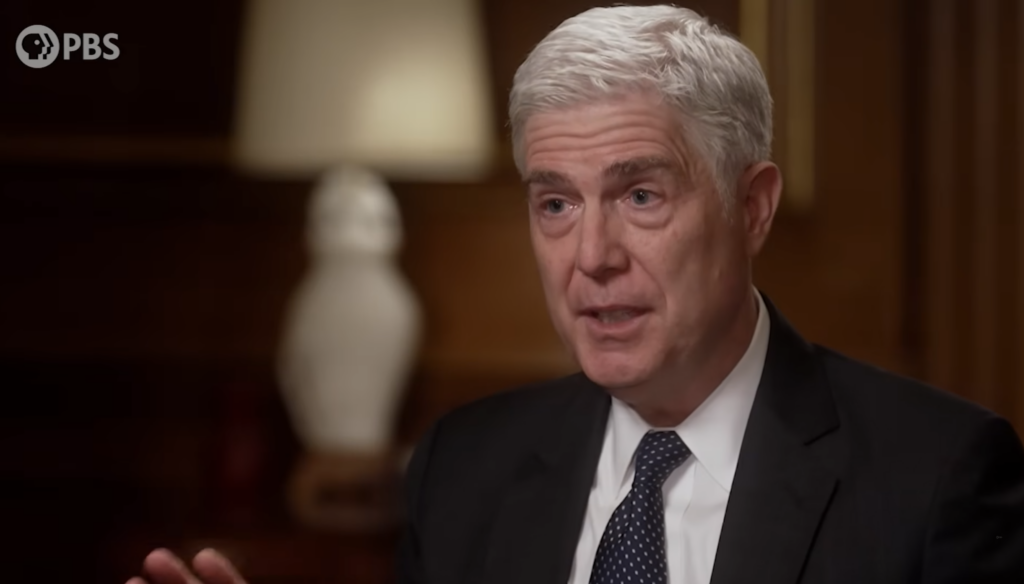
Old habits die hard. At least that is the case for our Supreme Court’s Justice Neil Gorsuch, who persists in repeating the erroneous narrative that America was founded as religiously neutral. In a July 24th interview with PBS’ Margaret Hoover, Gorsuch gave his interpretation of the American founding, denying America was founded as a Christian nation: “We were never supposed to be a nation that was about one race or one religion … It was about those ideas [in the Declaration of Independence] … We have a First Amendment, for crying out loud. No established religion.” Gorsuch has previously made this point about his belief in America as ultimately a “creedal nation” founded in shared ideas contained in the Declaration, not more fundamental ties of ethnic kinship or common religion. Gorsuch wants to maintain this position of America as a neutral nation, not preferential to any particular people group or religion. Despite his claims to be an originalist, Gorsuch is not truly original in his beliefs here. In particular, he misrepresents the numerous ways in which America was founded and perpetuated as a Christian nation, giving public support and favor to Christianity over any alternative religions because its people were Christian. Understanding the American Founding Those who share Gorsuch’s view are quick to point to the First Amendment of the U.S. Constitution, which states “Congress shall make no law respecting an establishment of religion, or prohibiting the free exercise thereof.” However, this was only ever intended to prevent Congress from establishing a religion federally, since that would interfere with the local self-government of the states which had distinct religious characters. The First Amendment prohibits the federal government from establishing a national church, but it was intended to preserve the right of the states to establish their own churches — many of which had established churches at the time of the founding and up through 1833. Even when states no longer continued establishing one particular Christian denomination, Christianity was still the dominant religion and upheld through the social and political framework. As scholar Thomas G. West has documented admirably in his scholarly work Political Theory of the American Founding, some of the states (e.g., Massachusetts) even provided public funding to Christian churches, since they believed that religious education and worship was necessary for maintaining public morals in the regime. Public schools taught the Bible, Christian ethics, and basic Protestant Christian doctrine. Most states not only had laws aligned with Christian morality regulating sexual ethics, but also laws requiring businesses to close on Sundays and laws banning blasphemy and obscenity. Multiple states had religious oaths as tests for public office, which were intended to limit only Christians to holding office. Even Thomas Jefferson, arguably the most pro-Enlightenment liberal of the American founders, did not reject a role for Christianity in the public square. His famous 1802 line to the Danbury Baptists about a “wall of separation between church and state” has been notoriously abused, and is typically interpreted in isolation from the entire informative context of his official policies. President Jefferson even encouraged Christian ministers to preach Sunday services in Congress. It is true that the American nation incorporated an unprecedented level of religious toleration so that religious dissenters would not be directly punished for their disagreements of conscience. However, guaranteeing liberty of conscience is not equivalent to a government being neutral on religious questions or even hostile to religion, which is what liberalism came to demand of government in the 20th century. Freedom From Religion In the era of the Warren Court, the Supreme Court ruled in landmark cases like Engel v. Vitale (1962) and Abington School District v. Schempp (1963) that public schools cannot include public prayer or readings and recitations from the Scriptures. The goal of the Warren Court was to impose “neutrality” on a secular public square safe from any preference for religion. Never mind that this goal is impossible to achieve; this paradigm was a complete reversal of the American tradition up to that point, and was not supported by the Constitution and the intent of its framers. A good litmus test for the Supreme Court to use in interpreting the Constitution and the laws is, if founding-era laws and state practices like religious education in public schools would be considered “unconstitutional” under prevailing Court standards today, that means the Court’s current standards are wrong and ought to be changed. Vance and Trump Get It Right Even as Justice Gorsuch persists in his erroneous opinion, we see a much better position being advocated by President Trump’s administration and its spokespersons. Vice President JD Vance actually disputed this topic on his recent long-form interview with podcaster Joe Rogan. Rogan criticized red states’ recent laws requiring the Ten Commandments to be displayed in classrooms and requiring students to read the Bible as part of their school curriculum. Relying upon the typical liberal framework, Rogan complained that this is a kind of intolerant indoctrination which favors some religious beliefs above others. Thankfully, Vance provided respectable pushback, arguing that Christianity is part of the character, experience, and formation of the American people in a unique way — something that is not true of alternative religions like Islam, Hinduism, or whatever else. As Vance put it, “Christianity is the majority religion of the United States, and is the religion that was extraordinarily influential to our founding.” At the October 2025 TPUSA event at Ole Miss, Vance also defended the idea that our government ought not (and cannot) be neutral on religion, but show preference and support for the Christian religion. He demonstrated an accurate knowledge of the original intention of the First Amendment and of founding-era practices toward religion, and he attacked the liberal Supreme Court decisions of the Warren Court era which made the federal government hostile to religion in the name of “neutrality”: “You do not have to completely kick God out of the public square, which is what we’ve done in modern America. It’s not what the founders wanted, it’s not good for the United States of America, and anyone that tells you that’s it’s required by the Constitution is lying to you.” President Trump, too, has frequently voiced support for Christianity and for Christian resurgence in the United States, saying that “to be a great nation, you must have religion, and you must have God.” His administration has also worked to roll back discrimination and weaponization of government against Christians by the Obama and Biden administrations. Gorsuch continuing to push this narrative about the United States not being a Christian nation is not helpful, and it actually grants legitimacy to the leftists’ desire to tear down America and exorcise its traditional Christian elements. Gorsuch helps the left by refusing to offer a full-throated defense of America’s Christian heritage. Thankfully, President Trump and VP Vance are charting a different path more consistent with the American founding and offering better inspiration to reform our once-great Christian nation. Samuel Kimzey is a doctoral student at Hillsdale College and a 2025 Publius Fellow at the Claremont Institute. He holds a B.A. in History and Christian Studies from Bluefield College and an M.A. in Humanities from the University of Dallas, and previously taught at Valley Classical School in Blacksburg, Virginia. Find him on X @SamuelMKimzey American FoundingBibleChristian nationChristianityFoundersFoundingHistoryjd vanceJoe RoganLawNeil GorsuchoriginalismReligionSCOTUSWarren Court
Gorsuch Abandons Originalism (Again) With Claims America Isn’t A Christian Nation
Full Article
Original Source
Read the full article at Thefederalist →KhanList aggregates and links to publicly available news content. We do not host full articles from third-party sources. Always verify important information with original sources.