
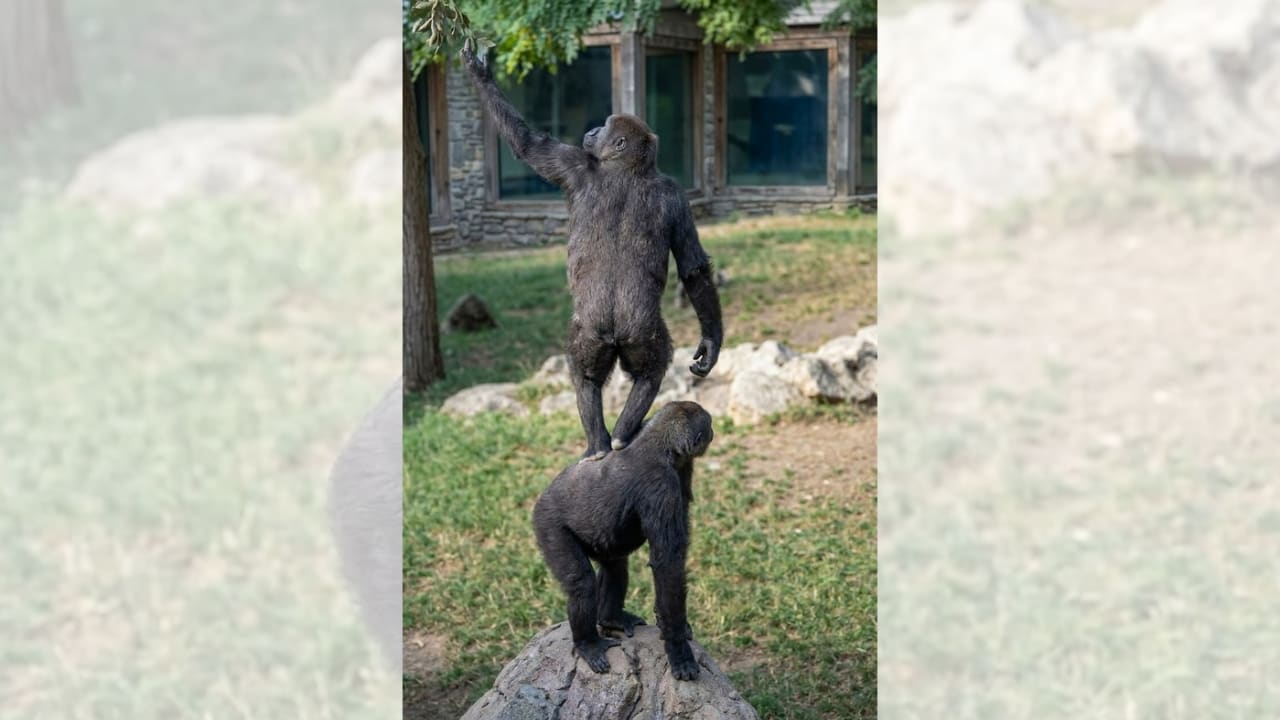
NOVEMBER 16, 2026 06:01Two female western lowland gorillas at the Ramat Gan Safari were documented cooperating to reach otherwise inaccessible branches, with one climbing onto the other's back to obtain food, according to a Tel Aviv University study.The study, published in the scientific journal Primates, describes a “rare example of spontaneous cooperation between adult gorillas,” with each animal assuming a distinct role in reaching the branches.It was led by Michael Levitzky and Prof. Israel Hershkovitz of the Department of Anatomy and Anthropology at TAU’s Gray Faculty of Medical and Health Sciences and the Dan David Center for Human Evolution and Biohistory Research.Researchers documented three incidents involving the same half-sisters, Amelia and Lisha, in 2021, 2024, and 2025. In each case, Lisha served as a platform while Amelia climbed onto her back to reach vegetation. Neither gorilla had been trained to perform the behavior.The most extensively documented incident occurred in September 2024, when keepers discovered the two gorillas eating bark and leaves from a branch that had previously been out of reach.Prof. Israel Hershkovitz. (credit: TEL AVIV UNIVERSITY)Security camera footage showed Amelia climbing onto a rock beneath a tree before Lisha joined her and positioned herself on all fours. Amelia then climbed onto Lisha's back, stood upright, and broke off a branch approximately 15 feet above the ground. An electric barrier prevented the gorillas from climbing the tree directly.Researchers examine cooperation between gorillasFootage from June 2025 showed a similar interaction, with Lisha approaching Amelia and positioning herself to support the climb without being physically guided."What I find fascinating is that Lisha did more than simply serve as a ‘step’ for Amelia," said Levitzky."She appeared to participate actively and willingly in solving the problem, approaching on her own initiative and positioning herself in exactly the right place, without Amelia physically guiding her. This is the difference between using another individual as a tool and true cooperation."The researchers also observed differences in how the gorillas behaved after obtaining the food. While the two shared the vegetation following the 2024 incident, Amelia ate alone in 2025, suggesting that cooperation does not necessarily lead to food sharing.The findings are particularly notable because the half-sisters do not typically spend much time together, suggesting that coordinated behavior can occur without a consistently close social bond.Yehonatan Samocha, head of the primate section at the Ramat Gan Safari, said the findings were consistent with the intelligence and social abilities zookeepers have observed."Sometimes, our surprise tells us more about our expectations of animals than their actual abilities."Hershkovitz said the observations could also contribute to understanding the evolution of cooperation in humans.Michael Levitzky. (credit: TEL AVIV UNIVERSITY)"These observations are important for understanding human evolution because they offer an explanation, albeit a partial one, for how we survived on the savanna - through social support and a high level of cooperation that can occur even without language or preplanning."According to the press release, the researchers cautioned that the study was based on just three documented incidents involving two gorillas. The available footage could not establish whether the animals communicated through vocalizations or subtle gestures or whether they planned their actions in advance.Nevertheless, the repeated behavior provides evidence of the gorillas' ability to coordinate their movements and use their surroundings to solve a shared problem, the study noted.Follow us on Google
Gorillas at Ramat Gan Safari form 'living ladder' to reach food, TAU study finds
Full Article
Original Source
Read the full article at Jpost →KhanList aggregates and links to publicly available news content. We do not host full articles from third-party sources. Always verify important information with original sources.