
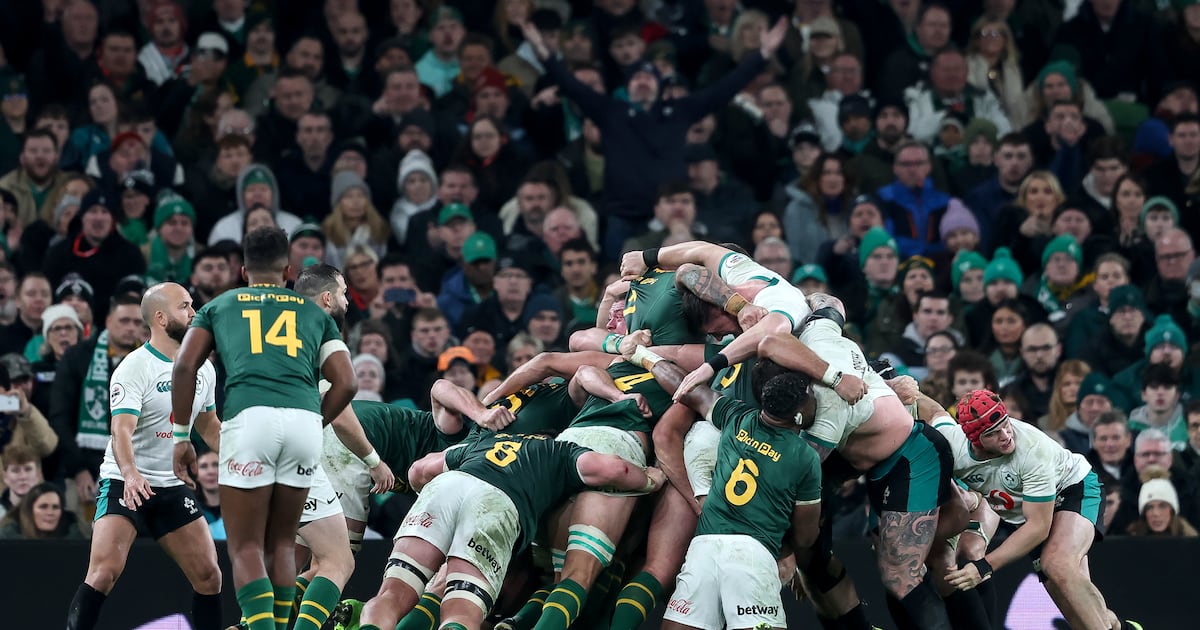
The result, yes. The performance, no. Ireland head coach Andy Farrell had plenty to ponder after the victory over Fiji. As is the case with matches of this nature, there were some good individual moments, but collective cohesion was fitful.For much of the last decade Ireland’s best displays were driven and underpinned by the sum of the parts rather than standout solo contributions. Last Saturday’s scoreline, 43-15, flattered the home side. Ireland led 17-15 at half-time before 26 unanswered points glossed over a dull display.Consistency has been elusive. Leinster have not delivered it often enough; the same could be said of the other three provinces. Ireland had been the outlier. After watching France’s battle against South Africa in Paris last Friday, and the last two Irish performances, I wonder whether the national management programme is getting the best out of players nowadays.The idea has been simple: minimise the minutes and maximise the output. For most of the professional era, it has been a real bonus for Irish rugby. But some of the errors in the last fortnight suggested a few players are still looking to find third or fourth gear.READ MORESome of that is context. The November window has never been this competitive and we have never had to hit a standard like this so early in the season. Argentina sit at the other extreme. Their players have played nearly every minute available in the French Top 14. You don’t want that either.France offer an interesting middle ground. Their season started earlier, but in summer they rested a lot of players, who are now fresh, match-hardened and sharp. Rugby is constantly evolving. Should player management stay static while it does? You would imagine David Humphreys, the IRFU performance director, is thinking long and hard about it.The litmus test will be how Ireland play on Saturday and where they finish in the Nations Championship table. We may look back on this block of games and wonder whether Ireland were a little undercooked.Farrell has spoken about concentration. Against Fiji, it was noticeably absent. Ireland looked a little off the pace mentally, like a team with one eye on the following week. I offer no excuses, only context.Craig Casey of Ireland tackles Fiji's Ponipate Loganimasi during a ruck on Saturday. Photograph: Ben Brady/INPHO I played in this fixture several times, and my motivation changed over the years. Early in my career it was about maximising my minutes, so the coaches didn’t forget about me. Later, as a senior player, it was about taking responsibility and setting the standard for those coming through.I’d struggle to think of a game where we coasted against teams like Fiji, even when we played well. These games are never as comfortable as the scoreline suggests. It always came back to individual responsibility.Against a side like Fiji the expectation is that you will win. Focus can then drift to a chance to shine as an individual rather than remain rooted in the team’s needs. Players are human. If focus and application dip, little gaps start to appear. How much they’re exposed depends on the opposition.Look at the other results. Wales beat New Zealand 35-28, their first win over the All Blacks since 1953. That was as much New Zealand’s making as a fantastic Welsh performance. The All Blacks made eight changes, and when the pressure came their fundamentals dropped.Beauden Barrett, Scott Barrett and Richie Mo’unga couldn’t rescue the result. The days of New Zealand dominating international rugby are consigned to the past. The aura has gone. Teams no longer arrive beaten before kick-off. Wales held on for dear life and tackled their way to victory, bodies on the line literally and metaphorically.France did something similar against South Africa, winning without scoring in the second half. Holding on for dear life isn’t a strategy, because you can’t replicate it. The script in the three matches was torn up early. New Zealand panicked. Ireland didn’t. France rolled with the punches.Technically, Ireland were off the pace. Fiji played smart. They rarely committed more than one defender to a ruck unless they had a genuine chance of stealing the ball. With 13 players fanning across the field, there is always space somewhere, but Fiji never offered an easy route to it. Ireland’s ruck speed was ponderous. It permits a defender to get back on their feet and into the line.Ireland squeezed Fiji in a traditional way. Familiar penalties, familiar territory, familiar possession, familiar tries with Sam Prendergast and Mack Hansen providing the finesse. But the general build-up was one-dimensional. When the defence was set, the footwork into contact was poor – and Ireland ended up in a physical confrontation with a team that was arguably bigger in some areas.The lesson is clear, because a physically bigger team arrives on Saturday. Running straight lines into two-man tackles is a sure-fire way to lose the collision, then the gainline, then possession. South Africa have their own adjustments to make. They are selecting halfbacks who don’t necessarily complement their real strengths.Sacha Feinberg-Mngomezulu of South Africa is tackled by Maxime Lamothe during France's 21-19 victory on Friday. Photograph: Anne-Christine Poujoulat/Getty Sacha Feinberg-Mngomezulu went walkabouts when playing off slow ball. The laws reward South Africa when they play territory, possession and go to their set piece. They are still trying to find the balance between beating a team up front and playing with pace and flair.That is an opportunity for Ireland. They will have to play at tempo, move a big, heavy tight five around the field and look for soft shoulders rather than run into collisions. South Africa arrive after a bruising night in Paris.Rassie Erasmus said afterwards that their discipline cost them. Out of one side of his mouth, he says you take the referee’s decisions as they come. Out of the other he makes it known that France’s eight scrum penalties should have carried more consequences.Jake White, Fiji’s head coach, warned that South Africa won’t let Ireland off the way the Fijians did. Ireland’s discipline has been reasonably good, but Tadhg Beirne’s yellow card against Fiji was a warning.Make as many handling errors again and each one becomes a scrum, each scrum a potential penalty, every scrum penalty brings a yellow card closer – and a yellow can mean a backrower being sacrificed; the upshot being a man down for those 10-minute windows. That is exactly what Erasmus wants: pressure penalties and pressure cards.Ireland must be disciplined and accurate, especially in kicking and trying to win the aerial scraps. A performance is built on winning enough moments and I think they can. Fiji was a step down from the Argentina victory, but the competitive juices will be flowing this week.Farrell will be clear and transparent in selection. Some players will be rewarded for form, but ultimately it goes back to individual responsibility. Farrell, Paul O’Connell and John Fogarty cannot win it from the coaching box. At some point on Saturday Ireland will be bailing water.There will be horrible moments and intense pressure, but that’s where you learn; about each other and the group. As Billie Jean King observed, pressure is a privilege. Wales showed what desire brings when it comes with organisation. No doubts, no regrets. Everything and everybody aligned to the goal of winning.
Gordon D’Arcy: Ireland players must be disciplined and accurate against wounded Springboks
Full Article
Original Source
Read the full article at Irishtimes →KhanList aggregates and links to publicly available news content. We do not host full articles from third-party sources. Always verify important information with original sources.