
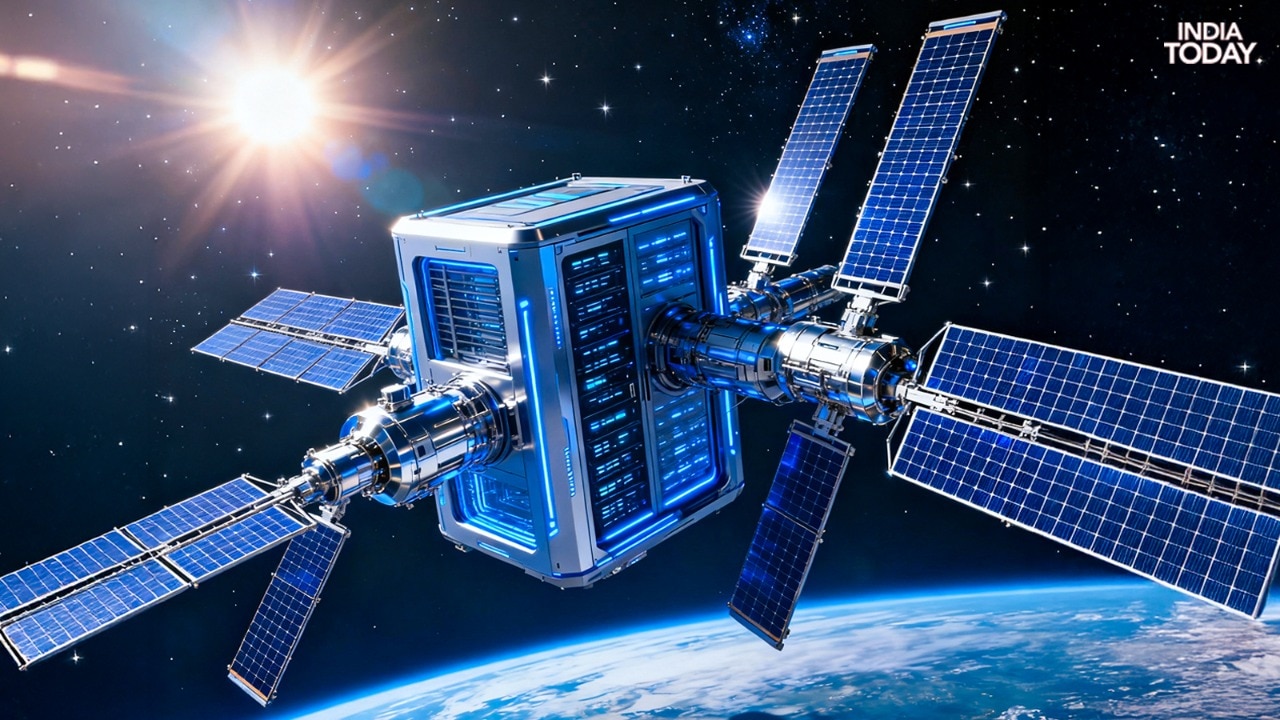
Google has been exploring ways to build AI data centres in space for a while. Now, its Project Suncatcher prototype satellite, launched on October 1, has successfully completed its first AI test in orbit. When engineers sent it an AI prompt, the satellite processed it and sent the response back to Earth. The test marks an important milestone in Google's long-term plan to move some of its AI computing infrastructure beyond the planet.The satellite was launched aboard a SpaceX Falcon 9 rocket, alongside more than 100 other spacecraft. After spending the next few weeks undergoing system tests, it finally completed its first AI task this week.Google CEO Sundar Pichai called it a “‘hello world’ milestone for Project Suncatcher” in a post on X. “After launching our prototype satellite a few weeks ago, we’ve now successfully sent a command up to orbit, booted up the TPU, ran the prompt, and received our first complete response back on earth - a haiku!” he added.Google's AI satellite writes a poem from spaceFor its first test, Google engineers sent a prompt to Gemma 4, an AI model developed by Google DeepMind and pre-loaded onto the satellite. They asked it to write a haiku about being in space. The satellite generated the following poem, which was then sent back to Earth: Blue marble belowData streams in silent grace Starlight feeds my core.Google also tested the model with space-themed limericks and prompts asking the satellite to report its technical status and surrounding orbital conditions.The satellite carries four Google Tensor Processing Units (TPUs), the company's custom chips designed to handle AI workloads. However, there is a catch. The satellite can generate up to 1 kW of electricity, but its power supply is not enough to run all four chips together. It can operate only one TPU at a time, and for around 20 minutes.Google is testing whether AI chips can survive in spaceRunning an AI model in orbit is not as simple as sending a computer into space. Google now needs to check how its TPUs perform under extreme temperatures and radiation.Radiation can cause what engineers call 'bit flips', where stored data changes unexpectedly. This can potentially corrupt information without triggering normal monitoring systems. Google says ground tests suggested that radiation could have a greater impact on AI training workloads than inference, but it now wants to test this in actual space conditions.Two more satellites planned for 2027If the current tests go well, Google plans to launch two more satellites in 2027. These will have greater power-generation capabilities and demonstrate optical links that allow satellites to communicate with each other.The bigger goal is to create networks of closely flying, solar-powered satellites that can work together on large AI workloads. However, this is still an early research project, with Google looking towards the 2030s for a potentially economical space-based computing system.The search giant has remained ambitious about AI data centres in space for a long time. Last year, in a blog post the company discussed that “In the right orbit, a solar panel can be up to 8 times more productive than on earth, and produce power nearly continuously, reducing the need for batteries. In the future, space may be the best place to scale AI compute.” The future has likely already begun unfolding with the poem from AI model Gemma 4.- Ends
Google's space-based AI data centre is now online, but it has a power problem
Full Article
Original Source
Read the full article at Indiatoday →KhanList aggregates and links to publicly available news content. We do not host full articles from third-party sources. Always verify important information with original sources.