
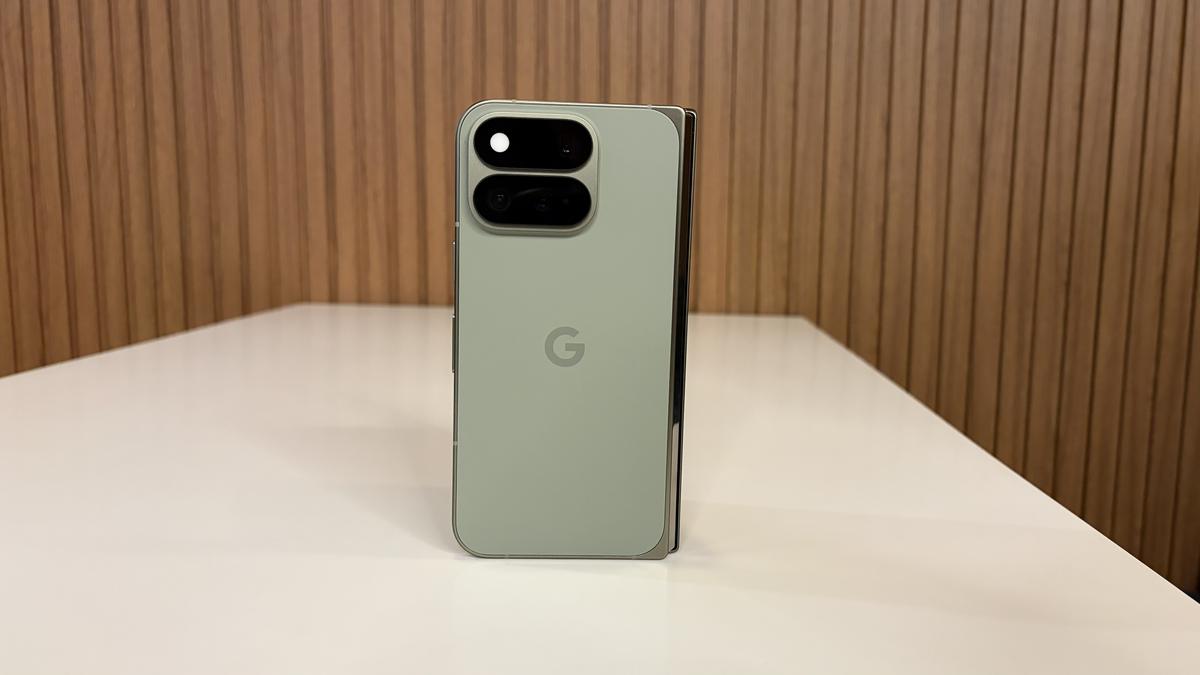
If the Google Pixel 10 Pro Fold marked a major step forward for Google’s foldable ambitions, the Google Pixel 11 Pro Fold builds on that foundation with a more refined approach.The foldable segment has become increasingly competitive, with Samsung raising the bar with its latest Galaxy Z Fold 8 and the Galaxy Z Fold 8 Ultra. Having recently used Samsung’s latest foldables, I found the benchmark for what a premium foldable should offer to be quite high. The Pixel 11 Pro Fold now has to prove that it has what it takes to turn up the heat.Compared to its predecessor, the Pixel 11 Pro Fold comes with a price bump of nearly ₹15,000. Available in a single 16 GB+512 GB configuration, the Pixel 11 Pro Fold is priced at ₹1,86,999. So, does Google’s latest foldable have enough going for it to challenge the best in the segment, or does Samsung still hold the upper hand? Let’s find out.DesignAt first glance, the Pixel 11 Pro Fold does not look dramatically different from the Pixel 10 Pro Fold. Google has retained the same overall large and wide form factor, but the new olive green colour gives the phone a fresher personality. The matte finish on the rear also continues to be one of my favourite elements, as it does a good job of keeping fingerprints away. The camera island, however, gets a visual refresh with a new dual-module arrangement that gives the rear a slightly different appearance.The Pixel 11 Pro Fold is also lighter than its predecessor, although it remains considerably heavier than Samsung’s Galaxy Z Fold 8 and the Galaxy Z Fold 8 Ultra. It is also thicker at 10.1mm when folded, compared to 9.7mm on the Fold 8 and just 8.9mm on the Fold 8 Ultra. At 155.2mm tall and 76mm wide when folded, it is a big foldable, and you notice that footprint when using it one-handed. Unfolded, it measures 150.4mm wide, giving you a sizable canvas without changing the fundamental dimensions too much from its predecessor’s.The construction itself feels premium. Google uses an ultra-durable glass ceramic cover glass, a composite matte back and a satin-finish spacecraft-grade aluminium frame. The multi-alloy steel hinge, covered with high-strength aerospace-grade aluminium, feels sturdy and reassuring. The power button and volume controls sit on the side, while USB Type-C 3.2 handles connectivity and charging. Opened up, the phone looks clean, with slim bezels surrounding the large inner display. However, Samsung’s more compact Fold 8 and the Fold 8 Ultra feel more refined from a portability perspective.Durability remains one of Google’s strongest arguments. The Pixel 11 Pro Fold retains IP68 dust and water resistance, while Google has also used recycled materials extensively throughout the device. The aluminium housing uses 100% recycled content, while the phone contains at least 24% recycled material by weight. So, while the Pixel 11 Pro Fold does not win the thinness or weight contest, it continues to feel like a solid, well-built foldable that is designed for everyday use.DisplayThe Pixel 11 Pro Fold gets a 6.5-inch Super Actua cover display with a 1080x2342 OLED resolution, 399ppi and a 1–120Hz refresh rate. This is a small step up in size from the 6.4-inch outer display on the Pixel 10 Pro Fold. More importantly, peak brightness now reaches 3,600 nits, up from 3,000 nits on its predecessor. HDR brightness can reach 2,000 nits, and the display supports HDR and 24-bit colour depth. During everyday use, the screen looks vibrant and remains easy to view outdoors.The 8-inch Super Actua Flex inner display remains the star of the show. It gets a 2076x2152 OLED resolution, 372ppi, a 1–120Hz refresh rate and ultra-thin glass. Peak brightness is also rated at 3,600 nits, making it significantly brighter on paper than the previous generation. Colours are rich, contrast is strong and the large canvas makes reading, browsing and multi-tasking particularly enjoyable.There is, however, one area where Google still has some catching up to do. The crease on the inner display is less prominent than before, but it remains a bit visible when compared with Samsung’s latest foldables. The Galaxy Z Fold 8’s crease is already difficult to notice during everyday use, while the Fold 8 Ultra does an even better job. The Pixel’s display is otherwise excellent, but for users who want the most seamless foldable screen experience, Samsung holds the advantage.OS and AIThe Pixel 11 Pro Fold ships with Android 17 and gets seven years of OS, security and Pixel Drop updates. As expected from a Pixel, software is one of its biggest strengths. Gemini Intelligence, Gemini Nano, Gemini Live and Gemini Apps are deeply integrated into the experience, making AI feel less like a collection of additional tools and more like part of the operating system. Features such as Circle to Search, Live Translate and Call Assist further expand what the phone can do.One particularly interesting addition is HiLight. It lets you interact with Gemini while the phone is lying face down, with an LED on the camera island indicating that it is active. It is an interesting idea that encourages you to stay present instead of constantly looking at the display, although I feel Google can still improve how useful and seamless it is.Rambler, meanwhile, makes voice-to-text message drafting more conversational, while contextual AI Overviews can surface useful actions, such as offering a Calendar link when someone suggests meeting up. The new Bubbles feature is also useful, letting an open chat float above other apps and minimise when needed. Samsung remains ahead in foldable-focused multi-tasking, but Google’s AI integration feels more natural.PerformanceThe Pixel 11 Pro Fold is powered by Google’s new Tensor G6 processor and comes with 16GB RAM and 512GB storage in the review configuration. During everyday use, the phone feels smooth and responsive, with apps opening quickly and multi-tasking remaining fluid. Google’s focus continues to be on AI processing and optimisation rather than simply chasing benchmark numbers.As I highlighted in my review of the Pixel 11 Pro XL, the Google phones are not big on scores. The Pixel 11 Pro Fold scored 2,281 in Geekbench single-core, 5,779 in multi-core and 3,213 in the GPU test. Its AnTuTu score was 1,369,819. The Galaxy Z Fold 8, powered by the Snapdragon 8 Elite Gen 5 for Galaxy, scored 3,510 single-core, 9,456 multi-core and 21,287 in the GPU test.What surprised me even more was that the Pixel 11 Pro Fold scored lower on AnTuTu than the Pixel 10 Pro Fold, which recorded 1,486,598. That is a drop of nearly 8% despite the move to the newer Tensor G6. Still, benchmarks do not tell the whole story. During actual use, the phone remains fast, animations are smooth and AI-powered functions respond quickly.Gaming performance is also good. Graphic-intensive titles such as BGMI, Asphalt 8 and Shadow Fight run smoothly at high settings, while the large inner screen makes gaming more immersive. Reading is arguably an even better use of the larger display. Watching films, however, does not feel radically different from other foldables because many apps still do not properly adapt their layouts to the unusual aspect ratio, leaving black bars around video content.CameraThe Pixel 11 Pro Fold continues to make a strong case for itself as a camera-focused foldable. Its triple-camera setup includes a 48 MP primary camera, a 10.5 MP ultrawide with autofocus and Macro Focus, and a 10.8 MP telephoto camera with 5x optical zoom and OIS. Super Zoom now extends to 30x, compared with up to 20x Super Res Zoom on the Pixel 10 Pro Fold. Pixel 11 Pro Fold camera sample | Photo Credit: Haider Ali Khan The primary camera is particularly impressive during the day, producing images with good clarity, detail and natural-looking colours. It also performs well at night. With a steady hand and a little precision, the camera can capture excellent detail while keeping shadows and highlights under control. Night Sight continues to be one of the Pixel’s strengths, and the overall processing does not feel excessively aggressive. Pixel 11 Pro Fold camera sample | Photo Credit: Haider Ali Khan The 5x telephoto is another highlight. Distant subjects retain good detail, and the additional reach is genuinely useful rather than being there simply to complete the specification sheet. Portrait shots also come out well, with good subject separation and pleasing background blur. The ultrawide, however, could have been better, particularly when compared with Samsung’s Galaxy Z Fold 8 Ultra, which gets a significant 50-megapixel ultrawide upgrade. Pixel 11 Pro Fold camera sample | Photo Credit: Haider Ali Khan Selfies are generally sharp and detailed, with the 10 MP cover and inner cameras doing a good job in most conditions. However, I occasionally found the processing on selfies slightly odd, almost as if the image had been adjusted more than necessary. Google also brings a long list of editing features, including Magic Capture, Camera Coach, Add Me, Night Sight, Rear Camera Selfie, Dual Screen Preview, Ask Photos editing, Magic Eraser and Zoom Enhance. Video recording goes up to 4K at 60fps, with Video Boost, Night Sight Video and Audio Magic Eraser adding further versatility.BatteryThe Pixel 11 Pro Fold packs a typical 4,806 mAh battery and promises more than 24 hours of battery life. Interestingly, this is actually smaller than the 5,015 mAh battery in the Pixel 10 Pro Fold, which delivered a full day with around 20% remaining in testing. The newer phone still manages a full day reasonably well, although the smaller capacity is not really an upgrade.Charging remains at 30W wired, with Google claiming the phone reaches 50% battery life in about 30 minutes using a compatible charger. The bigger improvement comes with wireless charging, which now supports up to 25W through Qi2.2-certified Pixelsnap, compared with 15W wireless charging on the Pixel 10 Pro Fold. This makes wireless top-ups considerably more useful, even if wired charging still feels conservative for a phone in this price segment.VerdictThe Google Pixel 11 Pro Fold is a refined continuation of an already strong foundation. The brighter displays, Tensor G6, expanded 30x zoom, improved AI experience, lighter build and faster wireless charging are meaningful additions. But some of the biggest changes are incremental, and the benchmark performance is surprisingly lower than the Pixel 10 Pro Fold despite the newer processor. The camera hardware also does not appear to bring a major leap, particularly when Samsung is now offering a 50 MP ultrawide on the Galaxy Z Fold 8 Ultra.At ₹1,86,999, the Pixel 11 Pro Fold remains an excellent choice for someone who values Google’s clean software, AI capabilities, photography and long-term updates. However, Samsung now offers a stronger overall value proposition for users who prioritise hardware, multi-tasking, thinner design and foldable-specific software.For existing Pixel 10 Pro Fold owners, the upgrade is difficult to justify unless the newer AI features, brighter displays and 30x zoom specifically appeal to you. For a first-time foldable buyer, meanwhile, the Pixel 11 Pro Fold is a compelling option, but it will take a lot of persuasion when considering the competition.
Google Pixel 11 Pro Fold Review | Builds on a strong foundation
Full Article
Original Source
Read the full article at Thehindu →KhanList aggregates and links to publicly available news content. We do not host full articles from third-party sources. Always verify important information with original sources.