
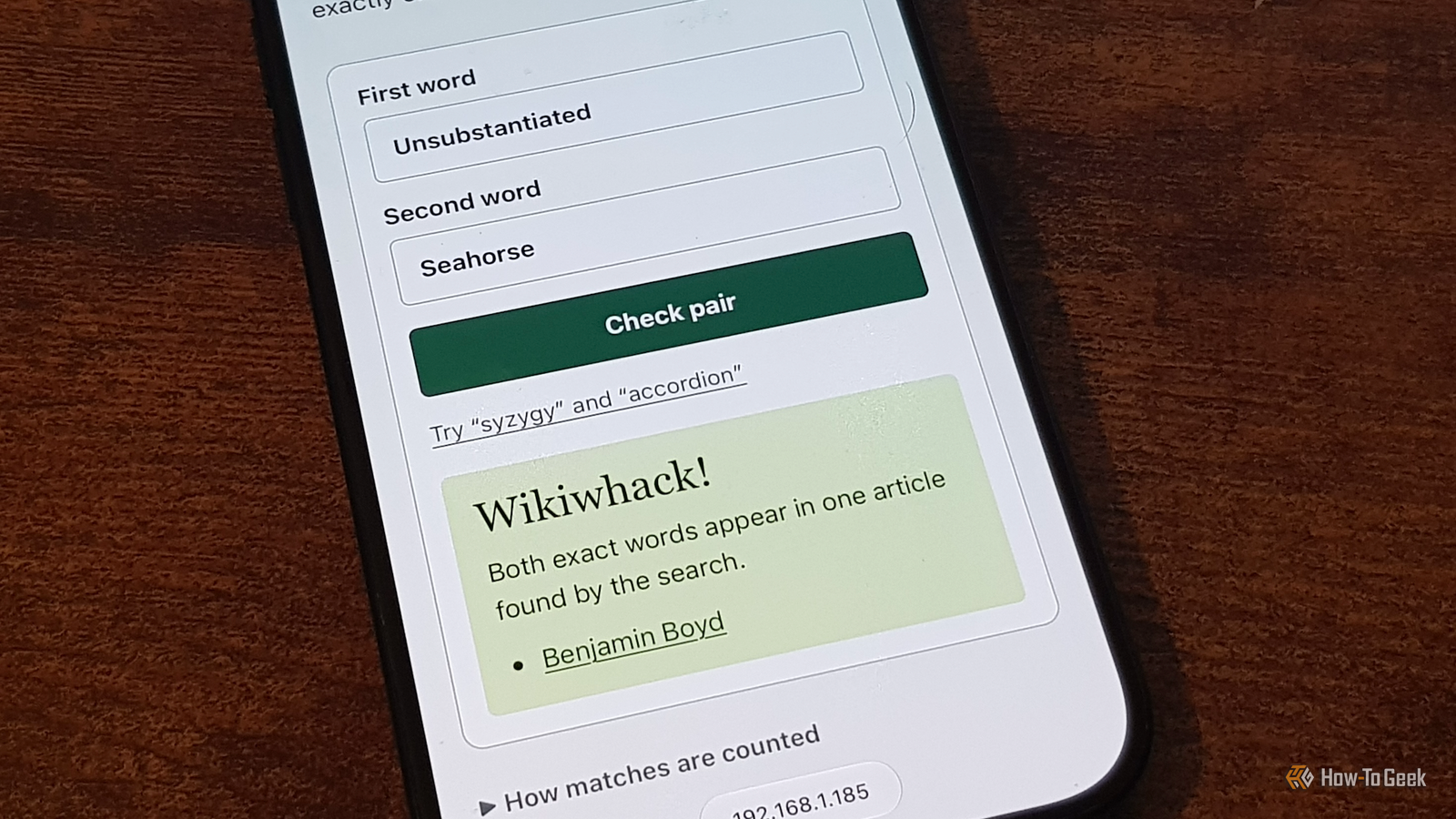
Published Nov 14, 2026, 7:00 AM EST Adam has a degree in Engineering and has a life-long interest in technology. He has been writing for over a decade for various print and online publications, with a focus on consumer tech. He joined How-To Geek in 2024 while working at Pocket-lint. As well as being a long-term fan of Apple products, he also has a strong interest in smart home tech, running a Home Assistant server at home to automate all his smart home devices. He believes that the ideal smart home should work with minimal interaction from the user, with automations running as if by magic rather than requiring you to push buttons on a control panel. You can find more of his work on Muck Rack. Back at the start of the century, you could play a game just by entering two words into Google Search. Like seemingly all things, it was soon completely ruined by Google changing its search algorithms. A quarter of a century later, I managed to recreate my own small version of Googlewhacking. Googlewhack was a game hiding in Google Search The challenge was to find a unique page from the internet In the early days of Google Search, it would actually search for the words you typed into the search field, instead of looking at what you typed, ignoring most of it, and then serving up the results that are most likely to earn Google even more money. For example, if you typed in an obscure word, Google Search might only return a handful of webpages that contained that word, and you’d see a count at the bottom of the page saying something like “Results 1-12 of 25”. The Googlewhack game was simple. You had to enter two dictionary words without quotes, which would give only a single result. In other words, you had to find two words that only appeared together on one single webpage in the whole of the internet. Or at least, the whole of Google’s index. The term Googlewhack was coined by Gary Stock, and for a while the game was popular among like-minded geeks, even inspiring a book and comedy tour by the English comedian Dave Gorman, which I was lucky enough to go and see. Googlewhacks became increasingly rare, since as soon as someone posted on a webpage that they had discovered one, that combination of words would then appear on at least two pages, so it would no longer count. I realized I might have what I needed to recreate a version of the game The whole of Wikipedia was sitting on my PC Sadly, the game had to end when Google updated search. Google Search no longer looks for the terms that you search for alone; it also considers what it thinks you might have been searching for, and gives you results that are beyond the scope of the exact keywords you enter. Google Search is so much worse now, so it was a lose-lose for users. I was writing an article about how I was able to download an offline copy of Wikipedia and use it to provide a local LLM with access to a huge amount of information, and I'd also added a smaller offline version of Wikipedia to my Kindle. I realized that I potentially had what I needed to make my own Googlewhack game. Instead of looking for single pages from the internet that contained two words, I could try to find single pages of Wikipedia instead. It would be like Googlewhack on a smaller scale: Wikiwhack. Kiwix search was too broad to work It would suggest plurals that weren’t found on the relevant pages Credit: Wikipedia As soon as I had the idea, I knew I had to try it. To my delight, the ZIM file I’d downloaded containing my offline copy of Wikipedia already included a full-text index. This allows Kiwix to look up articles based on a keyword without having to open millions of Wikipedia pages for each search. The index was already built and included in the archive, so I was immediately able to search for two random words to see how many Wikipedia pages it returned. I decided to go as obscure as I could, so I chose “syzygy accordion,” and to my delight, it came back with a single hit: the Wikipedia page for the Swiss composer Eric Gaudibert (you can check for yourself that both words appear). My delight was short-lived when it turned out that the same page would be returned for a search for “syzygies accordions” even though neither of those words appears on the page. The search tool uses a system called stemming, where it will accept variants of the keywords, so it might return what appeared to be a Wikiwhack when the exact searched words didn’t actually appear on the page at all. A small Python app checks if you’ve won Kiwix finds the candidates and the code does the rest The solution was to use search to provide candidate results, and then use a small Python script to look at each of those candidates in turn to see if the words actually appear in the correct form. As soon as two different pages have been found to contain both words, the script can stop, as the combination can’t be a Wikiwhack. If one confirmed article is found, the script keeps searching through the other candidates to ensure that it really is the only page containing that pair of words. Using this script, I was able to set up a small web page where I can enter potential Wikiwhacks, and see if I’ve won or not. It’s just like the real game, but on a smaller scale. For example, the combination “unsubstantiated seahorse” is a Wikiwhack, but “inconvenient misalignment” is not. The game runs locally, and I did consider turning it into a real online game, but the cost of hosting the Wikipedia archive put me off, so unfortunately you’ll have to set up your own version. Ask Claude Code or Codex, and they should be able to have it up and running for you in no time. I can now hunt for whacks like it’s 2002 I’ve really enjoyed trying to find Wikiwhacks. I’m still paranoid about whether it really works, so I always double-check the pages if the game says that I've won. It’s a great way to learn some random facts, such as the fact that the music of WikiWhack Eric Gaudibert was inspired by one of my favorite artists, Paul Klee. Thanks, Wikiwhack!
Google killed my favorite internet game years ago, so I rebuilt it using Wikipedia
Full Article
Original Source
Read the full article at Howtogeek →KhanList aggregates and links to publicly available news content. We do not host full articles from third-party sources. Always verify important information with original sources.