
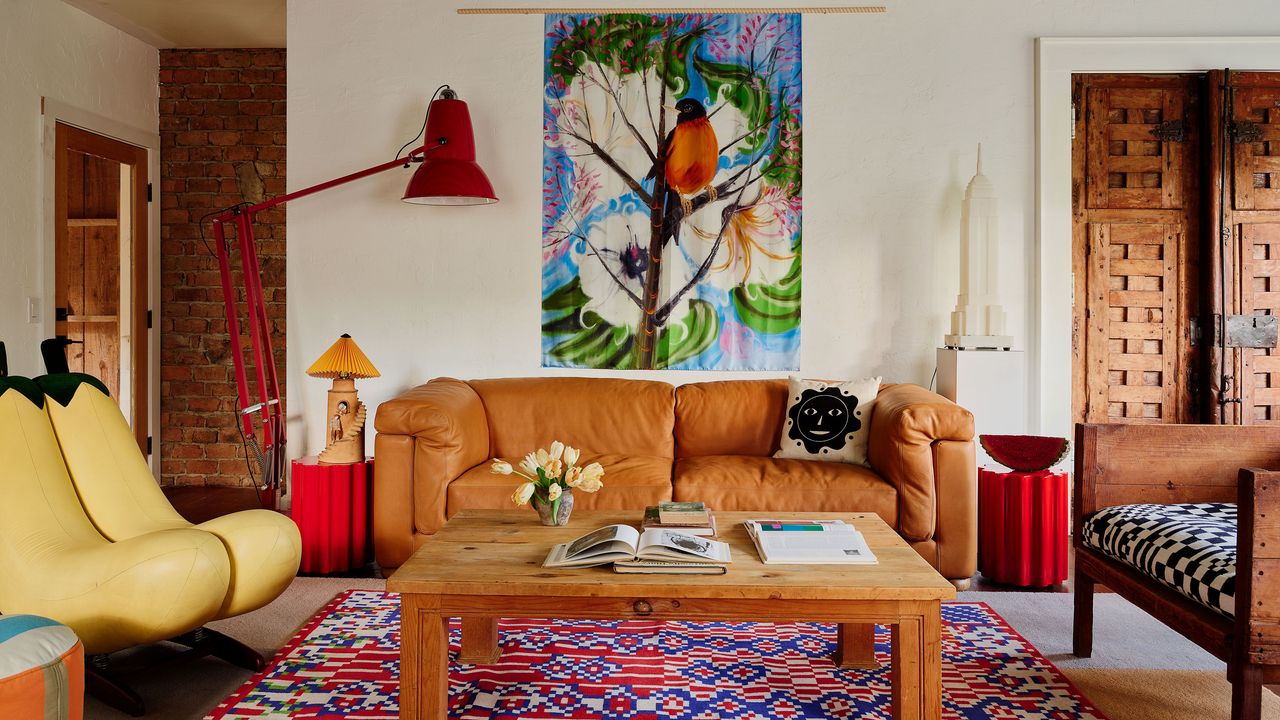
For the past two decades, the tasteful room was instantly recognizable: The materials were natural, the sofa was low, the lighting warm, and the whole thing communicated an expensive serenity that photographed beautifully.That ease is part of a larger problem. As design becomes more accessible, searchable, and shoppable, the traditional markers of good taste have lost authority. A Terrazza sofa, USM credenza, zellige tile, the perfectly deployed vintage Pacha lounge chair—they remain beautiful, but are so algorithmically ubiquitous, their gestural sense of “taste” has been neutralized.As people deviate from the expected design darlings, it’s no wonder good taste is becoming stranger and harder to recognize. This new approach defies categorization. It’s idiosyncratic, funny, historically aware, and more compelling than conventionally beautiful. It’s the object, color, gesture, or arrangement that resists immediate consensus. You can copy the pieces, but not the perspective that brought them together.A bathroom ceiling is covered in a watery wallpaper in this Los Angeles home by Leah Ring. Photo: Lance Gerber“To make it work, we needed a big rug to define the living room zone, and I honestly fretted about it for almost a year until I settled on the lively yellow perforated rug from Brooklyn-based Bi-Rite Studio,” creative director Sarah Keenlyside says of her Milan home. Photo: Patrick BillerThe data confirms the shift. Tony Freund, editorial director at 1stDibs, told me that the marketplace has been tracking “growing collector interest in furniture, art and objects that are chock-full of personality,” whether offbeat, surreal, or simply more vivacious than traditional good taste might have previously allowed. Searches on 1st Dibs for Salvador Dalí grew 19% from March to May of this year, while Alessandro Mendini surged 135% during the same period. Saves for surrealist-style art are up 23% year-over-year, in large part justifying the vintage retailer’s newly launched “Wonderfully Weird” collection.Freund traces the roots of this appetite to the pandemic, when people wanted homes with “distraction and joy” while stuck at home in an uncertain world. They wanted enchanting things with provenance, unexpected materials, strange biographies, or acquisition stories worth retelling.The shift feels more meaningful when you consider that interior aspiration has long centered around avoiding mistakes—not looking cheap or dated, like you didn’t try hard enough, or worse, that you tried too hard. Perhaps the most persistent fantasy in interiors is that a room can somehow escape its own time.Frances Merrill of Reath Design put it plainly: “The design that was dated the fastest is probably what was the safest at the moment.” She made the case for personal conviction: “It’s expensive to hire an interior designer. If you’re gonna do it, you might as well be getting what you like.”AD’s own archive reflects the shift. In Leah Ring’s Gracia LA project, the brief wasn’t “make it timeless” but “make it weirder”—a directive that materialized in an “underwater” guest bathroom with vintage jade fixtures, patterned tile, and themed wallpaper across the ceiling.Jennifer Shorto wallpaper complements the burgundy beams and walnut benches covered in an Osborne & Little weave in the dining room of a Los Angeles home by designer Frances Merrill. Photo: Laure JolietMeanwhile, Charlap Hyman & Herrero’s Los Angeles wonderland ventures into full surrealism with design-world literacy: Fornasetti clouds, gnome tables, a Nicola L eye lamp and insect-filled woodland fabric. The design studio’s cofounder Adam Charlap Hyman sees clients responding to designs with “depth and obscurity” in a way that simplicity and clarity no longer do; a craving, he suspects, for the material in both senses of the word.The same desire is showing up in material preferences: the return of Murano glass, prized for the one-of-one character of its making; and even chainmail, whose appeal lies in contradictions (hard but draping, severe but decorative, medieval but newly contemporary). The weathered clay vessels turning up recently in AD homes draw their appeal from irregularity, patina, and evidence of a life before the room. Strangeness, more than ever, seems to reside not only in what an object looks like, but the specificity of how it came to exist.“The cream ceramic has this patina to it that you’re not going to get no matter how much money you spend trying to,” says designer Barry Fox of a 1920s LA home he redesigned. “It’s so good.” Photo: Sam FrostRing says many clients come to her wanting “a decidedly weird, unique, and personalized space unlike anything they’ve seen before.” She creates that tension by blending eras and celebrating the “collectibles” and “family heirlooms,” alongside the quirky objects gathered on travels that clients might otherwise feel tempted to hide.Though “quirky” understates what’s really happening. These quirky objects are not always an accessory; they’re often the thing that gives a room its emotional center. Merrill recalled one client’s full-sized polar bear as “the kind of request she had been waiting her whole life to receive.” She underscores the importance of inherited pieces: “I’d fire myself if I told you that we couldn’t use your dad’s desk.” The desk may not be the “right” one. It may very well complicate the room. But a home that cannot absorb something deeply meaningful is striving for taste at the expense of inauthenticity.At its best, weirdness carries context: A five-legged 19th century Louis XVI chair, an exceptionally expensive tissue box cover, and a surfboard in a mountain lodge; a formal portrait wall of strangers or a mahjong corner treated like an altar—they’re all distinct reflections of the owner’s humor and personality.The risk, of course, is that weirdness becomes just another aesthetic. Buy the wavy mirror, add the odd stool or conversation piece and wait for personality to arrive. Designer Oliver Furth is rightly allergic to that. “Weirdness for weirdness’ sake is nothing more than clickbait.” The difference between a room with a point of view and a room wearing a costume is intention.In the kitchen of a Los Angeles home by designer Frances Merrill, a custom banquette wears a Knoll mod plaid complimented by Shaker chairs by S. Timberlake and cabinets are painted in Benjamin Moore’s Lafayette Green. Photo: Laure JolietAI only raises the stakes. It can aggregate all that has been liked, saved, published, and purchased. It can reliably reproduce decent taste in a moment’s notice. What it can’t generate is memory. In this context, good taste is not becoming random, it’s just becoming harder to fake. Its future may depend on what can’t be scraped, searched or moodboarded: memory, biography, obsession, and conviction. AI doesn’t know that the clashing nightstand should stay because it survived your first apartment, that the too-large painting gives the room its necessary arrogance, or that the life-size ceramic dog from your grandmother’s kitchen is a better fit than the more credentialed design could ever be.This doesn’t mean you should run to buy something bizarre or inelegant. As Pamela Shamshiri put it, “‘Weird’ doesn’t mean chaotic;” an object’s craftsmanship, detail, or inherent beauty “has to earn its place.” Mix old and new, easy and uneasy. Choose what makes the room feel alive, rather than correct. Ask if you’d still want it if no one recognized it.Shop Something StrangeZara Mesh Metal Magazine RackPorta Palio Chiocciola Dinner PlateOlivier Mourgue ‘Flower’ Wall Applique Sconce‘Suspiral’ Chair by Luigi Serafini for Sawaya & MoroniAmazonia Vase by Gaetano PesceLaguna Gold Crystal Wall Mirror by Speechi VenezianiSoft Shelves by Manon RitalyAmethyst Murano Glass Wall Hook with Millefiori by SARIYERCellophane Ovale by Sophie Bille BraheAbalone Wood Inlay Toucan Pitcher by Jeronimo Fuentes
Good Taste Is Getting Weirder
Full Article
Original Source
Read the full article at Architecturaldigest →KhanList aggregates and links to publicly available news content. We do not host full articles from third-party sources. Always verify important information with original sources.