
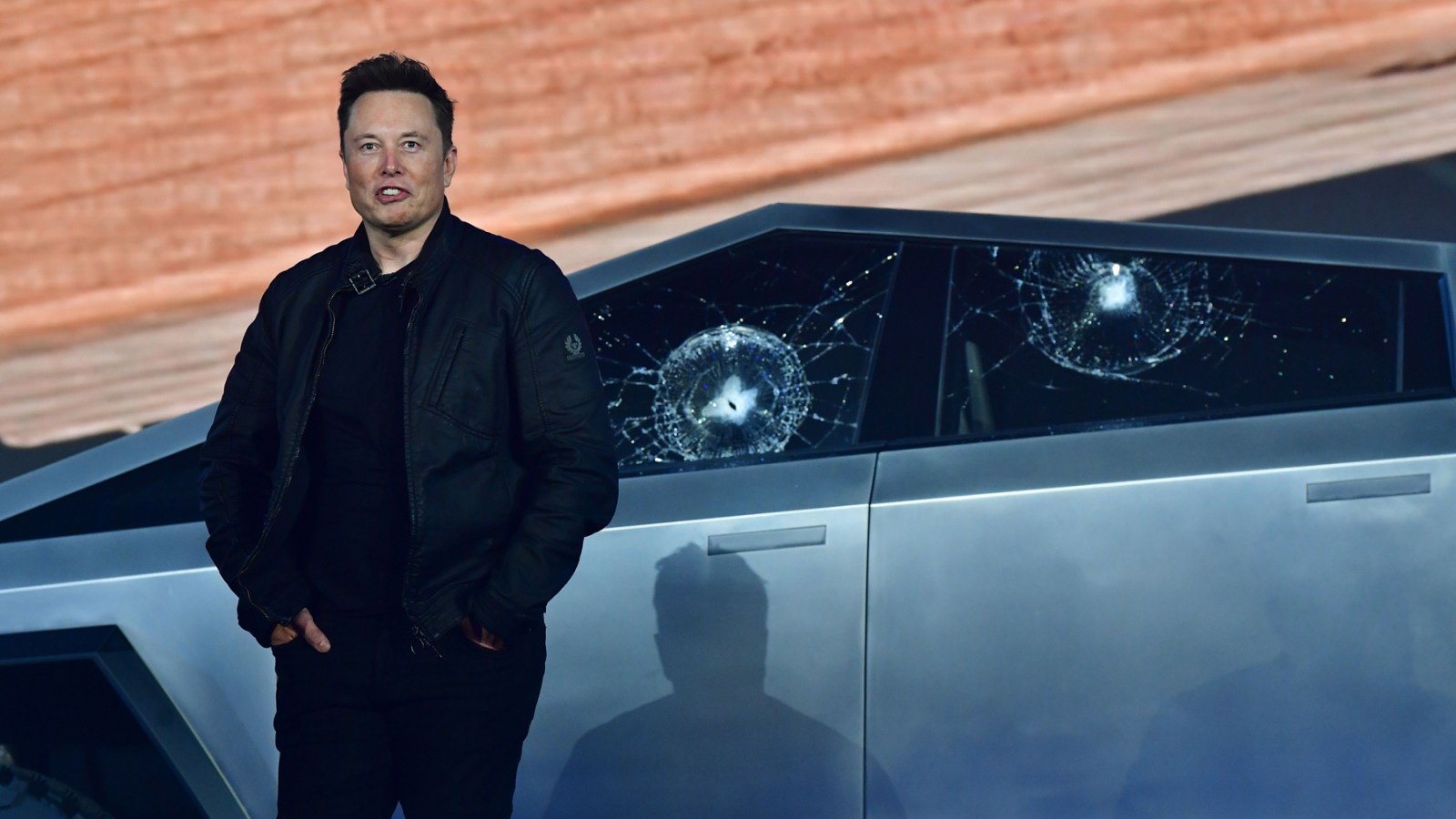
A eulogy for Elon Musk’s ill-advised and barely functional emblem of a failed and stupid era In early 2024, I started seeing one particular Tesla Cybertruck driving around Brooklyn. It was the first one I’d seen — a matte black version with a decal on the side that said “To the Moon,” a common phrase associated with trading cryptocurrency. I remember seeing it pop up in Williamsburg, in Greenpoint, and scattered spots throughout Bedford Stuyvesant and Crown Heights. At the time, it was a novelty — the only evidence I had seen in my little New York bubble that anyone was willing to buy these things. Evidently, though, people did buy Cybertrucks. Just not enough of them. All told, Tesla sold around 70,000 of the vehicles between their release in November 2023 and Friday, when CEO Elon Musk announced that the company would wind down production in favor of a new self-driving taxi, the Cybercab. When the Cybertruck launched, Musk predicted it would sell 250,000 units a year, one of many confident claims the tech billionaire has delivered that wildly overshot the mark. Very few of his products, it turns out, do actually go to the moon. But how could we ask for a better emblem of this stupid, violent, get-rich-quick era of America? The Cybertruck was a vehicle designed to the specifications of one man, who made himself the richest person in the world through a savvy combination of government kickbacks, stock manipulation, and viral marketing stunts. They were designed to look like a futuristic war-vehicle, manufactured in Texas at an absurdly named building called the Gigafactory, and equipped with bullet-proof side panels and doors. The Cybertruck was a car built for the paranoid fantasies that have gripped so much of a country destabilized by generations of economic theft. Electric to assuage the existential worry of climate change, bullet-proof to match America’s extremist gun culture and pervasive fear of crime, shaped like a video-game toy to please the frontal lobes of a generation doused in the recycled franchises of comic book heroes and supersoldiers. Editor’s picks They were also absolutely dogshit cars. The electric systems were prone to software bugs. Some trucks were known to shut down completely when they got wet. Their odd shape and bizarre design made them impractical for hauling, loading, or towing anything. In 2025 the company recalled 46,000 of them because it found they had a specific piece of side panel that fell off in the cold. Almost immediately after they came out, automotive YouTubers and professional mechanics posted videos of Cybertrucks that came in with ill-fitting body work and shoddy production quality, in itself a common hallmark of Tesla’s more recent vehicles. To be fair, the doors were bulletproof, provided you shot them with a small enough caliber of gun and didn’t aim for the windows. Shortly after announcing the Cybertruck, Elon Musk made an overt political move in backing Donald Trump’s 2024 campaign for president, pouring nearly $300 million into a dark money organization called America PAC and other ventures. Online, he ranted about trans people (he has a trans daughter who hates him), immigrationillegal immigrants (he was born in apartheid South Africa), and “woke” politicians pushing DEI policies (his factories were reported to be alleged hotbeds of racism and sexual harassment that have resulted in multiple lawsuits). When Trump took office in 2025, Musk leapt into a role as head of the Department of Governmental Efficiency, or DOGE, which itself was a reference to a 2010s-era Reddit meme about the Shiba Inu dog breed that subsequently inspired one of the first crypto “shitcoins.” DOGE promptly fired thousands of federal workers, ground multiple government agencies to a halt, and eviscerated USAID, a decision which directly contributed to tens of thousands of preventable deaths overseas of disease and famine in resource-starved regions of the developing world. Excited dorks who had signed up to buy the Cybertruck found themselves having to slap on bumper stickers that said “I bought this before Elon went crazy” so they wouldn’t get vandalized in public. Others, like the crypto nerds and Trump-friendly bros who made up the enormous middle section of the MAGA-Musk Venn Diagram, often decided to double down, wrapping their Cybertrucks with right-wing decals and tinting their windows with American flags. Simply driving one in public became a political statement, whether the driver intended it or not: I’d be lying if I said I didn’t sneer a little every time the matte-black to-the-moon-mobile drove past me in Brooklyn. Related Content I’ll admit, I was predisposed to hate the thing. A decade ago, in what feels like another life, I was a tech reporter at a startup publication that catered specifically to the Cybertruck demographic (though the truck itself didn’t exist yet). Our audience loved Marvel movies, sci-fi nostalgia, and Obama-era techno-optimism. Above all else, they loved Elon Musk. Musk, at the time, was presenting himself as a future-focused benevolent tech pioneer, with cameo roles in Iron Man II and a non-stop stream of quirky gags online, like his cars’ “Ludicrous Speed” mode and an Easter egg on the onboard computers that played the “Nyan Cat” meme. If those words mean nothing to you, that’s probably a good thing. Trending Stories What it showed, however, was Musk’s core nature, as a nihilistic salesman who would say anything in order to sell his products, no matter how divested from reality they were. Case in point, in 2017 Musk said that the “Fully Self Driving” feature on his Tesla vehicles could make them capable of “hands-free cross-country road trips” by the end of the year. Autonomous driving technology has come a long way since then, but the road trips never happened. Instead, Musk moved on to other schemes and startups, some successful, some not. The Cybertruck’s successor, the Cybercab, hopes to compete with Google’s driverless Waymo project, though neither vehicle is capable of those fully autonomous road trips yet. Maybe in another 10 years. By that time, I would be shocked if there are any Cybertrucks left on the road. Perhaps they’ll sit on blocks in the front yards of high-school dropouts who hit it big in the 2020s crypto booms. More likely they’ll end up as scrap, their somewhat bullet-resistant steel panels crumpled down or gathering rust while their massive lithium-ion batteries leech chemicals into the groundwater of some unfortunate industrial dump-adjacent community. Elon Musk, of course will still be rich, his companies subsisting off of an endless spigot of government cash and circular stock buybacks, no matter how many elections the Democrats manage to win. But maybe, if you squint a little, you can see a different future, one in which the occasional real and valuable advances made under mercurial hucksters are used for the greater good, instead of hoarded by monopolies enabled by politicians on the take. Maybe someday we’ll see the Cybertruck as a relic of a dark period in our past, and not a dire portent of the even more broken future down the road.
Good Riddance to the Cybertruck, the Chariot of the Dumbest Gods
Full Article
Original Source
Read the full article at Rollingstone →KhanList aggregates and links to publicly available news content. We do not host full articles from third-party sources. Always verify important information with original sources.