
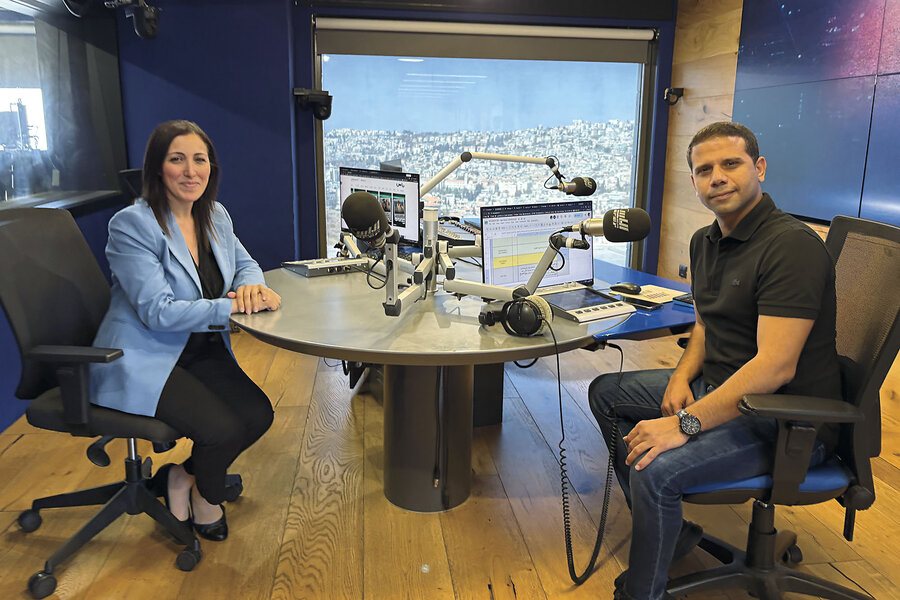
Nof Hagalil, Israel | Oct. 23, 2026, 4:21 p.m. ET | 11 min read It’s 8:30 a.m. and Mohammad Magadli and Sanaa Hammoud are sitting across an oval desk in a glass-enclosed soundproof studio. They have been on the air since dawn, reporting the news at the popular Arabic language station Nas Radio.On this morning’s program: The United States and Iran are negotiating over the Strait of Hormuz. The first day of school in Israel is coming up. And just this morning, Israeli authorities demolished buildings in nearby Arab towns.Below the studio, through floor-to-ceiling windows, is the view of Nazareth, a city in the hills of the Galilee. It’s the largest Arab city in Israel, a collage of tightly packed limestone-clad apartment buildings, minarets, mosques, and church spires. The city’s most prominent landmark is a large, modernist basilica built over the spot where, according to tradition, the angel Gabriel told Mary she would give birth to Jesus. The mix of cultures within the Arab population of northern Israel, the only part of the country where Arab citizens constitute the majority, is reflected within the 50-person newsroom of Nas Radio. There are Muslims here, as well as Christians and Druze. Together, the news anchors say, it is a diverse group that gives unique insight into the stories that impact the lives of its listeners.Down the hill from Nas Radio, or Radio al-Nas in Arabic, which means “the People’s Radio,” customers are filing into bakeries selling honey-soaked baklava and semolina cookies, and the narrow, winding streets are snarled with traffic. Inside the studio, the flagship morning broadcast is wrapping up. Dina KraftJawad Omary, a producer, adjusts sound levels as Mohammad Magadli, news director of Nas Radio, and Amir Oren, a veteran military affairs reporter, discuss upcoming Israeli elections. Afaf Sheeny sits at her desk in the newsroom. She looks up from her laptop where she’s finalizing a script for a local news broadcast that starts in 30 minutes. “I’m the host, so don’t have much time to talk,” she apologizes, motioning toward a digital clock on the wall.Mr. Magadli and Ms. Hammoud remove their earphones, push back their microphones, and sink into swivel chairs. Their razor-sharp broadcast postures begin to relax. “When we discuss main news items, you see how different people look at it, each from a different angle,” Mr. Magadli says. “It’s always interesting, and it also gives added value to the news we make.”It’s 8:58 a.m. The next show is about to go live.Nas Radio opened in 2020 and quickly became one of the most listened to Arabic language radio stations in the country. Radio, more than TV news or newspapers, is the predominant source of news for Arab citizens of Israel. They make up 21% of the country and they live largely separate lives from the Jewish population, though integration has been on the rise, especially on university campuses and through the healthcare system.Mr. Magadli, who co-founded the station with Fares Khatib, a friend and former BBC producer, says the goal of Nas Radio was to be a voice for in-depth, independent journalism in Arabic – a place for listeners to engage with day-to-day political and personal issues for Israel’s Arab population.Palestinian citizens of Israel, which is how many refer to themselves, are descendants of the Arab population that remained in the country following the 1948 war and founding of the modern-day state of Israel. Hundreds of thousands of Palestinians at the time left or were pushed out, but some Arab communities stayed in Israel. Dina KraftAfaf Sheeny, host of a program focused on local news at Nas Radio, gets up from her desk ahead of stepping into the studio to go on air, Aug. 4, 2026. Nas Radio does something uncommon. It provides a range of perspectives on regional news, including the wars in Gaza, Lebanon, and Iran. It also covers current events inside Israel. Mainstream Israeli news in Hebrew focuses squarely on the Jewish Israeli experience. That has been especially true since Oct. 7, 2023, when Hamas breached the border fence in Gaza, killed around 1,200 people, and took more than 250 others hostage. It was the deadliest day in the country’s history. The war in Gaza that followed has claimed more than 74,000 Palestinian lives, according to Gaza’s health ministry, both civilians and militants.On Nas Radio, the same broadcast can feature interviews with a father living in Gaza trying to provide for his family, the relative of an Israeli hostage describing the agony of having a loved one captured by Hamas, and an academic in Lebanon analyzing the fighting between Israel and Hezbollah.“It’s the only media outlet that shows a 360-degree picture,” Mr. Magadli says.Shortly after 9 a.m., Ms. Hammoud leaves the studio, settles into a chair, and pushes back a lock of dark hair that has been blown-dry pin straight. She says that even after 30 years of doing live radio and TV, she still needs a few moments to unwind after a broadcast. A self-described “workaholic,” she has been up since 3 a.m. today, prepping for the 7 a.m. show.“It’s not always easy listening, but we are able to hear directly from the sources, these voices from the streets – and as Palestinian Arabs living in Israel we understand all the complications,” she says. Providing a “bridge” between the Arab and Jewish populations of Israel, says Mr. Magadli, is an intentional goal for this station, “so that both will know more about each other.”Mr. Magadli made a name for himself as the first Arab analyst on a major Israeli TV station. His father is a former Israel Labor Party lawmaker and government minister. Like much of the young, ambitious staff here, he is fluent in both Arabic and Hebrew. Oded Balilty/AP/FileTwo Christian nuns (photo center) look out from Mount Precipice, near the northern Israeli town of Nazareth. The radio station’s biggest ongoing story is violent crime. Israel’s figurehead president has declared the crime crisis in Arab cities a “national emergency.” But many Arab citizens say the situation has further deteriorated under far-right National Security Minister Itamar Ben-Gvir.Mr. Ben-Gvir was thrust from being a fringe ultra-nationalist provocateur to the center of Israeli political power four years ago, when Prime Minister Benjamin Netanyahu granted him a Cabinet position. For Arab citizens of Israel, Mr. Ben-Gvir and his far-right political allies are seen as a threat to their safety and security.Nearly 80% of homicide victims nationwide last year were Arab citizens. Only a tiny fraction of those cases have been prosecuted. This reality is deeply personal for much of the staff at Nas Radio. They know murder victims and their families. They live in fear of being shot by a stray bullet from the drive-by-shootings so commonplace that parents move their children’s beds away from windows.The situation has become so bad, Ms. Hammoud says, she secured arrangements to send all three of her children abroad. Her oldest, who just graduated high school, will attend college in Spain. And her twins, a boy and a girl in the 10th grade, will be studying at a boarding school in Switzerland.“I feel like a big stone has been lifted from my heart now that my kids are going to a healthy and safe place where they will be both politically secure and away from the violence,” she says. Ms. Hammoud grew up in the mixed Arab-Jewish seaside city of Acre, whose stone buildings and ancient port speak to its layers of Crusader, Ottoman, Arab, and Jewish history over the centuries. In school, she was sometimes the only Arab girl in her classes.“I always had to explain who I was. This sense of trying to preserve my identity stayed with me throughout my childhood and influenced my decision to become a journalist,” she says.After doing internships at both CNN and Al Jazeera in Washington early in her career in the 1990s, Ms. Hammoud returned home, hoping to bring more journalistic attention to the Israeli-Palestinian conflict. She eventually settled in Nazareth, finding herself living in an Arab city for the first time.She describes it as a revelation, both the joy that came from being immersed in an Arabic-speaking community and the difficulty of living near criminal violence. Someone from her apartment building lost his legs after a bomb was planted under his car.There are days she weeps after interviewing bereaved family members who lost loved ones to the crime epidemic or the war in Gaza. “We are people at the end of the day; these conversations impact us. I am interviewing mothers who lost sons and daughters on a daily basis. It’s extremely painful,” she says. Dina KraftA staffer works on the Radio Nas website in the newsroom in the late afternoon. After Oct. 7, she says she felt personally at risk as an Arab journalist in Israel for the first time. She reported on fellow Arab citizens, from professors to a famous singer and a nursery school teacher, who were arrested for online comments deemed sympathetic to Hamas. It brought home the risks of saying anything that might be construed by authorities as subversive, she says.Arab citizens’ civic identity is Israeli but their national identity is Palestinian, and their identification with those in the West Bank and Gaza leads some Jewish citizens to view them as less than loyal. In November 2023, a prominent local Arab leader and former lawmaker was detained after doing a radio interview with Ms. Hammoud. He had talked about organizing an anti-war protest. She was so worried that she might get arrested herself, she wrote the number of her lawyer, the contact for her kids’ counselor at school, as well as a list of their extracurricular activities, and put it into her husband’s work bag.“I am a journalist,” she says. “We are part of what happens here. We live among our listeners.”From 10 to 11 a.m., an hour of musical programming runs in a smaller studio, while in the main studio Mr. Magadli sits down for an Israeli politics podcast with host Amir Oren, a seasoned former military affairs correspondent and columnist.Israel’s Oct. 27 elections are seen as a referendum on Mr. Netanyahu’s leadership and the question of his culpability in the Oct. 7 attack. It’s often described as the most consequential vote in the country’s history – by both his supporters and those determined to oust him from the prime minister’s office.On this day in August, there is breaking news about a retired police commander, a Jewish Israeli named Yoav Segalovitz, contemplating the unprecedented move of joining the slate of Ra’am, a conservative Arab Muslim political party. (The move would become official a few weeks later.) The shared top priority for Mr. Segalovitz and the members of Ra’am is fighting crime.On the other side of a glass window, producer Jawad Omary is adjusting audio levels on a mixing board and recording video of an exchange inside the studio that will be uploaded later to YouTube. Mr. Omary is not convinced that any opposition parties running in the elections will fundamentally change the baseline sense of inequality in Israel between its Jewish and Arab citizens. “Racism in Israel since October 7 has shot up. In the street you feel it, in the courts you feel it, even in the hospitals you feel it. The whole country changed after October 7,” he says. Dina KraftA tray brimming with cheese, olives, and salads arrives at the table as Nas Radio news director Mohammad Magadli and Amir Oren, his guest and a veteran military affairs reporter, sit down for lunch. By 12:38 p.m., the politics podcast has wrapped and Mr. Magadli invites Mr. Oren downstairs for lunch. The 1 p.m. broadcast will start soon.Nas Radio is located on the top floor of a high-rise hotel owned by local businessman and social activist Ziad al-Omari, who provided the initial financial backing for the station. The building is on the edge of Nof HaGalil, founded in 1957 as a Jewish city bordering Nazareth.Downstairs, a full spread of traditional Arab dishes are laid out for lunch: labneh cheese, finely chopped tomato and cucumber salad, hummus, tahini, and piping hot fresh pita bread.Mr. Magadli and Mr. Oren are discussing the career paths of young journalists in Israel. Most Jewish Israeli broadcast journalists get their training with Israel’s Army radio station.“In Arab society, there is no such path,” says Mr. Magadli. He began his career with the Arabic language section of i24 television news, and then worked for a Palestinian broadcaster in the West Bank. At first, he says, when he entered the Hebrew news media landscape, he had to fight to prove himself as a journalist – there were no other Arab commentators on mainstream news channels.“Today, the mission is different,” he says. Since the start of the war in Gaza, “the struggle in the Israeli media is to prove that you are not against the state of Israel.”He has been called an “enemy” for recounting on the air how family members in Gaza told him about soaring prices for a bag of flour. He’s no stranger to death threats, both from the Jewish community and from Arab organized crime figures.At 2 p.m., Mr. Magadli is back in his office meeting with Fadi Zaraimi, a therapist by profession, who is on air from 3 p.m. to 5 p.m., first with a music program and then a call-in segment where he leads conversations about social issues.Mr. Zaraimi often touches on sensitive topics for traditional Arab society, such as navigating relationships from romantic infidelity to interfamily dynamics.“But we talk about things in a very sensitive, controlled way,” says Mr. Zaraimi. His open, easy manner, both in person and on-air, has helped him create a connection with listeners. While there was some early pushback to his program, he has a large and growing following.“We now have people from all walks of life discussing things that they never thought of talking about in public,” he says. Dina Kraft“But we talk about things in a very sensitive, controlled way. ... We now have people from all walks of life discussing things that they never thought of talking about in public,” says Fadi Zaraimi, who hosts an afternoon call-in program about social issues, just before he starts his show. At 3:20 p.m., editor Thaer Younis is at his corner desk organizing the evening news broadcast. Tonight’s edition will feature updates from southern Lebanon and cover the rise of house demolitions in Israel’s Arab communities.The disproportionate number of house demolitions in the Arab sector is an example of the kind of systemic discrimination Arab citizens face, according to many locals. Building permits are more difficult to obtain in these areas, an outgrowth of government land planning that has historically favored Jewish towns and cities and restricted growth in Arab-majority areas. That means families building additions or new homes are at higher risk of having their structures torn down by Israeli authorities.But reporting on subjects like this, Mr. Younis says, is why he’s proud to be part of Nas Radio.“It reflects our major problems and what we need to do about them,” he says.The station makes a conscious effort to highlight solutions, and hear from Israeli leaders trying to improve the lives of Arab citizens. During the morning news program, for instance, there was a segment on a visit to a Galilee town by President Isaac Herzog, who had come to hear more about house demolitions there.“We must also give my listeners a sense that not all Jews are Ben-Gvir,” says Mr. Magadli. “So even when we cover the bad things happening to the Arab public and this government, I also always need to find the balance by interviewing other people who show that there is an alternative, that there is hope, that there is a possibility for something else to exist here in Israel.”By now, almost every desk in the newsroom is full and there’s a whirl of activity, typing, and conversation.It's 5:30 p.m. and Muhammed Zidan, a news editor who has been working since 6:30 a.m., has returned to his desk to update the website with news of renewed fighting in southern Lebanon. Deepen your worldviewwith Monitor Highlights.Politics with respectGet political stories with respectful analysis.There‘s a world of new ideas in everyBooks newsletter.There‘s more to life, enrich yours withCulture & Learning weekly.Follow humanity‘s discoveries withScience & Nature stories in your inbox.Gain a spiritual perspectivefrom the stories in your inbox.Want to understand the deeper impact of critical events? Learn the Monitor‘s insight.Already a subscriber? Log in to hide ads. At 7 p.m. Mr. Magadli is meeting with a team of editors and producers to discuss the plan for the rest of the night and the following morning’s news lineup.He’ll be back in a few hours to put it on the air. ALREADY A SUBSCRIBER? LoginReal news can be honest, hopeful, credible, constructive.The Christian Science Monitor was founded in 1908 to lift the standard of journalism and uplift humanity. We aim to “speak the truth in love.” Our goal is not to tell you what to think, but to give you the essential knowledge and understanding to come to your own intelligent conclusions. Join us in this mission by subscribing.
‘Good morning, Israel’: An Arab-run radio station aims to tell the full story
Full Article
Original Source
Read the full article at Csmonitor →KhanList aggregates and links to publicly available news content. We do not host full articles from third-party sources. Always verify important information with original sources.