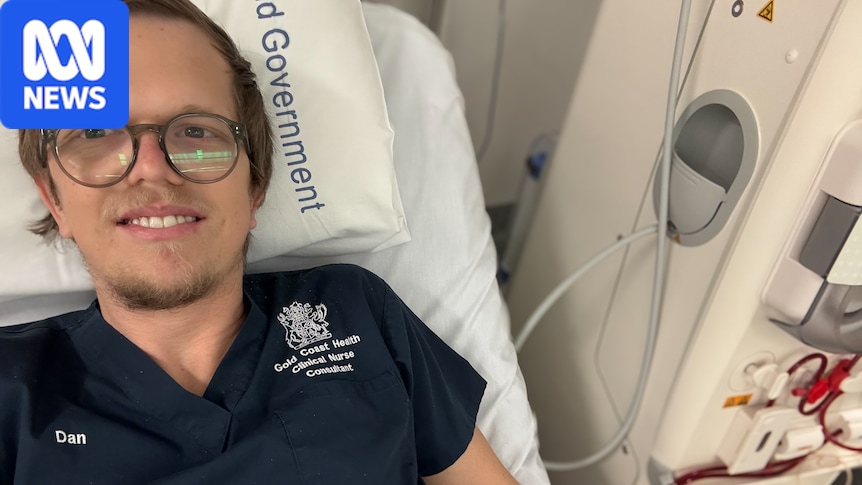
Gold Coast nurse Daniel Hoepner spends his days responding to medical emergencies and helping save lives. But, unbeknown to many of the patients he cares for, he is also waiting for life-saving treatment of his own.The 30-year-old is living with kidney failure and is waiting for his third kidney transplant after being diagnosed with a rare disease shortly after birth.Despite spending six hours every second day on haemodialysis to filter his blood, Mr Hoepner continues to work full-time as a clinical nurse consultant in the Clinical Response Unit across Gold Coast University Hospital and Robina Hospital.Daniel Hoepner was diagnosed with congenital nephrotic syndrome of the Finnish type. (Supplied: Daniel Hoepner)"I definitely don't make it known to patients. I think they've got enough going on to not be worrying about their nurse being unwell," he said."But I actually found when I wasn't working, I was a lot more tired."[Work is] something to take my mind off it, something to do, keep my brain active, and obviously my body active too."Mr Hoepner has spent his entire life in and out of hospital after being born with congenital nephrotic syndrome of the Finnish type (CNF), a severe genetic disorder that causes the kidneys to leak large amounts of protein into the urine.The condition leads to severe swelling, kidney failure and, ultimately, requires dialysis and kidney transplantation for survival."When I was born, my mum saw something was wrong. I was just like a little football, really swollen," he said."She took me to a couple of doctors and they kind of just said I was just a fat baby, which is normally a good thing but, in this case, it wasn't, unfortunately."Daniel Hoepner continues to work as a nurse. (Supplied: Gold Coast Health)Because he was too small for a transplant, Mr Hoepner began dialysis as a baby and remained on treatment until he was six years old, when he received his first kidney transplant from his stepfather.The transplant gave him more than 16 years of improved health before it began to fail, just as he was starting his nursing career."I'd just finished university and had just started a job," he said."Then I just started becoming a lot more unwell."His mother wanted to donate one of her kidneys but was not a suitable match.Instead, she donated to a stranger through the Australia and New Zealand paired kidney exchange program, which in turn allowed Mr Hoepner to receive a compatible kidney from another donor.But now, that second transplant is failing and Mr Hoepner has once again joined the donor list.This time, it's his partner who has stepped forward, offering to donate her kidney in the hope it will lead to Mr Hoepner receiving another life-saving transplant.Daniel Hoepner with his family. (Supplied: Daniel Hoepner)While balancing full-time nursing with regular dialysis treatments is challenging, Mr Hoepner has learned to adapt."I've always wanted to work in a profession where I could make a real difference in people's lives during some of their most difficult moments," he said."Even now, after becoming a dialysis patient myself, that motivation hasn't changed."I've learned to be organised, listen to my body and make the most of the time I have."Nursing is a huge part of who I am, and continuing to work gives me a sense of purpose and normality beyond being a patient."The latest figures from the Australian Institute of Health and Welfare show just over 1,000 kidney transplants were performed across Australia in 2024.Natasha Rogers, the head of transplantation at Westmead Hospital, said while transplant numbers continued to rise, receiving three or more kidney transplants remained uncommon."We have the Australia and New Zealand Dialysis and Transplant Registry that reports on all the kidney-transplant activity across the nation and probably only about 1 to 2 per cent of recipients will have had three or more kidney transplants," Professor Rogers said."So, it's pretty unusual."Natasha Rogers says receiving three or more kidney transplants is uncommon. (Supplied)Regardless, she said Mr Hoepner's ability to continue working while undergoing dialysis was "impressive"."Having kidney disease and having to do dialysis is a full-time job by itself. It's very labour-intensive," she said."Dialysis does not make you feel great and you go from one treatment to the next to stay alive, essentially, and to pair that with full-time work is amazing."Although Mr Hoepner doesn't know when a suitable kidney will become available, he hopes sharing his experience will encourage others facing similar challenges not to put their lives on hold."Keep making memories, keep setting goals, and keep hoping," he said."A transplant can give you a new chapter, but your life is still worth living today."
Gold Coast nurse with rare disorder awaiting fourth kidney
Full Article
Original Source
Read the full article at Abc →KhanList aggregates and links to publicly available news content. We do not host full articles from third-party sources. Always verify important information with original sources.