
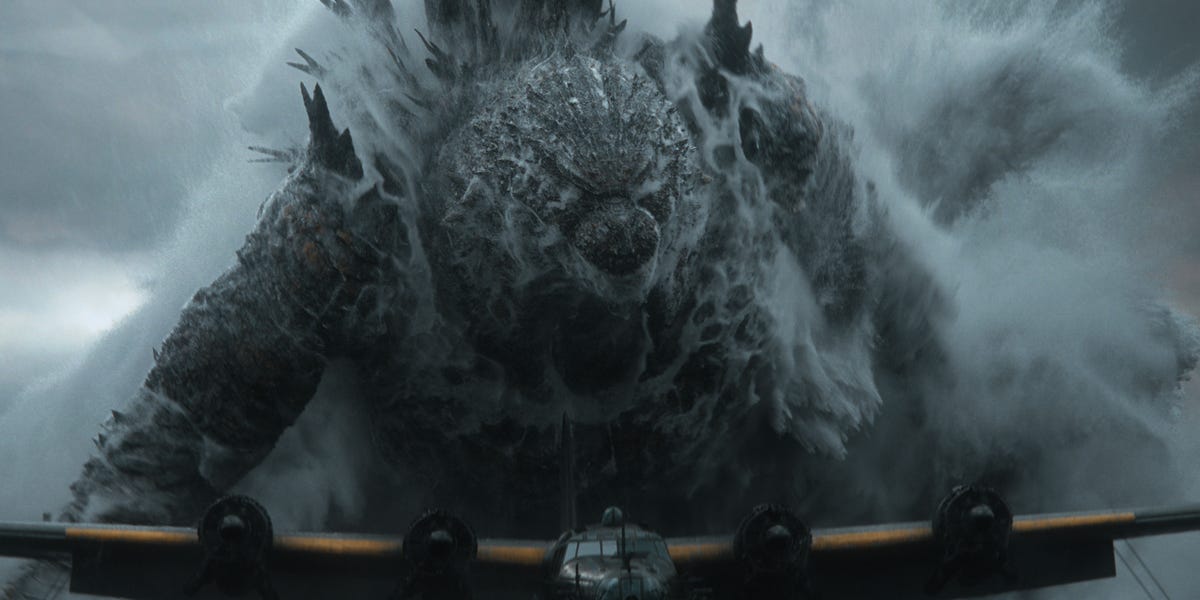
TOHO8 min readHowever much Takashi Yamazaki loves Godzilla, he might love his rival more. In 2023, the filmmaker wowed the world with Godzilla Minus One, an emotionally stirring disaster epic that told a deeply human story about sacrifice, self-forgiveness, and the power of found families, against the backdrop of postwar Japan. At the 96th Academy Awards, Godzilla Minus One clinched the Oscar for Best Visual Effects, which not only righteously recognized its handsome design but lent credence to its rep as a prestige-level event film.But many years ago, its director was just a seven-year-old boy eager to imagine his hometown wrecked by Ghidorah, one of Godzilla’s most prolific enemies. “In the theaters, fifty-five years ago, was the first time I saw Ghidorah,” Yamazaki tells Esquire via English interpreter. It was at a revival screening of the 1964 film Ghidorah, the Three-Headed Monster, when a school-aged Yamazaki saw a gold dragon with three heads stomp over Matsumoto City, where his family lived. But instead of glee, Yamazaki actually felt crushing ... disappointment.“I was looking forward to seeing the utter destruction of my hometown by that kaiju,” Yamazaki says with a laugh. “They didn’t go as far as I wanted them to. So what I’ve done here is my childhood dream come true.”On Friday, November 6, the King of the Monsters returns to the screen in Godzilla Minus Zero. Set in 1949, the sequel continues the story of Godzilla Minus One’s ex-kamikaze pilot Kōichi (Ryunosuke Kamiki). It’s been two years since Godzilla’s rise, and now he and his wife Noriko (Minami Hamabe) are raising their adopted daughter Akiko (Sae Nagatani). But when Ghidorah shows up, Kōichi regroups with his colleagues who’ve since formed the Large-Scale Disaster Response Bureau. While trying to stop Ghidorah’s terrible rampage, they cook up a desperate, if inevitable plan: Convince Godzilla to fight him.TOHOTakashi Yamazaki, on the set of Godzilla Minus Zero.Although Yamazaki spent the promotional cycle of Godzilla Minus One insisting that he had no plans for a sequel, the director had actually drummed up a story outline for Minus Zero. Yamazaki tells Esquire that he wanted to keep following the characters he introduced in his previous film to see how their traumatic circumstances could bring them closer together.“In this series, Minus One and Minus Zero, Godzilla is a metaphor for war,” the filmmaker says. “What I wanted to do with this one is see how this family recovers and thrives after having suffered, and then see them survive another challenge. I wanted to see how they were going to deal with that. I love this family. I’m very attached to this family. I just wanted to see how they march forward.”Below, Yamazaki reveals how surprised he was by the Western reception toward his first movie, why he included Ghidorah in the sequel, and whether a third movie is in the cards.This interview has been edited for clarity, with Japanese-to-English translation performed by an interpreter.ESQUIRE: Let’s rewind to the release of Godzilla Minus One in 2023. The movie was acclaimed outside Japan, particularly in the United States, while critics in Japan were less enthused. Did this response surprise you?YAMAZAKI: The way Minus One was received in the United States was a surprise to me. We made Minus One without international audiences in mind. Step by step, it grew larger; first there was the L.A. premiere, which was received with a passionate reaction. That made me happy. Then the release came, and we started to see all of these comments and reaction clips on YouTube. That was surprising. I feel grateful because it was something I had not foreseen or imagined.Why do you think there was such a stark difference towards Minus One from U.S. audiences versus Japan?U.S. fans are so expressive. We tend to be more reserved. We don’t wear our excitement on our sleeves. I guess this is just how American people are versus Japanese. But to experience that kind of reception was wonderful. I remember watching American movies and imagining how great it would be to put a film out there and have that kind of reaction. That is what came true. So I’m very grateful.Earl Gibson III//Getty ImagesTakashi Yamazaki at the Godzilla Minus Zero premiere in Los Angeles, California.When you first revealed Godzilla Minus Zero, it was with a teaser that showed Godzilla stomping into New York City. What compelled you to make this the very first look at the movie?I wanted the first [look] of Minus Zero to be impactful. To have people wondering, “What the hell is going to happen?” Because the first film was so wonderfully and warmly received among American audiences, this was a way for me to communicate to the American audience, “Your country is part of the story.”Between these two movies, you make the point that just because you aren’t related by blood or marriage doesn’t mean you can’t be a family. Where does this story come from? Do you have any similar relationships in your life?This does not come from my personal experience, but it is something I touched on in a film I made about twenty years ago, Always: Sunset on Third Street. I feel that, if a parent and child are non-biological, sometimes their connection is stronger than biological parents and children. One of my inspirations is Shuhei Fujisawa. One of his novels is a story about a ronin who accepts a mother and child, albeit reluctantly at first, as his own family. I’ve been inspired and affected by that.Godzilla Minus Zero continues the postwar period setting you introduced in the first film. What about Japan’s status in the immediate aftermath of World War II makes it fertile ground for the stories you want to tell with Godzilla?With Godzilla Minus One, I attempted to tell the story of, What do people do when they are lost? When they are stripped of all means to fight? With this one, it’s a continuation of that story, about people who have to fight without anything to fight with when an even greater catastrophe than Minus One befalls them. I also wanted to tell the story of people not using weapons, but their brains. Their wits and wisdom. In this film, you see how they have to resort to means no human being should resort to. Trying to put an end to it all, but having to resort to taboo means.TOHOGodzilla Minus Zero brings to the screen Ghidorah, one of Godzilla’s most famed enemies. Yamazaki says the inclusion is a boyhood dream realized.Out of all of Godzilla’s other rivals, what excites you most about Ghidorah?I was born in the Year of the Dragon, so it just so happens I love dragons. But it’s also the form factor of this kaiju. It straddles the line; if it were any weirder as a form, it would be really weird. But it’s cool visually. It’s a strange kaiju you can’t compare with anything. And it’s been Godzilla’s archnemesis for years, and the strongest nemesis of Godzilla. I don’t know how many more Godzilla films I will be invited to do, so I didn’t want to save Ghidorah for later.Sometimes the spectacle of Godzilla fighting another monster undermines the dramatic weight he’s meant to carry. How did you strike the balance between maintaining Godzilla’s terrifying aura and the blockbuster thrills of watching him fight?The way I approached this, in what we call a versus film, I wanted to portray how mankind relates to Godzilla and Ghidorah. Godzilla is a wild beast that humans have to deal with. Mankind harbors fear and awe in the face of Godzilla. But as I mentioned, they have to step into a taboo [solution], which mankind must never step into, to deal with this godlike beast. It is that fear and awe and conflict I wanted to depict. It was never my intention to have Godzilla as a friendly kaiju.I see Godzilla as a very angry god, or the wrath of God, because it is a metaphor for nuclear weapons and war. Godzilla has appeared in many different shades over the years. He’s been a monster, a folk hero, even a mascot. How do you, personally, see Godzilla? Is your depiction of him in your films reflective of how you think the monster should be?I see Godzilla as a very angry god, or the wrath of God, because it is a metaphor for nuclear weapons and war. If we are going to tell a story set in the 1940s, after World War II, relying on Godzilla’s powers is tantamount to relying on nuclear weapons. Godzilla has that much of an immense power. There’s no way we can utilize his power without suffering repercussions. There is no happiness on the other side.There have been a lot of Godzilla movies made in Hollywood lately. To your view, what are American filmmakers getting right or wrong?I have no complaints about the different ways in which Godzilla is depicted. That’s actually one of the things I like about Godzilla. There’s room for avenues and perspectives. You also have Showa Era Godzilla that is quite funny. Then you have the Hollywood Godzilla, the monster battle films. They’re all wonderful. It’s great Godzilla can encompass all of these forms. I don’t intend at all to say, “This Godzilla is good” and “This Godzilla is not right.”TOHOYamazaki cites author Shuhei Fujisawa as a driving influence on his interest in families who come together through circumstance, as seen in his main characters, the Shikishimas.When Godzilla Minus One first released, there was so much talk about how it achieved so much with a limited budget. With Godzilla Minus Zero having more money than its predecessor, what were you able to accomplish on a technical level that wasn’t possible before?We put all of that extra money into the visuals. I don’t want you looking at a movie, I want you in the story. There are a couple scenes where it’s longer takes, in which we show the kaiju coming and the people are scrambling, trying to escape but there’s nowhere to go. I want the audience to feel that anxiety. It is also the first Japanese film filmed for IMAX. So we were able to realize that immersive in-theater experience. It’s not a film, it’s an experience.What are the chances of a black-and-white “Minus Color” version of Godzilla Minus Zero?I don’t know. Personally, I want to make it. It’s of the times, isn’t it? It feels like a documentary. It’s something I want to do. I don’t know if I’ll do it yet.You said during Minus One you didn’t plan on doing a sequel. So I’m asking now, after Minus Zero, do you have plans for a third movie?It would be great if we could do a third film. But we have to have an offer before we embark on a new project. I’m also curious what other people might do with Godzilla in other films. Nothing is planned yet.If there’s a third movie, do you imagine including other enemies from Godzilla’s history? I ask as a big Destroyah fan...[Laughs]. I’ll refrain from any comments that might be misconstrued as huge news. But it would be interesting to have the option of a completely new kaiju appear. Already existing kaiju would be great, but new kaiju too.You’re now working on your first English-language Hollywood movie, Grandgear. How are you adapting after a long career making movies in Japan?It’s like I’m starting all over again. It makes me feel the way I felt when I was making my debut in Japan. I don’t really care about making films in Hollywood versus making films in Japan, as long as I can embark on a project that I truly want to make going forward. No matter the territory.
Godzilla Minus Zero Is a Sequel Over 50 Years in the Making
Full Article
Original Source
Read the full article at Esquire →KhanList aggregates and links to publicly available news content. We do not host full articles from third-party sources. Always verify important information with original sources.