
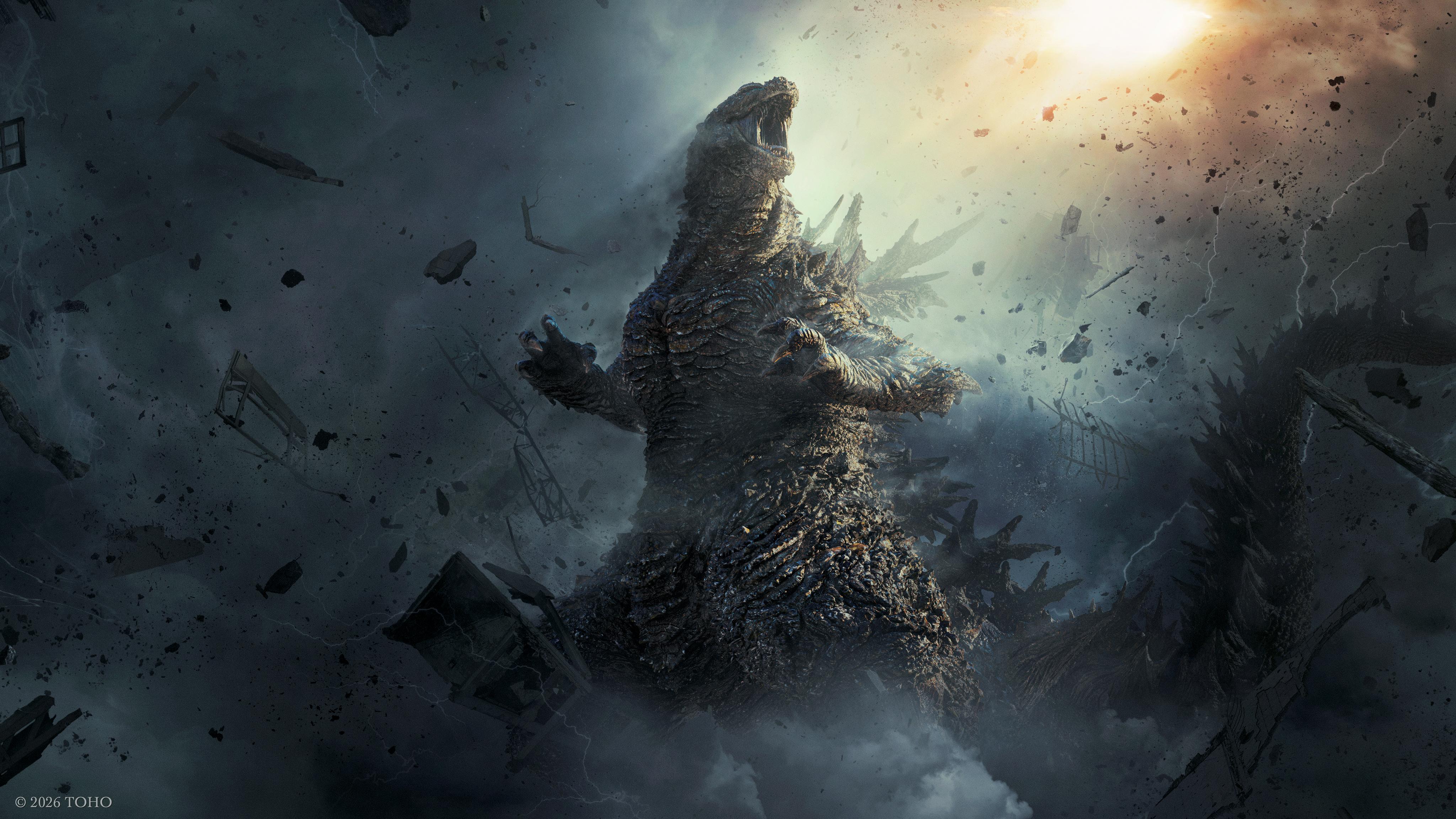
Shortly after they'd both won Academy Awards at the 2024 Oscars, Godzilla Minus One director Takashi Yamazaki got a chance to speak with Christopher Nolan when Oppenheimer premiered in Japan. "As part of our conversation I told him, 'One day I think I would like to make a response to your movie,'" Yamazaki recalls. "In my mind I was thinking I'd develop a film that looks directly at Hiroshima. But then I began thinking, 'Wait—Godzilla is itself a metaphor for nuclear war. Maybe I can combine the two and make a Godzilla movie that is also an answer to Oppenheimer.'"It wasn't a crazy idea; the King of the Monsters has indeed been a walking, building-smashing allegory for the atomic bomb ever since the very first film in 1954. But audiences may be shocked by the degree to which Godzilla Minus Zero, the follow-up to 2023’s Minus One, is a full-throated response to Oppenheimer. No movie in this franchise that's three-quarters of a century old has ever been as explicit about the bomb as Godzilla Minus Zero—including the original. Minus Zero is an intense, often gruesome film that tackles big themes, and it does this while also giving the big guy another kaiju to fight in an action-packed spectacle. Set in 1949, four years after the end of World War II and two years after Godzilla was seemingly vanquished in Minus One, the sequel has a new monster attack a still-rebuilding Japan. Ghidorah, a dragon who arrived from outer space, destroys a city in the opening set piece and only gets more dangerous from there. Yamazaki, who wrote Minus Zero in addition to directing it and helming the visual effects, admits that the classic kaiju's alien background is a bit goofier than the more grounded world he'd created for Minus One. Ghidorah speaks to a challenge that all Godzilla sequels have faced: movies where Godzilla is the only monster can be serious metaphors, but as soon as you start adding other kaiju for him to fight, the franchise seems doomed to turn dumb. Yamazaki was mindful of avoiding this with Minus Zero. The entertainment spectacle would be there, of course, but especially considering the previous film reached a much wider audience than anyone expected—making north of $114 million globally against a budget between $10 million and $15 million—Yamazaki thought the sequel had an obligation to "really dig deeper and even explore some uncomfortable subjects."As the characters, including Ryunosuke Kamiki's returning protagonist Kōichi Shikishima, try and fail to stop Ghidorah on their own, a professor, Murakami, unveils an invention that could lure Godzilla (who it turns out is still alive) to Ghidroah's location. The plan is for the two kaiju to fight so the humans might have an easier time doing a coup de grâce on the weakened victor. On paper, this is the sort of plot that you might expect from the sillier Showa era of the franchise, in the '60s and '70s. But Professor Murakami's past trauma and hidden agenda push Minus Zero into more provocative territory. Min Tanaka as Professor Murakami Courtesy of GKidsMurakami survived the bombing of Hiroshima, but as the audience sees in a flashback to the immediate aftermath of the event, his daughter and grandson did not. While the bombings of Hiroshima and Nagasaki have been key parts of Godzilla's backstory and significance, they've never been part of the plot in the way they are in Minus Zero. Godzilla's atomic breath in Minus One evoked a mushroom cloud and the resulting mass destruction, but in Minus Zero we see what nuclear death actually does to humans. The charred bodies of Murakami's family are a much more graphic and human-scale sort of violence than is normal for the franchise. But Minus Zero goes even further. In a sequence where Murakami imagines Godzilla getting revenge on the United States by attacking New York City, the monster unleashes atomic breath on Manhattan, and the action suddenly switches to slow motion. Unsuspecting Americans look up in shock and horror as a massive inferno erupts and engulfs them. We see the flesh peel off their faces. Oppenheimer drew criticism for not showing the effects of the bomb its subject created. Godzilla Minus Zero does so in horrifying detail, and Yamazaki says he was inspired by a different American blockbuster director in his depiction of nuclear death. "It was important to show as many people as possible what the effects of an atomic bomb would really look like. With the violence we see in New York City, I think back to Terminator 2, where James Cameron shows audiences what nuclear war does to us," Yamazaki explains. "I wanted to evoke something similar because it's very important for it to feel relatable—to jog our imaginations in a way that says, 'Wow. This is real. It is a very violent act.'"Sakura Ando in Godzilla Minus Zero Courtesy of GKidsWhile the Big Apple's destruction is only a terrifying dream sequence, the United States doesn't come off especially well in other parts of Godzilla Minus Zero. The American forces occupying postwar Japan have ulterior motives as they offer "help" in the fight against Ghidorah. They’re invested in controlling this Godzilla-luring device so they can add the kaiju to their nuclear arsenal, rendering the US of A as a secondary antagonist by the end of the film. Other movies, like 2016's Shin Godzilla and 1991's Godzilla vs. King Ghidorah, have been critical of the United States. (The latter, which features flashbacks to a pre-mutated Godzilla stomping American GIs in WWII, is about an American who travels back in time to destroy Japan because it's too economically successful in the future.) But Minus Zero's unflattering depiction feels different—though considering that Minus Zero had its world premiere in New York City, there doesn't appear to be any real animosity towards the U.S. Yamazaki says he intentionally avoided making the American military too prominent in Minus One, instead having the army be "an almost unseen threat" throughout the film, but the 1940s setting meant that it was inevitable that the Yankees would take on a more explicit role. "As time passes, it was important to really take a look at what that relationship between the U.S. and Japan was," Yamazaki explains. "I went down the rabbit hole and did a lot of research about U.S. and Japan's military forces and tension, ultimately leading up to the story we see."There's a lot going on in Godzilla Minus Zero, but Yamazaki thinks the monster is up to the task. "Godzilla was the only creature, kaiju, or entity that could handle all that weight on its shoulders," he says. Yamazaki found a way to make an exciting Godzilla sequel and respond to Oppenheimer. If he ever makes a third Godzilla movie, though, he'll face a different challenge: What to call it. "We've gone from Minus One to Minus Zero so we're now neutral," Yamazaki says somewhat sheepishly. "That might be the biggest problem we have to solve if there is a sequel."
Godzilla Minus Zero Director Made His Film as a Response to Oppenheimer
Full Article
Original Source
Read the full article at Time →KhanList aggregates and links to publicly available news content. We do not host full articles from third-party sources. Always verify important information with original sources.