
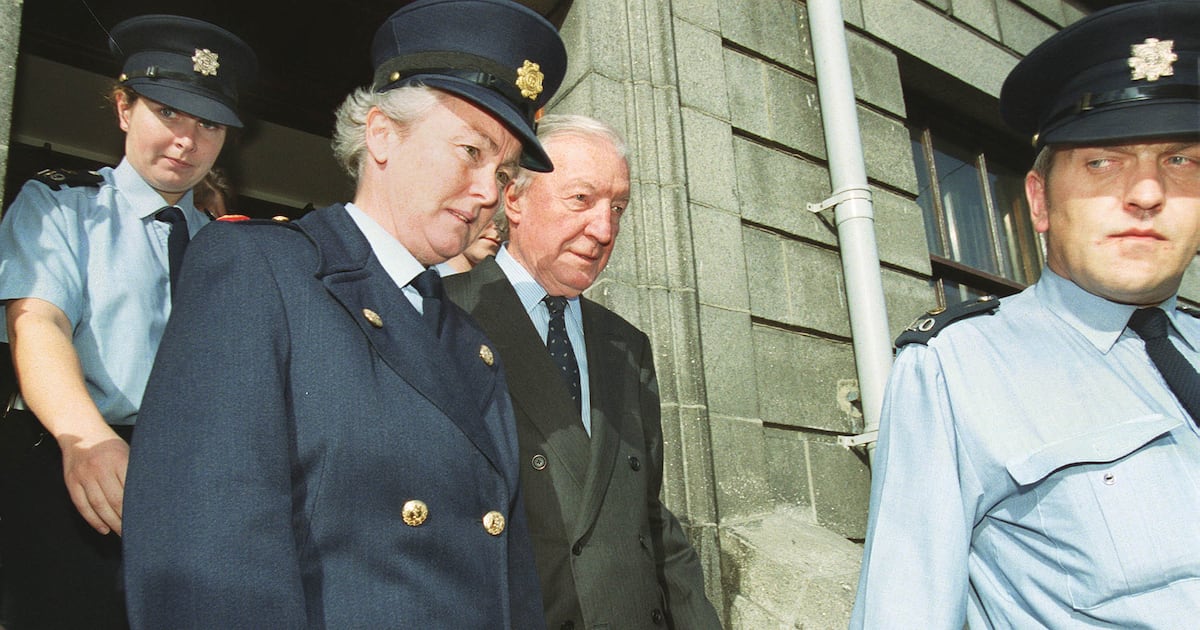
Charles Haughey: Glory, Greed and Guns Author: Vincent BrowneISBN-13: 978-1804443484Publisher: EriuGuideline Price: £ 26.99; 696ppCarlow-born writer Michael Farrell is best remembered for his bestselling lengthy novel Thy Tears Might Cease, published posthumously in 1963. He began writing it in the 1930s, and its prolonged gestation became the talk of literary Dublin, to the extent that during his lifetime many wondered whether its existence was a myth. Likewise, there has been talk about Vincent Browne working on a Haughey biography for decades. Thankfully, the biography was not a myth, and it is gratifying too that Browne, veteran journalist, broadcaster and one of our great interrogators of hypocrisies, is alive, aged 82, to see it published.It was worth the wait. The book, as long as Farrell’s 600-page novel, is absorbing, spirited, revealing and often riveting. Nobody except Browne could have written this book, because it is not just the dramatic story of Haughey, but also about Browne’s relationship with him and the political hinterland Haughey occupied, dominated and always soiled. Browne has stripped him bare, to document, in forensic detail, his sheer odiousness. But this is the same Browne who liked Haughey, having first met him in 1965, and spent time in his home as his life ebbed away in 2006, the two of them drinking wine and reminiscing. These scenes provide the book’s opening. The intimacy was surprising given that Browne had spent much time haranguing Haughey about his poor leadership and the origins of his obscene riches, but time had mellowed the “rancour” and “truculence”. Browne told Haughey to focus on his achievements, after Haughey’s response to the question of what he was most proud of was “Nothing”.It was a fitting answer, Browne’s protestations notwithstanding. Their chats were a reminder that Haughey “rarely spoke well of anyone, and he had a fine repertoire of viciousness”. He was venal, cynical, cruel, selfish, misogynistic and a “serial groper” of women. READ MOREThe 31 chapters provide many more reminders of that risibility and his failure to attain dignity through an honest living. What makes it so readable is that Browne loves political journalism and has spent decades crusading for accountability. He does not pretend to rise above the fray, striving for a neutral tone. The book is punctuated with his trademark withering put-downs (Haughey had a “big nose, menacing eyes, a limp handshake, an awkward smile, bad teeth”), abruptness and acerbic asides.[ Vincent Browne: Haughey loved Terry Keane. She made his life miserableOpens in new window ]If there are ethical issues about publishing private conversations, it is also debatable whether Haughey, given the scale of his betrayals, deserves any discretion. Haughey married Maureen Lemass, daughter of Seán, in 1951, but as Maureen said, “he was more interested in my father than he was in me”. Journalist Terry Keane, Haughey’s lover from 1972, was “the love of his life”. They were well matched, both being parasitic and narcissistic.Haughey’s childhood was shaped by straitened circumstances due to his father John’s disability; he had to retire from the Irish army in 1928, having served during the Civil War. John was afflicted with multiple sclerosis (not scoliosis, as stated). It is surprising more is not made of the impact of this, but the book covers Haughey’s early years briskly, including Christian Brothers schooling, a scholarship to UCD to complete a commerce degree, sportiness and displays of “toxic masculinity”. He qualified as a barrister but did not practice and joined Fianna Fáil in 1947. In 1951, he established an accountancy firm with Harry Boland, son of Gerald, one of Fianna Fáil’s founders. His first electoral outings were “pitiful”, before his election as a TD in 1957.As he moved deeper into politics, he preached about “Christian” politics and told Fianna Fáil’s general secretary, Tommy Mullins, “I can speak with authority and accuracy on any conceivable subject.” As secretary of Fianna Fáil’s Ó Cleirigh Cumann he was involved in a committee that argued unionists should be coerced into a united Ireland “by some means or other”. Haughey “suddenly acquired huge wealth in 1958-9”. He received two £10,000 payments; one from Dominick Browne, the Dublin-born British peer, seeking to prevent the Land Commission from acquiring his Mayo estate (which happened anyway); the other from Laurie Gardiner, a former British army major desiring to import Charolais cattle into Ireland, which ultimately happened through a decision of a separate minister. Browne stresses the absence of definitive proof, but it is likely these were “bribes for favours”. The bulk of the book recounts Haughey’s political career over the next 35 years when he served, in the 1960s, in the ministries of justice, agriculture, and finance, was relegated to the backbenches in 1970, came back to cabinet as minister for health in 1977 and then led his party from 1979 until 1992, serving three terms as taoiseach. Browne’s tone in covering these periods comprehensively is sometimes ribald, often outraged, occasionally humane, and, very occasionally, sympathetic. He thinks Haughey was exceptionally clever, resilient and charismatic, with impressive work aptitude. He championed artists, while not much of a reader, and spoke of environmental protection at a time when few others did. But there was often “a pretence at profundity” and “equality was not on his agenda”. Much of the prolonged media preoccupation with him was “engineered by himself”. He displayed energy as minister for justice and introduced the Succession Act and free legal aid legislation but did “nothing to mitigate” the scale of censorship. Penal reforms displayed “insight, initiative and compassion”, alongside boozing and judicial interference as he and fellow young ministers Brian Lenihan and Donogh O’Malley “pretended to be sophisticated together”. He displayed an “unfailing obsequiousness” to Archbishop John Charles McQuaid and rode to hounds with the Ward Union Hunt. As minister for finance, he argued for the deferral of the free education scheme, provided tax exemption for artists at the suggestion of writer Constantine Fitzgibbon, and free electricity and travel for pensioners at the suggestion of civil servant Michael Lillis. He showed contempt for the heritage of Georgian Dublin while the luxuriousness and scale of his mansion and estate in Abbeville was “breathtaking”. Of nationalist sufferings in Northern Ireland, he offered “no understanding, sympathy or support, at least until he discovered his inner republicanism”. The arms trial of 1970 is covered in illuminating detail. Haughey, probably trying to outflank the republicanism of others in Fianna Fáil, “diverted funds for the relief of distress in NI to the purchase of arms for republicans” at a time when Fianna Fáil’s policy on the North was a “mishmash of contradiction, intimidation and delusion” under a pusillanimous taoiseach Jack Lynch. The funds were supposed to be “for the victims of the current unrest.” [ Vincent Browne: The scale of hatred for Gerry Adams is unfairOpens in new window ]Sacked from government and accused of conspiring to import arms, which he had, he lied through his bad teeth during the trial: “the ease with which Haughey engaged in perjury after perjury reflected his shamelessness”. He also attempted to suborn the secretary of the Department of Justice, Peter Berry, to prevent him exposing Haughey’s lies. Browne also castigates Des O’Malley’s “monstrous and lifelong hypocrisy” about his dealings with Haughey during this period. Haughey worked his way back to cabinet, and as minister for health and social welfare from 1977 he extended free hospital care, protected private practice and lacked the courage to tackle hospital rationalisation or squalid psychiatric institutions. He was conservative but adroit in legislating for contraceptives for married couples. Browne excels in dissecting the internal politics of Fianna Fáil as Haughey won the party leadership in 1979: he seemed “almost above it all” as supporters and opponents plotted.He had also purchased Inishvikillane island in Kerry in 1974 for £20,000, “another trophy purchase paid for with other peoples’ money”. Browne is strong on that money trail, but he asks, “Why did no-one notice?” His lifestyle was funded partly by “enormous unauthorised borrowings from AIB”. His bagman, Des Traynor, operated several accounts for him offshore. In 1976, at AIB headquarters, Haughey was told “to hand over his chequebook forthwith. At this point Mr Haughey became quite vicious” and “stressed the importance of his position and prestige”, warning he could be “a very troublesome adversary”. By December 1979 he had borrowings of £1,143,839, (more than €8 million today). He was bailed out by his minions and a drastic discount from AIB, and in using funds from the proceeds of Cayman Island accounts, he was “defrauding the government of which he was taoiseach”. He also provided “reckless stewardship” of the economy in his early years as taoiseach: “He had spent so much of the previous years working out how to become taoiseach. He had spent little time devising what he would do if he were elected taoiseach.” He was indecisive and continually reversed positions “which didn’t say much for his authority”, while “unctuousness prevailed” in relation to his stances on abortion and divorce. [ Haughey ‘quietly intervened’ while gravely ill to increase naval funding, ex-chief saysOpens in new window ]Regarding foreign policy, “he could not care less about neutrality” and in private “expressed concurrence with Thatcher in not agreeing to the hunger strikers’ five demands” in 1981. The fear and loathing within Fianna Fáil are expertly chronicled and Browne criticises political journalists who crossed ethical lines by colluding with Fine Gael and Fianna Fáil dissidents. Haughey was lucky that most seeking to replace him “gave rise to an appalling vista of rank mediocrity”, but Browne wonders why his enemies accepted cabinet positions if they had no confidence in him. This was the era of phone tapping and heaves, but Seán Doherty, the minister for justice in the early 1980s who in 1992 gave an interview about knowledge of those phone affairs that dethroned Haughey, is also demolished by Browne for his lies and inconsistencies.By 1987 Haughey was finally prepared for office with the dissidents absent from the long grass. Browne credits him with then “rescuing” the economy, but he was greatly helped by Fine Gael under Alan Dukes not impeding the necessary economic medicine; it is certain “Haughey would never have acted similarly”. He basked in the limelight when Ireland held the presidency of the European Council in 1990, and Chancellor Helmut Kohl praised his encouragement of German unity.In retirement, as details began to unravel about payments made to him by Ben Dunne, he said to Dunne’s solicitor, “Is there anyway we can get rid of these?” There was not, and Browne carefully unravels the evidence generated by the McCracken and Moriarty tribunals. Haughey’s strategy amounted to “a stack of lies” and obstruction. He had defrauded Revenue “at a time when he was engaged in comprehensive cuts to public spending”, an instance “not just of criminality but of treachery”. Haughey’s salary in 1981 was £34,855, but from February 1979 to May 1987 lodgements to accounts in his name amounted to £1,762,704 from “unidentifiable sources”. He deliberately inflated fund raising beyond what was needed for Brian Lenihan’s liver transplant; of £265,000 “no more than £70,283” was applied to meeting Lenihan’s medical treatment; a “sizeable portion of the excess” was misappropriated for Haughey’s personal use. It is still shocking to read the scale of this immorality, but another key question asked is this: why did Revenue not interrogate the vast sums at his disposal? Throughout his career, Haughey’s corruption was facilitated by far too many. His overarching aim was “the attainment of power and maintaining it”. What he did with that power, above all, was abuse it, and Browne has the measure of him.Diarmaid Ferriter is professor of modern Irish history at UCD and an Irish Times columnist.
Glory, Greed and Guns: Diarmaid Ferriter reviews Vincent Browne’s Charles Haughey biography
Full Article
Original Source
Read the full article at Irishtimes →KhanList aggregates and links to publicly available news content. We do not host full articles from third-party sources. Always verify important information with original sources.