
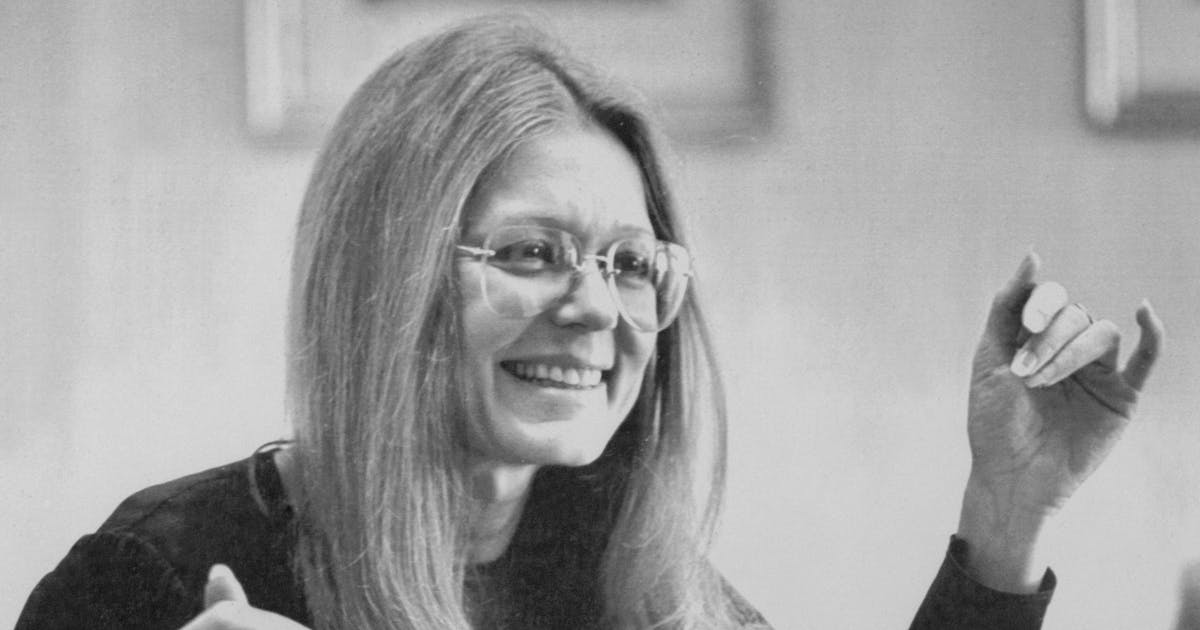
I have many books about feminism on my bookshelf, but only one by Gloria Steinem. It’s an old copy, possibly a first edition, of Outrageous Acts and Everyday Rebellions, the book she considered her first. (Prior to this, she’d co-authored a book and curated an anthology of writing about the beach.) Published in 1983, Outrageous Acts brings together 20 years’ worth of Steinem’s writing, most of it previously published, ranging from her 1963 undercover report on the labor practices of the Playboy Club—a piece that made her notorious in New York media circles—to her 1982 profile of the poet and novelist Alice Walker, a longtime contributor to Ms. Magazine, the feminist glossy Steinem and other activists founded in 1971. My copy of the book is a signed one, inscribed by Steinem “To Robin—with gratitude for this International Women’s Day—and the future.” I can’t be certain, but I like to think that the Robin addressed here is the poet and activist Robin Morgan, Steinem’s friend and collaborator, and one of the books many dedicatees (there are more than a dozen of them). Outrageous Acts may have a single author, but Steinem knew that feminism is a collective project. Steinem, who died this past Wednesday at 92, was many things: an editor, an organizer, a public speaker, a fundraiser, a co-founder, a mentor, and, in her own words, an “entrepreneur of social change.” But before she was all these things, she was a writer, and she remained one until her death. (Her final book, the memoir An Unexpected Life, will be published on September 22.) It’s easy to forget this, despite her impressive publication record—she published 11 books over the course of her lifetime—and her evident way with words. A kind of poster girl for women’s liberation, with her aviator sunglasses and her long sun-kissed hair, Steinem spent so much time in the public eye that one could be forgiven for thinking she was more like the jet-setting elites she occasionally profiled (and dated) than the working writer toiling away in relative obscurity. But writing was Steinem’s first and perhaps most enduring love, the activity that gave her a sense of purpose even though, or perhaps because, it could be so daunting. “For me, writing is the only thing that passes the three tests of a metier: (1) when I’m doing it, I don’t feel that I should be doing something else instead; (2) it produces a sense of accomplishment and, once in a while, pride; and (3) it’s frightening,” she wrote in Harper’s in 1965. That she felt so committed to writing is all the more impressive given the media environment surrounding her. Media was a man’s world: Magazines and newspapers were run by men, edited by men, and distributed by men—although much of the work needed to put out an issue was done by women. Male journalists got assigned better stories and earned higher fees. Even though many magazines were marketed to women, male editors scarcely believed women knew how to read. (A top editor at Ladies’ Home Journal described its audience as “mental defectives with curlers in their hair.”) Steinem struggled to earn respect, let alone interesting assignments. When she first tried to break into Life magazine, the editor she spoke to told her, “We don’t want a pretty girl. We want a writer.” Steinem was a writer, as the pieces in this book attest. At her best, as in the 1978 piece “If Men Could Menstruate,” she is pointed and funny, displaying the same gift for aphorism that she showcased in her public speeches. But she could also be earnest and introspective, expressing complicated truths in a plainspoken style. “I still don’t understand why so many, many years passed before I saw my mother as a person and before I understood that many of the forces in her life are patterns women share,” she writes in “Ruth’s Song,” a moving autobiographical essay about her troubled mother, written specifically for Outrageous Acts. “I suppose I couldn’t afford to admit that what had happened to my mother was not all personal or accidental, and therefore could happen to me.” But she was not always the writer she wanted to be. During the 1960s, when she wrote the most, she rarely expressed her political commitments or personal values in print. During the 1970s, when she honed her politics, she rarely had time to write. “It’s one of the ironies of trying to be a writer and an activist at the same time that just when you feel you have the most to say, you have the least time to say it,” she later recalled. Traveling on the lecture circuit, often with Black feminists like Florynce Kennedy or Margaret Sloan-Hunter, she couldn’t even find time to keep a diary. It’s a problem familiar to many activist writers: how to live according to your political principles without sacrificing your art—or vice versa. (We’ll leave aside, for now, the whole question of earning money.) How do you reach a wide readership without diluting your message? When does the world need your words, and when does it need your action? Should you go to that organizing meeting or meet your deadline? Steinem lived these tensions, wrestling with them and, sometimes, writing about them. If she never quite resolved them, she did something perhaps equally admirable: She faced head-on the challenge of being a writer while living a politically committed life.The fact that Steinem became a writer at all is remarkable. Born in 1934 in Toledo, Ohio, to Leo Steinem, an antiques dealer and the owner of a summer resort, and Ruth Steinem, a journalist turned homemaker, Steinem, the second of two girls, had a difficult, itinerant childhood. Her father was a schemer and a dreamer, taking the family on the road in a trailer during the winter and evading the debt collectors who tried to track them down. Ruth, meanwhile, struggled with mental illness and underwent multiple hospitalizations. When Steinem was ten, her parents separated; with her sister away at college, Steinem became her mother’s caretaker. The two lived in “a deteriorating farm house” on a small fixed income. Steinem tended to her mother, who used tranquilizers to calm her nerves and who often slipped into a stupor. When she could, she escaped into books—and plotted her ultimate escape. “My ultimate protection was this: I was just passing through, a guest in the house,” she later reflected. She would get out of East Toledo and avoid her mother’s fate. She succeeded, matriculating at Smith College, where she majored in government. Smith in the 1950s presented a different set of challenges than East Toledo did. Populated by well-off, intelligent, entirely conventional women, Smith sent, in Steinem’s words, a “double message” to its undergraduates. As she later wrote, students were “encouraged toward personal accomplishment and excellence, and then expected to subordinate themselves to children and a husband’s career.” Ambivalent about marriage, and eager to chart her own course, Steinem left Smith for a fellowship in India—but not before stopping in Britain to have an illegal abortion, performed by a doctor who made her promise never to mention his name. It wasn’t until she was sent, as a journalist, to cover a 1970 Greenwich Village speak-out on abortion that she would understand her abortion in political terms. “Suddenly, I was no longer learning intellectually what was wrong,” she later wrote. “I knew.” She called it her “big click,” as in the “click of recognition,” a term used in feminist consciousness-raising circles to describe the moment when the scales fall from your eyes. Radicalized and galvanized, she did what journalists do: She pitched stories about her new interest. There were a few takers: New York, where she was a regular contributor, ran several of her columns about sexual politics. But for the most part, editors were dismissive—as Steinem later wrote, the very same “editors who had assumed I had some valuable biological insight into food, male movie stars, and textured stockings now questioned whether I or other women writers were biologically capable of writing objectively about feminism.” Such stonewalling and sexism drove Steinem to “try speaking instead of writing,” despite her longstanding fears of speaking publicly. Inspired by her companions on the lecture circuit, by Kennedy in particular, she got more comfortable in the limelight—so much so that other leading feminists, such as Betty Friedan, came to resent her. It also drove Steinem to create her own magazine. In 1971, she hosted a group of female journalists at her Manhattan apartment to talk about the sexism in their industry. One of them, Brenda Feigen, suggested that the group produce a “slick magazine,” something that would stand out from the pamphlets and newsletters that various feminist groups distributed. With the help of Clay Felker, Steinem’s editor, Ms. magazine launched as a special insert in New York. Few thought the project would be successful, but when Ms. published its first standalone issue, the magazine sold out in eight days. As a founding editor of Ms., and one who remained with the magazine until 2001, Steinem did more than almost anyone to change the media environment for women. Ms. was entirely run by women, and it solicited only female contributors. It broke taboos about what could be published in a glossy, running articles on lesbianism, welfare (a “woman’s issue”), abortion, and the household division of labor. Editors solicited contributions from women of color and put a Black woman on the cover of the June 1982 issue—to the dismay of Southern newsstand owners, who refused to distribute it. And Steinem and her fellow editors proved that there was, in fact, a national audience of intelligent, curious, politically engaged women who were willing to pay for a magazine that spoke to them about the real problems they faced. Ms. eventually reached a circulation of 550,000, spawned all sorts of feminist media successors, and recently published an anthology celebrating its 50th anniversary. Steinem contributed to Ms. as she could. Her first piece for the magazine, “Sisterhood,” is a well-meaning if perhaps overly optimistic argument for building solidarity across racial and class lines. But she spent much of her time courting advertisers, whose money was needed to fund the production and distribution of the magazine. In a 1990 essay for Ms., she wrote about the sense of “desperation” she felt, trying and failing to convince advertisers to buy space. Ms. eventually started running more ads, including ads for traditionally feminine products, which meant cutting fiction and poetry. In that same essay, Steinem admitted that the magazine’s “edges got smoothed down—in spite of all our resistance.” It’s a tidy formulation, as so many of Steinem’s were, providing a perfect image of political compromise. One imagines a counterfactual Ms.—less successful but perhaps spikier—and wonders what writers it might have nurtured, and to which readers it might have appealed. But Steinem was smooth, not spiky; there is a reason she became the figurehead of women’s liberation and not, say, Kate Millett. She wanted feminism to reach as many women as possible: not just the New Yorkers and the professed radicals, but, as she put it, the “wives with white gloves welded to their wrists” and the “students with boots who used words like ‘imperialism’ and ‘oppression.’” She wrote—and edited, and fundraised—for the white woman, the woman of color, the agricultural worker, the factory worker, the housewife. She knew what it was like to need print the way one needs water. She wanted her magazine to reach the women who needed it desperately, so they could learn that were others who felt just the same.By the 1980s, the beginning of the “backlash” against feminism described by Susan Faludi in her book of the same name, Steinem didn’t see herself primarily as a writer. She had given herself over to other projects; she’d let political action triumph over art. “There have been days in the last ten or twelve years when I thought my collected works would consist entirely of fund-raising letters, scribbled outlines of speeches, statements hammered out at the birth of some new coalition, and introductions to other people’s books,” she writes in the introduction to Outrageous Acts. She imagined her legacy wouldn’t be a book or an essay but rather “the invention of something as brief and pithy as the phrase reproductive freedom.” It wasn’t until her friend and Ms. co-founder Letty Cottin Pogrebin went through boxes of old articles and put together a potential collection that Steinem took seriously the idea of writing a book. There was a part of Steinem that always wondered what she could have done as a writer, had she had world enough and time. “I didn’t take myself very seriously,” she reflects in the introduction to Outrageous Acts, recalling the frivolous stories she wrote as a young journalist. She didn’t fight hard enough for the stories she wanted; she let herself be distracted and make excuses. “I’m not regretful of the time I’ve devoted to those projects”—those many projects that took her away from writing—and one can’t help but think that she’s protesting too much. In truth, neither Outrageous Acts nor any of her subsequent books amount to Steinem’s legacy—though they are certainly part of it. In this way, Steinem differs from her contemporaries—Shulamith Firestone, Germaine Greer, and Millett among them—who are best known for their books theorizing sexism and feminist utopia. Steinem will be remembered for her actions: co-founding Ms., advocating for the Equal Rights Amendment, mentoring younger feminists, and forming coalitions with feminists whose politics and interests might have differed from her own. By her own account, she loved the work of organizing—as much as she loved writing, or perhaps more. “On a good night, a roomful of people can set off a chain of thought that leads us all to a new place—a sudden explosion of understanding, a spontaneous invention,” she writes in the introduction. “We hear ourselves saying things we had felt but never named.” It’s an ephemeral moment, a collective feeling. It’s an experience that can’t be captured in words.
Gloria Steinem’s Life Between Art and Activism
Full Article
Original Source
Read the full article at Newrepublic →KhanList aggregates and links to publicly available news content. We do not host full articles from third-party sources. Always verify important information with original sources.