
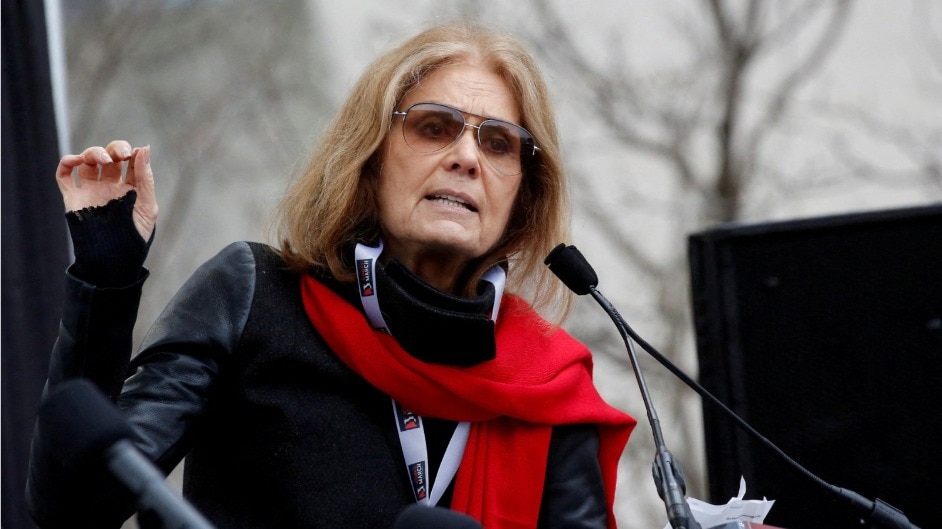
A leading voice of the women's liberation movement, Gloria Steinem fought for gender equality, reproductive rights and social justice for more than five decades. She was awarded the Presidential Medal of Freedom in 2013 for her lasting contribution to American society.Feminist activist Gloria Steinem dies at age 92 (Photo: Reuters)Gloria Steinem, the pioneering American writer, journalist, lecturer and activist who spent more than five decades challenging gender inequality and fighting for women’s civil and reproductive rights, has died at the age of 92. Steinem died on Wednesday, her foundation announced in an Instagram post on Thursday, bringing to a close the life of one of the most recognisable and influential figures of the modern feminist movement.For generations of women, Steinem was more than a writer or campaigner. She became a voice of the women’s liberation movement, helping transform feminism from a growing political current in the late 1960s into a powerful force that reshaped conversations around work, marriage, abortion, domestic violence, equal pay and women’s representation. Pioneering feminist Gloria Steinem poses for a portrait after being interviewed in Beverly Hills, California March 16, 2010. (Photo: Reuters) As Julie Taymor, the director of the 2020 film The Glorias, once described her: “From reluctant spokesperson to a beacon of positive change, hers is a singular journey.” Steinem herself had a simpler description for the role she chose: an "entrepreneur of social change." “I want to do justice to the women I meet, to tell their stories,” she told The New Yorker in 2015. “It's making connections, and using myself to listen, because we can't empower women without listening to their stories,” she said.FROM JOURNALIST TO FEMINIST ICONBorn on March 25, 1934, in Toledo, Ohio, Steinem grew up far from the institutions and privileges that would later define her public life. She was the younger of two daughters of a travelling antique dealer. Because her family moved frequently, she did not attend school regularly until around seventh grade. When she was 11, her parents separated, leaving Steinem to live with and care for her mother, who suffered a mental breakdown and depression. That childhood experience would leave a lasting imprint on her understanding of women, marriage and social inequality. Steinem later reflected that she had already been “the very small parent of a very big child” – her mother – and did not want to spend her adult life in a role where her choices were similarly constrained. Gloria Steinem salutes the graduating students as she receives an honorary Doctor of Humane Letters during Harvard University's 371st Commencement Exercises in Cambridge, Massachusetts, US on May 26, 2022. (Photo: Reuters) After graduating from Smith College, she began working as a freelance journalist. Her early career would eventually take her into places few mainstream journalists were willing to enter, including the Playboy Club. In 1963, she spent 11 days working undercover as a Playboy Bunny for Show magazine. Her resulting two-part investigation, A Bunny’s Tale, exposed the low wages, humiliating working conditions and sexist treatment faced by the women employed there.The story became a landmark piece of journalism and was later adapted into a 1985 television movie starring Kirstie Alley.THE MOMENT HER LIFE CHANGEDSteinem's emergence as a feminist leader gathered momentum during the social upheaval of the 1960s. In 1968, she helped found New York magazine, where her essay After Black Power, Women's Liberation placed her firmly within the growing women's movement.But Steinem later identified another moment as the real beginning of her life as a feminist activist. In 1969, she attended an abortion speak-out at a church in New York. Steinem had herself undergone an illegal abortion in London when she was 22, an experience that gave personal urgency to the fight over reproductive rights.The issue would become one of the defining battles of her public life.A voice that had begun in journalism soon became part of a broader political movement demanding that women have control over their own bodies, careers, finances and futures.MS. MAGAZINE GAVE WOMEN A NEW VOICEIn 1971, Steinem co-founded Ms. Magazine, helping create a publication that looked radically different from the traditional women's magazines of the era.Instead of focusing primarily on beauty, cooking and how women could better support their husbands, Ms. confronted abortion, sexism, equal pay, domestic violence and women's political rights.One early issue carried the names of 52 women, including Steinem, who acknowledged having had abortions. The magazine used their collective declaration to demand the legalisation of abortion, two years before the US Supreme Court's landmark 1973 Roe v. Wade decision. Gloria Steinem protests against the opening of the first United States branch of De Beers jewelry store in New York, June 22, 2005. (Photo: Reuters) Steinem remained associated with Ms. for decades, serving as its consulting editor and helping establish it as one of the most influential feminist publications in America. But her activism extended well beyond journalism.In 1971, she joined former US Representatives Bella Abzug and Shirley Chisholm and writer Betty Friedan in founding the National Women's Political Caucus.Over the years, she helped create or establish several other organisations, including the Coalition of Labor Union Women, the Women's Media Center, Voters for Choice and the Ms. Foundation for Women.FEMINISM, SHE INSISTED, HAD TO INCLUDE EVERY WOMANSteinem's image became inseparable from the movement she helped lead. With her long, blonde-streaked hair, centre parting and aviator glasses, she brought a glamorous and recognisable face to a movement that was often portrayed by its critics as radical or fringe.Yet Steinem consistently pushed feminism beyond the experiences of white, middle-class women.She emphasised the central role of women of colour in shaping feminist thought and argued that discrimination could not be understood through a single lens. “If you've suffered discrimination, you're sensitive to it on every level,” she told The New Yorker. “Women of color basically invented feminism.”Her activism therefore increasingly intersected with questions of race, class, labour and political representation.A FEMINIST WHO QUESTIONED MARRIAGE; AND MARRIED AT 66Steinem was also outspoken about the institution of marriage and the unequal division of labour within families. “Women are not going to be equal outside the home until men are equal in it,” she said.She never had children and for much of her life remained unmarried. Then, at 66, she surprised many by marrying David Bale, a South African businessman and environmentalist who was the father of actor Christian Bale.Steinem presented the decision not as a contradiction of feminism, but as an expression of it. “I hope this proves what feminists have always said -- that feminism is about the ability to choose what's right at each time of our lives,” she said after the marriage.David Bale died of brain cancer in 2003.HER PEN NEVER LEFT THE FIGHTSteinem's activism was accompanied by a prolific writing career. She wrote books on feminism, identity, politics and social change, including Marilyn: Norma Jean, her 1986 study of Marilyn Monroe, and Revolution from Within: A Book of Self-Esteem. She also published collections of essays and her bestselling 2015 memoir, My Life on the Road.Her work also reached television and film. She conceived and narrated the Emmy Award-winning HBO documentary Multiple Personalities: The Search for Deadly Memories in 1993 and produced the Lifetime film Better Off Dead. She later hosted Woman, a documentary series examining violence against women.Her own life became the subject of multiple productions, including the 2011 HBO documentary Gloria: In Her Own Words, the 2018 play Gloria: A Life and Taymor's 2020 film The Glorias, which traced Steinem's journey through different stages of her life.FROM ACTIVIST TO AMERICAN INSTITUTIONBy the time Steinem received the Presidential Medal of Freedom from then-President Barack Obama in 2013, her influence had extended far beyond the feminist movement. She had become an enduring figure in American political and social life -- a journalist who became an organiser, an organiser who became an activist, and an activist who helped redefine the national conversation about women's rights. US President Barack Obama presents the Presidential Medal of Freedom to women's rights activist Gloria Steinem at a ceremony in the East Room of the White House in Washington, November 20, 2013. (Photo: Reuters) Yet Steinem continued to work well into her 80s, refusing to treat feminism as a battle that belonged to a single generation. Her legacy was not simply a collection of organisations, books, magazine covers or political campaigns. It was the idea that women's stories mattered – and that listening to those stories could itself become an instrument of social change.Author Carolyn Heilbrun, who wrote the 1995 biography Education of a Woman: The Life of Gloria Steinem, once described her as “the epitome of female beauty and the quintessence of female revolution.”Few descriptions capture more neatly the contradiction and power of Steinem's public life: she was both a product of her time and one of the people who helped change it.- EndsPublished By: Shipra ParasharPublished On: Sep 3, 2026 16:13 IST
Gloria Steinem, feminist icon who reshaped America's fight for equality, dies at 92
Full Article
Original Source
Read the full article at Indiatoday →KhanList aggregates and links to publicly available news content. We do not host full articles from third-party sources. Always verify important information with original sources.