
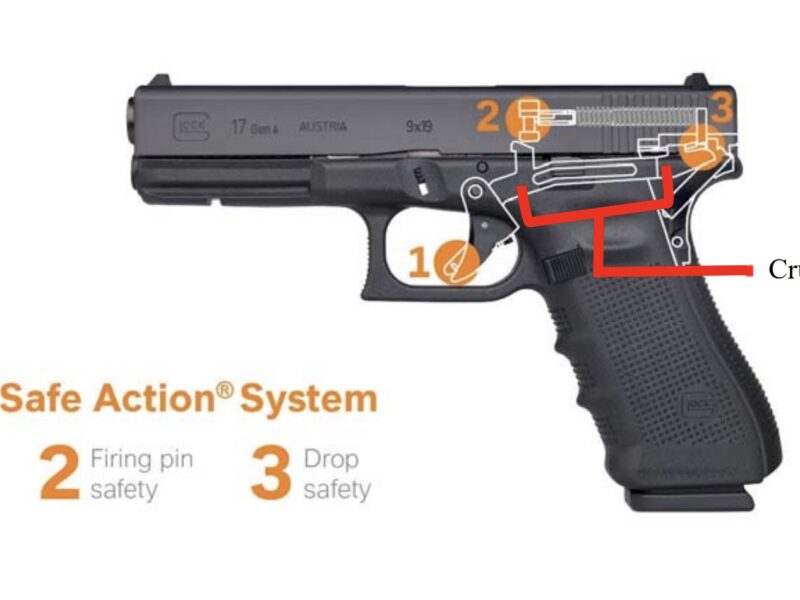
Before 2026, Glock says, no semiautomatic firearms had been banned only because of their ability to be converted into a fully automatic weapon using a machinegun conversion device.(CN) — Glock Inc. and gun rights activists sued Connecticut in separate complaints on Monday, challenging a ban on Glock-style semiautomatic handguns set to take effect soon.Starting Oct. 1, a state law will make it a felony to sell semiautomatic weapons known as cruciform-trigger handguns. The term refers to the cross-shaped trigger bar that moves back and down to release the firing pin when the trigger is pulled. The design is easy to modify with “switches” to enable fully automatic fire, prompting restrictions in several states including New York, California and Maryland.Under Connecticut’s legislation, the “convertible pistols” will be illegal to sell or possess.But the plaintiff gunmakers and advocacy groups say the cruciform design makes weapons less likely to discharge accidentally, fueling their popularity. According to the lawsuits, hundreds of thousands of cruciform-trigger handguns are made in the U.S. each year, and the weapons are used by Connecticut state troopers.“If Connecticut can ban cruciform-trigger handguns because of the risk that criminals can convert them into fully automatic machine guns, then it could ban ‘virtually any semiautomatic weapon’ for the same reason,” writes the National Shooting Sports Foundation Inc., a trade association for the firearm, ammunition, hunting and shooting sports industries, in its lawsuit.The organization is joined by gunmaker Shadow Systems LLC and retailer Blue Trail Range Corporation.In Glock’s own lawsuit, the gun manufacturer points to its “safe, simple, and fast system” consisting of three mechanical safeties that disengage when the trigger is pulled and reengaged when the trigger is released. The company points to its guns’ popularity among law enforcement officers and civilians, claiming that it sells hundreds of thousands of pistols each year and has sold more than any other handgun manufacturer.Before 2026, Glock says, no semiautomatic firearms had been banned solely because they could be converted into fully automatic weapons using machine gun conversion devices.Once the ban takes effect next month, violations can carry a five-year prison sentence and a fine of up to $5,000.Glock seeks written confirmation that three of its pistols — the Slimline, V Series and Gen6 — do not fall under Connecticut’s definition of a convertible pistol. According to the company, state officials have not provided a clear answer about whether those models are subject to the upcoming ban.The gunmaker and the National Shooting Sports Foundation both claim in their lawsuits that Connecticut will violate the U.S. Constitution if it implements its law as scheduled.Both lawsuits name Patrick Griffin, the chief state’s attorney, among other state officials. The Office of the Chief State’s Attorney did not immediately return a request for comment.Connecticut Governor Ned Lamont signed the ban on June 5.“This is a commonsense law that prioritizes public safety while respecting the rights of responsible gun owners,” Lamont said at the time. “With the lack of action on gun violence prevention measures being passed by Congress, it is up to the individual states to enact laws like these.”Among those championing the ban is Everytown for Gun Safety, an organization formed in the wake of the 2012 Sandy Hook Elementary School shooting in Newtown, Connecticut, that killed 20 children ages 6 and 7, and six adult staff members.Subscribe to our free newslettersOur weekly newsletter Closing Arguments offers the latest about ongoing trials, major litigation and rulings in courthouses around the U.S. and the world, while the monthly Under the Lights dishes the legal dirt from Hollywood, sports, Big Tech and the arts.Additional Reads
Glock and gun advocates challenge Connecticut handgun ban
Full Article
Original Source
Read the full article at Courthousenews →KhanList aggregates and links to publicly available news content. We do not host full articles from third-party sources. Always verify important information with original sources.