
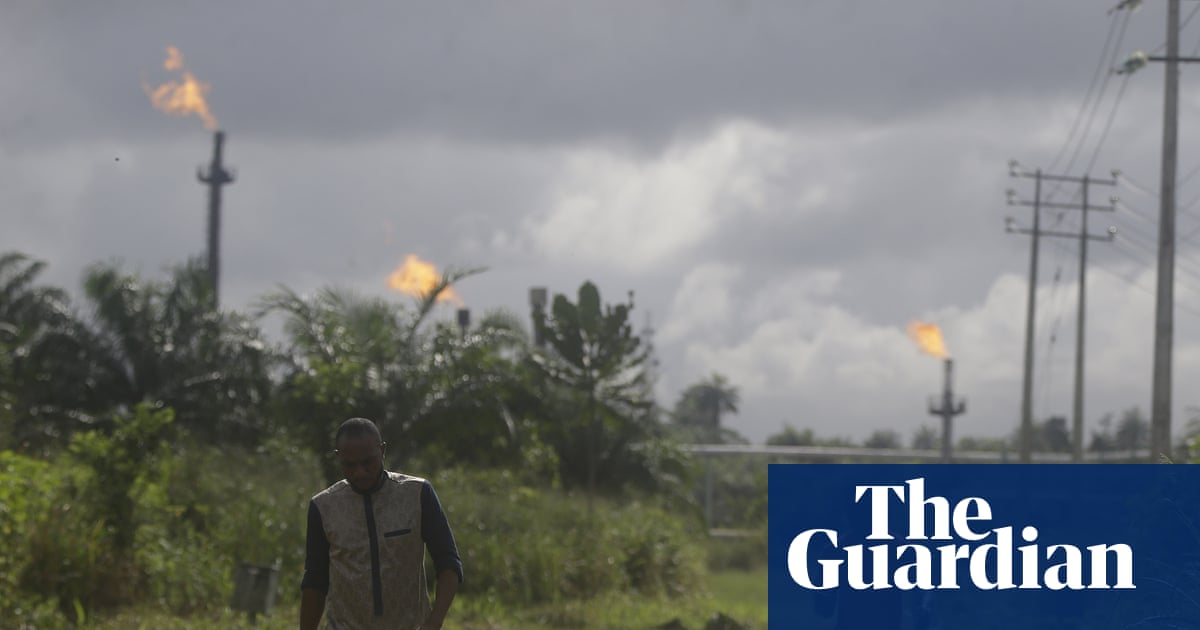
Conflict, migration and economic upheaval will accompany the global move away from oil, unless governments act urgently to help the worst afflicted countries to cope, research has found.Nigeria, Iran, Angola and Algeria are among the countries that will be severely affected, as they rely strongly on oil revenues for their government and provision of public services, but have little diversification and too little capital to cushion the blow.Oil use is already waning in many countries, with the growth of renewable energy, and has been hastened by the effects of the Iran war, which has constrained supply and sent prices soaring, triggering high inflation and political instability.Global demand for oil is forecast to plateau in the coming decade, with a peak likely in the early 2030s, which will force producers to chase a shrinking pool of buyers. Many will try to hang on to their resource revenues as long as possible, according to research from the E3G thinktank published on Tuesday, but the cheapest producers with abundant resources – such as Saudi Arabia and the United Arab Emirates – are likely to win against those with less advanced infrastructure.The example of Venezuela, which was suffering collapse and have had a partial takeover of government by the US, now shattered further by the impact of earthquakes, should warn countries of what is at stake, the report’s authors found.“Governments are not thinking about and not prepared for [these outcomes],” said Beth Walker, co-author of the report. “The transition becomes riskier for everyone when oil producers are left to adjust on their own, and oil markets left to manage themselves. Producer fragility becomes a global security risk.”Putting off or slowing down the transition is an even worse option than confronting it, however, as the climate crisis is rapidly worsening. “None of this is an argument for slowing the transition,” said Maria Pastukhova, a co-author of the report. “A slow but chaotic transition can be just as destabilising as a fast one, maybe even more so.”E3G compiled the report over two years, in part through “war-gaming” various scenarios for declining oil demand with more than 100 public servants and experts from around the world.Bob Ward, policy director at the Grantham Research Institute at the London School of Economics, who was not involved in the report, said developed countries would also be affected. “Many oil producers have been in denial about the pace and scale with which both demand and supply will have to fall if we are to avoid dangerous climate change,” he said. “We should be clear that the highest-cost producers will likely be the first to feel this shock. The North Sea has high operating costs and so is unlikely to be economically viable once demand starts to fall sharply and market prices reduce.”Income from oil makes up more than 40% of the revenue to governments in 17 countries around the world, and in some cases is overwhelmingly the biggest source of income, for instance in Iraq and Libya, where it represents 70% to 90% of government revenues.But this revenue will fall rapidly from 2030: E3G forecasts that Algeria will experience an 87% drop in revenue and Nigeria more than 60%. Algeria in particular was “one to watch” said Walker, with its position near the borders of Europe and almost total reliance on the EU for its exports.This will leave countries with big gaps to fill in providing basic services, which will destabilise social structures. Debt will be an increasing burden – already, Angola and Mexico spend more than a quarter of their government revenue in servicing public debt, the report found.Walker said: “This isn’t one dramatic global oil or security crisis, it’s a series of national fiscal crises that could turn into very different security problems: unrest and migration in Algeria; a much more brittle settlement in Iraq with spillover into Gulf regional stability; weaker state capacity in the most populated country in Africa, Nigeria, with spillovers across the continent; military competition over oil infrastructure in Libya with heightened security risk in Europe. Most of these problems are a much larger scale than Venezuela, and they could all unravel just as the UK and Europe’s capacity to contain live conflicts is drained.”Any attempt to remedy this situation will require organisations such as the International Monetary Fund, the World Bank, private sector financial institutions and governments to work together.“Much of the toolkit already exists, but in separate policy boxes that need to work together,” said Pastukhova. “Major demand powers need to coordinate and communicate more clearly about their future demand. They need to produce adjustment not just as part of their development assistance or climate policy, but as part of their foreign and economic security policy, given the consequences that otherwise might follow.”China was the dominant source of increasing oil demand over the past few decades, but its oil consumption is now on a downward path, in part owing to the rapid uptake of electric vehicles. India’s future direction is less certain, and the country could become pivotal to whether demand declines in time to stave off some of the worst impacts of climate breakdown.
Global move away from oil could lead to conflict and migration, experts say
Full Article
Original Source
Read the full article at Theguardian →KhanList aggregates and links to publicly available news content. We do not host full articles from third-party sources. Always verify important information with original sources.