
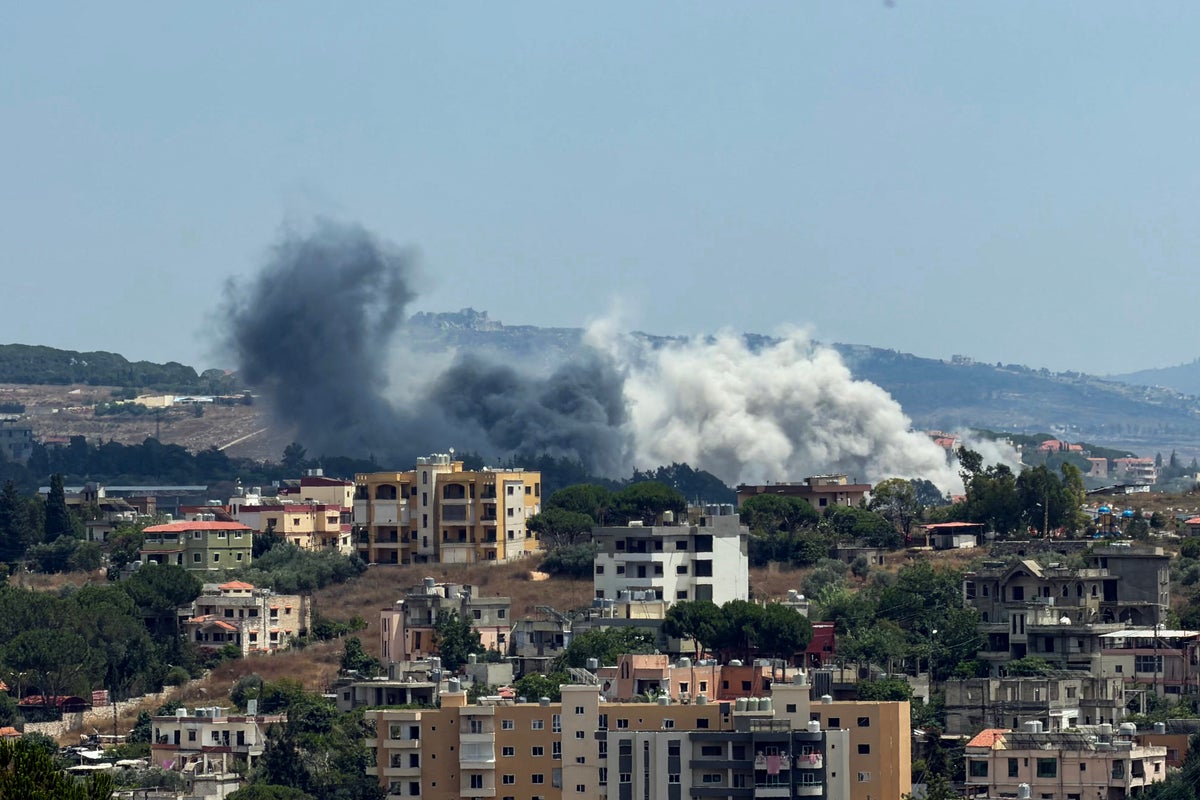
Efforts to establish legally binding controls over lethal autonomous weapons have collapsed in Geneva after the United States, Russia and Israel derailed calls for a formal United Nations treaty.The technology - dubbed “killer robots” by critics - will now continue to be developed unchecked until 2028.During the Convention on Certain Conventional Weapons (CCW) , 98 countries – backed by UN secretary-general António Guterres and the International Committee of the Red Cross (ICRC) – pushed for an urgent mandate to negotiate legally binding prohibitions.But under the CCW’s consensus rules, any state has the capacity to effectively veto any agreement.Throughout the sessions, Russian delegates raised repeated procedural objections, while Washington and Tel Aviv joined Moscow in blocking any commitment to legally binding restrictions.Smoke rising from the site of an Israeli airstrike that targeted the village of Nabatieh al-Faouqa on July 16, 2026. Israel’s use of AI-assisted decision-making has drawn widespread international condemnation (AFP/Getty)At the close of the week-long conference, the 128 participating states agreed only to “elaborate” on a possible framework by 2028 – leaving fundamental questions over autonomous warfare unresolved.For critics, the diplomatic stalemate lays bare a glaring contradiction: the very states blocking international regulation are the ones deploying algorithmic warfare most aggressively on active battlefields across Europe and the Middle East.Humanitarian monitors have warned that stalling until 2028 ignores how rapidly algorithmic warfare is already being deployed in live conflicts across the Middle East and Europe.“Autonomous weapons technology, including AI in the targeting cycle, is being deployed on the battlefield – delaying the creation of a legally binding instrument puts civilians and humanity at risk,” said Nicole van Rooijen, executive director of Stop Killer Robots.Talks on autonomous weaponry at the Convention on Certain Conventional Weapons (CCW) have stalled after pushback from Russia, the US and Israel (AFP/Getty)The coalition, which represents more than 300 non-governmental organisations, has dismissed the final compromise as a “watered-down mandate” that “fails to chart a clear path towards a legally binding instrument.” The ICRC similarly warned that states had missed a critical opportunity to preserve meaningful human control over the use of lethal force.IsraelIn Gaza, the Israel Defence Forces (IDF) has faced intense scrutiny from UN investigators and human rights groups over its deployment of AI-assisted targeting platforms – including Lavender and Where’s Daddy? – to automate strike decisions. Investigative probes and testimonies from Israeli intelligence sources revealed that Lavender processed mass surveillance data to generate tens of thousands of suspected militant targets, with human operators sometimes spending around 20 seconds reviewing an algorithmic recommendation before authorising a strike.The United StatesThe United States has similarly placed AI at the centre of its targeting operations. The Pentagon's targeting of a primary school in Iran earlier this Summer has heightened pressures to regulate the use of AI in military strikes (AFP/Getty)The efficacy of the military’s AI-assisted targeting has come under intense scrutiny during the Iran campaign, including after a first-day US strike hit an elementary school in Minab housed in a former military complex, killing more than 160 people – mostly children. Earlier this year, a joint investigation published by Airwars and The Independent saw the US officially acknowledge its first civilian death in an AI-assisted theatre, where the Pentagon admitted it had “no way of knowing” whether the deadly strike in Iraq relied on AI.This lack of transparency prompted critics to warn that the situation will only worsen as militaries deploy faster, increasingly autonomous weapons without binding international rules.Binding legislation would prohibit Russia’s use of autonomous drones in Ukraine (AFP/Getty)RussiaFor Moscow, meanwhile, a ban on weapons capable of operating without a live human link would directly outlaw the next generation of drones it is fielding in Ukraine. Russian forces have deployed increasingly autonomous loitering munitions – including upgraded Lancet variants – equipped with onboard computer-vision and terminal-guidance software capable of identifying, tracking and striking targets even after Ukrainian electronic jamming severs radio contact with an operator.
Global efforts to control ‘killer robots’ blocked by US, Russia and Israel
Full Article
Original Source
Read the full article at Independent →KhanList aggregates and links to publicly available news content. We do not host full articles from third-party sources. Always verify important information with original sources.