
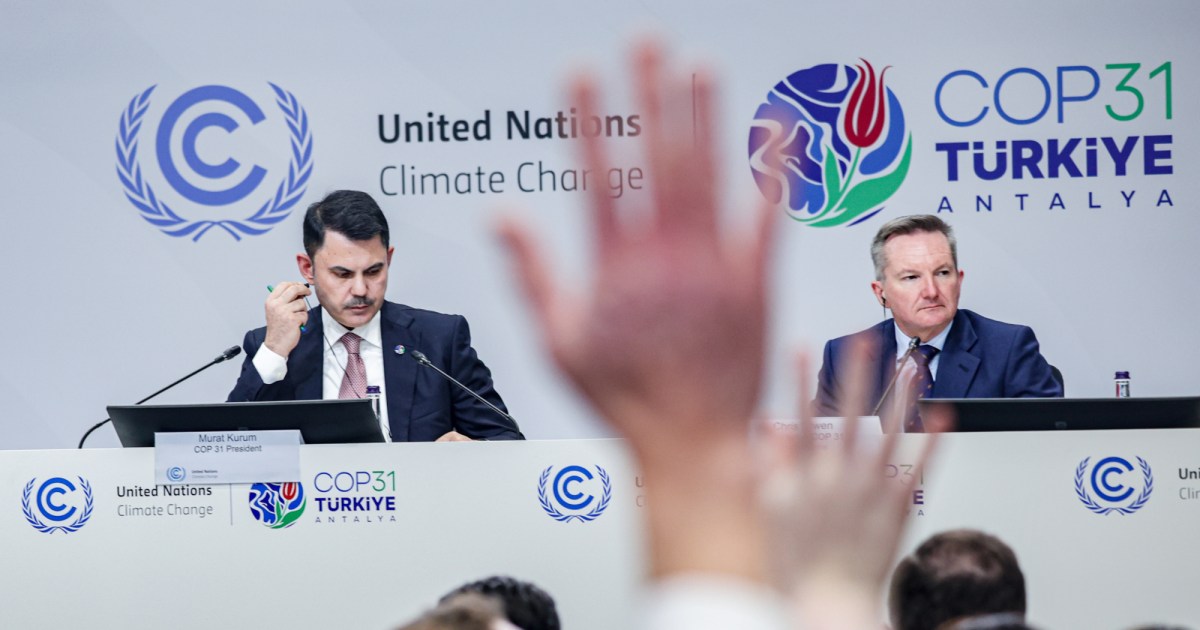
COP31 President Murat Kurum of Turkey and Australian Minister for Climate Change and Energy and COP31 President of Negotiations Chris Brown take questions during a press briefing at the UN climate change conference on November 19.Bianca Otero/Zuma Get your news from a source that’s not owned and controlled by oligarchs. Sign up for the free Mother Jones Daily. On the day the largest global climate summit started earlier this month, my colleague Rachel Santarsiero posed a key question: “Will anyone finally say ‘fossil fuels’?” The past three decades of discussions have largely sidestepped the issue despite the fact that fossil fuels are the largest contributor to climate change—and the past two weeks in Turkey have proved no different. Deliberations at COP31, the 31st annual United Nations climate action convention, broke down Sunday after the European Union and other nations rejected the draft agreement setting out commitments to address climate change. “These decisions go nowhere near the level of ambition needed to tackle climate change,” Irish minister Darragh O’Brien, representing the EU at the convention, said Sunday. “It is unconscionable that we would have a climate pact that makes no mention of fossil fuels.” The Panamanian delegation, which also rejected the proposal, said: “Science does not negotiate. The planet cannot continue to wait.” The convention became the longest in COP history. The first draft agreement came a week into the talks and mentioned “fossil fuel” or “fossil fuels” six times, including a commitment to phasing out fossil fuel subsidies that “do not address energy poverty or just transitions.” But subsequent documents removed all references to fossil fuels. Major oil producers like Saudi Arabia and Russia, as well as significant consumers such as India, have argued against including the language. All countries have to agree on the text for it to pass. As Rachel wrote in Mother Jones earlier this month, it wasn’t until 2023 climate talks in Dubai that a final agreement explicitly committed to transitioning away from fossil fuels, and that deal did not list how or when a wind-down process would take place. Panama’s environment minister, Juan Carlos Navarro, said that the world was “being held hostage by the petroleum mafia.” “We love the petroleum guys,” he said in a Wednesday press conference. “We can’t live without them, and they are so smart they have convinced us that they are doing this for our own good.” Many of the developing countries that are disproportionately vulnerable to climate disasters have also long been requesting more money for adaptation and recovery efforts. The draft agreement called for adaptation finance to at least triple by 2035, but as CNN reported, provided no baseline or exact numbers. “Rich countries refused to put money on the table to help communities prepare for and recover from climate disasters, and handed polluters a free pass instead,” Harjeet Singh, founding director of the Satat Sampada Climate Foundation, a climate justice and advocacy organization, told the media outlet. That includes the United States—the second largest greenhouse gas emitter behind China—which did not attend the summit this year, after President Trump pulled the country out of a 2015 international climate treaty and subsequent talks for the second time. An October UN report confirmed the world will overshoot its target under the same 2015 treaty that aimed to limit global warming to 1.5 degrees Celsius above pre-industrial levels. The planet is currently at around 1.4 degrees of warming. Just this year, we’ve seen devastating flooding in Nepal and deadly heat in Europe.
Global Climate Talks Fail Over Fossil Fuel Dispute
Full Article
Original Source
Read the full article at Motherjones →KhanList aggregates and links to publicly available news content. We do not host full articles from third-party sources. Always verify important information with original sources.