
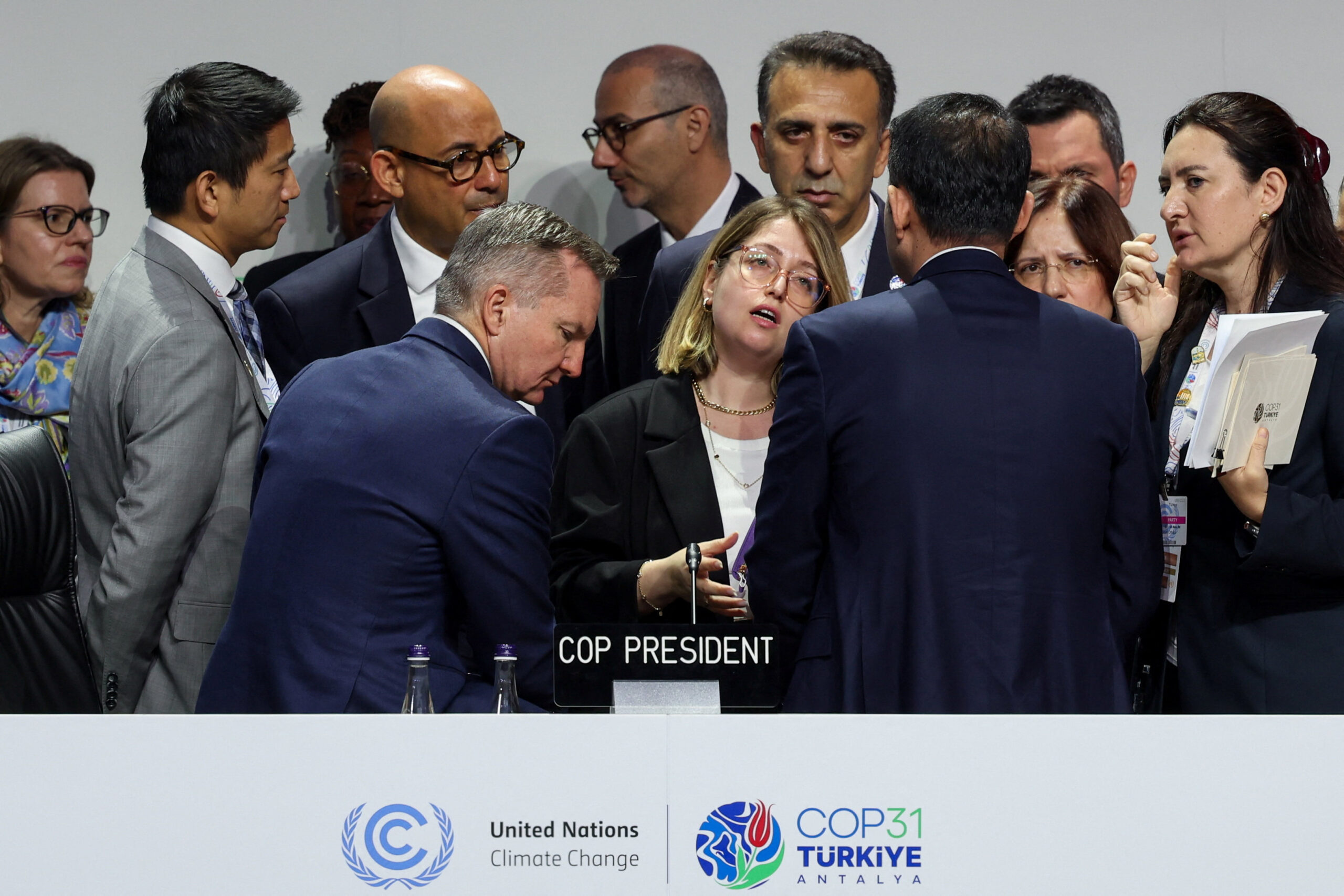
Two weeks of negotiations and two days of overtime talks weren’t enough. On Sunday, the 31st Conference of the Parties (COP31) concluded without consensus, exposing deepening divisions over fossil-fuel phaseouts and the financing needed to make them possible. Amid warnings that the world is on course to breach 1.5 degrees Celsius of warming before 2030, COP31’s inconclusive outcome is yet another indication that multilateral climate cooperation is struggling to deliver. And the absence of the US from the Antalya meeting—the second consecutive climate conference it has been unable to attend following its withdrawal from the UNFCCC and the Paris Agreement—only adds to the challenge. But the fragmentation of global climate governance does not mean that global cooperation is coming to an end. In fact, countries are increasingly turning to smaller groups of like-minded partners to advance climate action. Brazilian roadmaps and Turkish initiatives Since COP29, there has been a concerted effort to advance key negotiating decisions through the so-called Action Agenda, an implementation track designed to complement the COP process but operating outside of it. The Action Agenda primarily seeks to mobilize voluntary climate action by state and non-state actors, such as civil society, cities, investors, and businesses. At COP30, for instance, participating countries failed to agree on a plan for transitioning away from fossil fuels. Nevertheless, the Brazilian Presidency developed a voluntary roadmap for phasing out fossil fuels and combating deforestation outside of the formal negotiation process. Although opposition from several countries prevented its inclusion in the final agreement, more than eighty countries backed the initiative. Brazil has since published the roadmap, which gives countries a framework for assessing their exposure to fossil fuels and identifying priorities for a just, orderly, and equitable transition. By taking the process beyond formal negotiations, the Brazilian administration hopes to expand the coalition of countries willing to pursue these goals. Turkey, this year’s COP co-host, is pursued a similar approach. It proposed a non-binding “35 by 35” electrification pledge, which aims to raise electricity’s share of global final energy consumption from around 21 percent today to 35 percent by 2035. The proposal would accelerate electrification across buildings, transport, and industry, while encouraging investment in modern electricity grids to reduce emissions. Though some countries would like to see a commitment to transitioning away from fossil fuels incorporated into the pledge—particularly through a just transition mechanism providing financial and technical support to developing countries—nearly one hundred countries are already supporting the initiative. This is yet another example of how countries can make progress without negotiating a comprehensive agreement through the consensus-based COP process. And the effort to build plurilateral coalitions doesn’t end there. In April, Colombia and the Netherlands co-hosted the first International Conference on Transitioning Away from Fossil Fuels. The fifty-seven participating countries developed a practical agenda for accelerating the clean energy transition, centered on national and regional roadmaps, greater coordination of cross-border trade policies, and efforts to overcome financial, fiscal, subsidy, and debt-related barriers. The conference participants also established a plurilateral process for continued international cooperation outside the traditional COP negotiations—and agreed to hold a follow-up conference in Tuvalu in 2027, co-hosted by Tuvalu and Ireland, to review progress and advance practical solutions. The limits of plurilateral cooperation Despite these efforts, opposition to a clear commitment to phasing out fossil fuels remains substantial. Several major fossil-fuel-producing and consuming countries remain reluctant to endorse language committing them to such a transition. These divisions were on full display in the final COP31 negotiations: disagreements over the pace and scope of the transition, as well as its financing—including a proposed $120 billion adaptation financing target—undermined the adoption of a final agreement. The Saudi-led Arab Group even opposed any mention of Brazil’s transition roadmap in the final COP draft. At the same time, developing countries face a substantial gap in the funding needed to adapt to climate change. According to the UN Environment Programme’s 2026 Adaptation Gap Report, they will need approximately $305 billion annually by 2035—and that figure excludes private-sector adaptation needs, which could nearly double the total. This shortfall persists despite the broader commitment to mobilize at least $1.3 trillion annually by 2035, a goal agreed upon during COP29 and expanded at COP30. In 2024, international public adaptation finance from developed countries was estimated at $28.2 billion to 31.7 billion—just one-tenth of the projected requirement. COP31 President Murat Kurum sought to address this gap by launching the Climate Implementation Bridge (BRIDGE), an initiative designed to help countries translate their national climate plans into investment-ready projects and attract financing, particularly from the private sector. BRIDGE aims to identify implementation bottlenecks, strengthen institutional capacity, and connect countries with technical, financial, and delivery partners. Turkey has committed $3 million in grants to support the platform’s operations. However, this initiative alone will not close the financing shortfall. BRIDGE does not resolve the underlying shortage of project preparation capacity in developing countries, nor does making projects formally investment-ready guarantee that private capital will follow. Experience with blended finance and other project preparation initiatives suggests that commercial viability, risk allocation, institutional capacity, and access to concessional financing remain critical constraints. More fundamentally, private capital cannot replace public and concessional finance where returns are uncertain or social benefits cannot be fully captured by investors. High borrowing costs, limited fiscal space, and debt constraints further restrict developing countries’ ability to invest in climate action. Without substantial additional concessional resources and effective risk-sharing mechanisms, implementation of transition and adaptation plans will remain far below the scale required. From declarations to delivery COP31 thus laid bare the obstacles to global climate cooperation. Geopolitical rivalry, divergent national interests, and resistance from fossil-fuel-producing countries continue to make ambitious collective commitments difficult to secure. Yet the conference also underscored the potential of smaller coalitions to advance climate action, building on successive COP frameworks that have created space for voluntary initiatives among like-minded countries. The official COP29 decision to create the Baku Climate Unity Pact, for instance, was followed by the Global Mutirão decision under the COP30 Action Agenda. The former called on “all actors” to raise at least $1.3 trillion per year and on developed countries to mobilize at least $300 billion annually by 2035; the latter sought to triple adaptation finance by 2035 and provided a platform for Brazil’s voluntary roadmaps on transitioning away from fossil fuels and deforestation. Meanwhile, COP31 helped advance Turkey’s 35-by-35 electrification pledge. Together, these developments illustrate how coalitions of like-minded governments can pursue specific areas of cooperation even as consensus-based multilateral negotiations become more difficult. Plurilateral arrangements allow countries willing to move ahead to develop practical solutions and build momentum for wider international agreements. They could also help establish common standards, encourage cross-border energy investments, foster technology partnerships, and coordinate financing arrangements. However, plurilateralism is no substitute for multilateral action. It cannot, on its own, mobilize the scale of concessional and private financing developing countries need to implement their climate transition and adaptation plans. Nor can voluntary initiatives guarantee that participating countries follow through on their commitments. The test for plurilateralism will therefore be whether it can turn political declarations into tangible results. That will depend, above all, on whether these coalitions can mobilize the necessary financing and help developing countries implement their adaptation measures—a formidable challenge, especially without US participation. Hung Tran is a nonresident senior fellow at the Atlantic Council’s GeoEconomics Center, a senior fellow at the Policy Center for the New South, a former executive managing director at the Institute of International Finance, and a former deputy director at the International Monetary Fund. Image: Australian Climate Minister and COP31 negotiations president Chris Bowen, UN climate chief Simon Stiell, and COP31 President Murat Kurum at COP31. Source: REUTERS/Murad Sezer.
Global climate governance is fragmenting. But plurilateralism can keep cooperation alive.
Full Article
Original Source
Read the full article at Atlanticcouncil →KhanList aggregates and links to publicly available news content. We do not host full articles from third-party sources. Always verify important information with original sources.